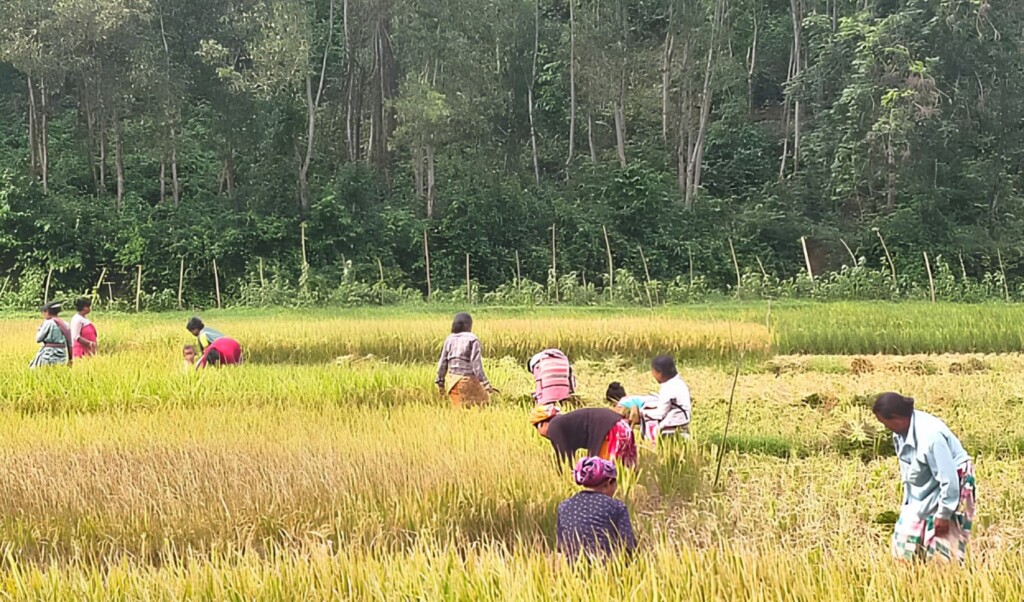
Farmers in the border regions of Sherpur district are currently facing a severe threat from herds of wild elephants, compelling them to harvest their Boro paddy crops prematurely. The surge in elephant activity across the sub-districts (Upazilas) of Jhenaigati, Sreebordi, and Nalitabari has created widespread panic among the local agricultural community, who fear the total destruction of their livelihoods.
Local Impact and Farmer Testimony
Rajib Koch, a 48-year-old auto-rickshaw driver from Gandigaon village, invested 16,000 BDT to cultivate Boro paddy on 60 decimals of land on the slopes of the Ghazni hills. Although the grain required an additional 15 to 20 days to ripen fully, the imminent threat from the forest has forced his hand. Mr Koch has hired six labourers at a daily wage of 700 BDT each to secure what remains of his crop.
“There is no other way,” Mr Koch stated while standing by the border road on Saturday. “The elephant herd is in the hills. If the paddy is not cut now, they will destroy everything in a single night. They have already ruined many nearby fields.”
This sentiment is echoed by many in the region. Lal Krishna Koch, 37, reported that wild elephants destroyed one acre of his crop over two nights, trampling and eating the grain that his family relied upon for sustenance. He has since filed a compensation claim with the Forest Department. In the village of Somoshchura, 55-year-old Hanif Mia confirmed that the sheer size of the herd—numbering between 40 and 45—makes it impossible to defend the fields once the animals descend from the forest.
Forest Department Observations
According to Salehin Nawaz, the Ghazni Beat Officer of the Forest Department, the current herd includes approximately 15 calves. After spending a week moving through various areas of Jhenaigati, the herd recently migrated toward the Somoshchura forest in Nalitabari.
To mitigate the risk of the animals entering human settlements, the Elephant Response Team (ERT) and local villagers have organised night watches. Tohidul Islam, an official at the Mymensingh Forest Department, confirmed that in the last week alone, approximately five acres of land belonging to 20 to 25 farmers have been decimated.
Regional Cultivation Statistics
The Department of Agricultural Extension (DAE) provides the following data regarding Boro cultivation in the affected border sub-districts for the current season:
| Sub-district (Upazila) | Cultivation Area (Hectares) |
| Sreebordi | 4,501 |
| Jhenaigati | 2,240 |
| Nalitabari | 2,116 |
| Total Area | 8,857 |
Agricultural Risks
While the total cultivated area exceeds 8,000 hectares, the majority of the crop is not yet mature. Experts and local officials note that harvesting “half-ripe” or green paddy results in a significant reduction in yield and grain quality. However, for residents in villages such as Balijuri, Kharamura, Tawakucha, and Baromari, the risk of losing the entire harvest to the 45-strong elephant herd outweighs the loss incurred by an early harvest.
The Forest Department continues to monitor the herd’s movements in the Somoshchura and Batkuchi forests, balancing the need for elephant conservation with the protection of local agricultural interests. Farmers have been formally advised to submit applications for financial compensation regarding their documented losses.