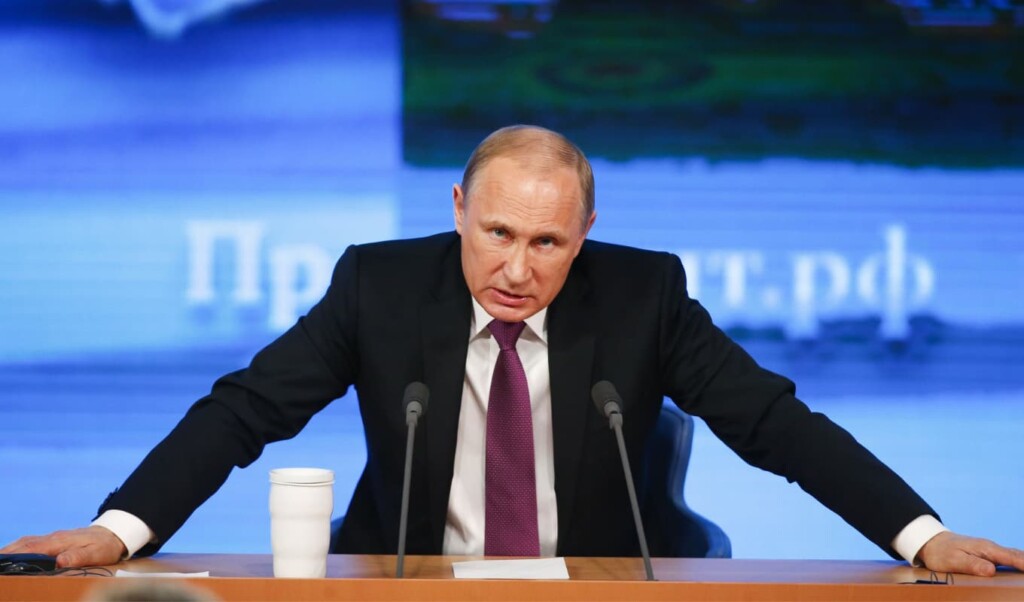
Throughout his prolonged tenure as Russia’s head of state, Vladimir Putin has remained acutely aware of the power of the moving image. This observation is underscored by the accounts of veteran journalists, including Bridget Kendall of the BBC, who conducted her first interview with Putin in 2001.
During that initial encounter, moments before the cameras commenced recording, an aide rushed forward to remove small water glasses from the table positioned in front of the leaders. When Kendall queried the reason behind this sudden adjustment, Putin replied directly:
“We don’t want anyone to think they are glasses of vodka. Besides, during a live broadcast, we cannot risk a glass being knocked over and spilling water. In terms of dissemination, television is akin to a nuclear bomb.”
The Creation of a Television President
Long before ascending to the pinnacle of state authority, Putin harboured a deep fascination with the authority of visual media. Growing up in the 1960s and 1970s, he was a child of the Soviet television era, idolising the stoic intelligence officers depicted in state-sanctioned espionage films and serials. Putin has freely admitted that these resolute, laconic intelligence operatives inspired his initial career choice to join the Soviet state security agency, the KGB.
As a KGB officer and later a dedicated party bureaucrat, Putin initially operated strictly away from the public gaze. However, following his sudden appointment as acting president in late 1999 and his subsequent election victory months later, he and his public relations advisers recognised how vital a choreographed image would be to consolidating state control.
Image Building and Strategic Erasures
Aspects of his lifestyle that did not align with the desired national narrative were methodically concealed from public view. Publicly, Putin sought to establish a stark contrast with his predecessor, Boris Yeltsin, whose frequent public intoxication had caused international embarrassment for the state. Consequently, Putin carefully cultivated a public persona as a strictly sober leader.
Contrast in State Leadership Public Personas
| Leadership Era | Public Persona Traits | Media Impact and Visual Strategy |
| Boris Yeltsin (1991–1999) | Unpredictable, visibly frail, frequent public intoxication. | Perceived as a symbol of a chaotic, weakened, post-Soviet state. |
| Vladimir Putin (2000–Present) | Teetotal, physically disciplined, calculating, active. | Choreographed as a potent, orderly, and resurgent nationalist power. |
Even at the annual meetings of the Valdai Discussion Club, where international foreign policy experts were treated to premium wines, Putin routinely opted for a single cup of tea mixed with honey. On the rare occasions he did consume alcohol, his aides strictly ensured that such moments were hidden from the press.
A local Russian museum curator once recounted to Bridget Kendall that she had shared traditional pancakes with the President, which had been lightly drizzled with vodka to enhance their flavour. The curator immediately implored the journalist, saying:
“Please do not tell anyone. They are incredibly strict about this. If this becomes known, I could face severe trouble.”
The Action-Man Era and Authoritarian Propaganda
To project an image of physical vitality and national strength, Putin’s public relations team engineered a series of highly publicized action sequences. The President was regularly documented wearing a pilot’s helmet inside fighter jets, demonstrating advanced judo maneuvers, and embarking on highly publicised outdoor expeditions.
The most widely discussed of these initiatives began in 2007, featuring a series of photographs depicting a bare-chested Putin riding horses, fishing in remote Siberian rivers, and swimming aggressively through cold waters.
Author and political analyst Peter Pomerantsev asserts that these hyper-masculine displays were far from accidental, describing them as a distinctly modern form of authoritarian propaganda designed to appeal to his core nationalist support base.
Platon, the British photographer who captured Putin’s portrait for Time Magazine’s “Person of the Year” cover in 2007, recalled that during their session, the Russian leader deliberately projected absolute authority. Platon remarked:
“During the shoot, Putin explicitly presented himself as a powerful commander. He likes these images because they validate him to his supporters as a uncompromising nationalist leader.”
The “Moth” Who Emerged from the Shadows
This overt thirst for the camera stands in sharp contrast to the early phases of his career. Early archival photographs depict Putin as a slender, reserved individual who appeared distinctly uncomfortable in front of lenses.
During his training as a KGB officer, he was specifically conditioned to blend seamlessly into crowds and avoid drawing attention to himself. Nina Khrushcheva, the great-granddaughter of former Soviet leader Nikita Khrushchev, noted that within old KGB circles, Putin was colloquially referred to as the “Moth”—a figure capable of operating undetected within the shadows.
Following the collapse of the Soviet Union in late 1991, Putin transitioned into civilian governance, serving under the Mayor of St Petersburg before relocating to Moscow to join the Yeltsin administration. In photographs from this decade, Putin is routinely positioned at the periphery or background of the frame, consistently avoiding direct eye contact with the camera.
The Hardening of the Mask
Over time, this carefully constructed image of strength directly mirrored Russia’s domestic and foreign policy shifts. Putin progressively consolidated state control over Russian society, systematically restricting independent journalism, reducing the independence of the parliament, and marginalising political opposition figures.
By 2011, observers noted a distinct physical transformation in Putin’s appearance. His facial expressions became notably static and rigid, sparking international speculation regarding potential medical treatments, such as the use of steroids or cosmetic procedures like botox to mask the signs of ageing.
Following his subsequent return to the presidency in 2012 amidst widespread domestic protests, Putin was famously filmed with tears streaming down his face during a victory rally. While some journalists, including Kendall, interpreted this as a genuine release of emotional relief after an intensely stressful campaign, other political analysts viewed the tears as another calculated performance designed to present him as the emotional savior of the motherland.
Now at the age of 73, following the isolation of the COVID-19 pandemic and the deployment of the full-scale invasion of Ukraine, Putin is rarely seen in spontaneous public settings. His modern media appearances are strictly managed, deliberate, and designed to project distance.
US Russia analyst Fiona Hill notes that this extreme level of media control underscores a profound sense of personal insecurity and paranoia, leaving the aging leader increasingly isolated within the rigid political machine of his own creation.