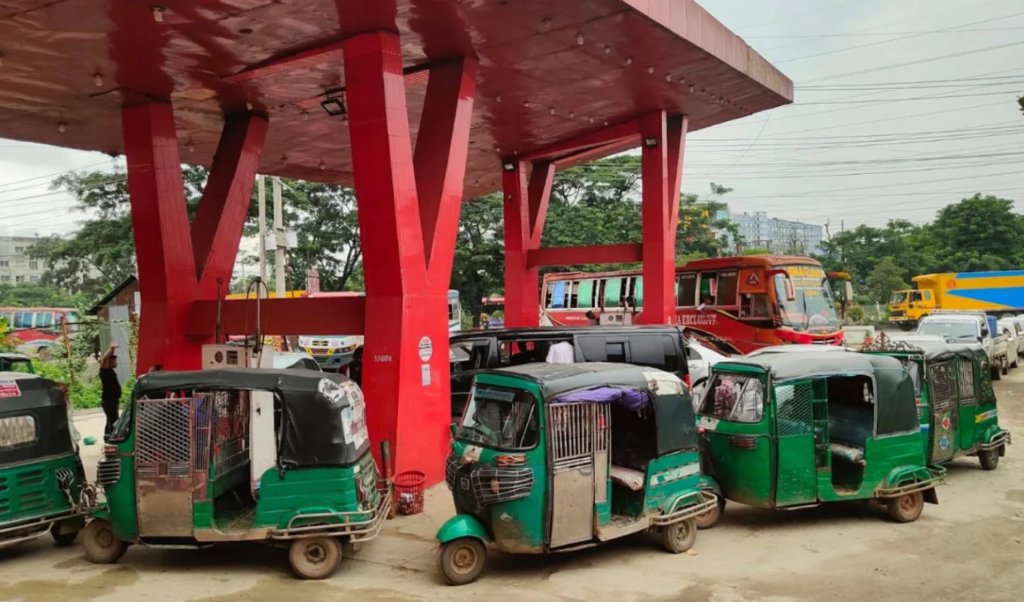
A severe crisis in natural gas supply has brought Dhaka’s compressed natural gas (CNG) transport sector to a near standstill, leaving thousands of drivers stranded in sprawling queues across the capital.
Diminished pipeline pressure has drastically slowed down operations at refuelling stations throughout the city, forcing several establishments to halt operations temporarily. Drivers now find themselves waiting for hours on end, often unable to secure enough fuel to sustain a single day’s work.
Capital-Wide Queues and Commuter Disruption
Surveys conducted on Saturday morning revealed extensive queues clogging major thoroughfares and refuelling stations across Malibagh, Bishwa Road, Motijheel, Maniknagar, Khilgaon, Banasree, Mugda, and Sabujbagh. Supply levels have plummeted well below daily demand, creating bottleneck conditions across almost every operational pump in the metropolitan area.
The consequences of the shortage extend beyond public transport into residential neighborhoods. Weak gas pressure in domestic pipelines has disrupted home cooking from early morning until mid-afternoon in various parts of the city, heaping additional domestic hardship onto urban households.
Mounting Financial Strain on Commercial Drivers
Transport workers report that the supply situation has deteriorated markedly over the past week. Extended waiting times at stations have severely curtailed their active driving hours, causing daily revenue to drop sharply while fixed expenses remain unchanged.
For many CNG auto-rickshaw and commercial vehicle operators, daily financial obligations—such as vehicle rental fees paid to fleet owners, loan repayments, and basic household costs—have become impossible to manage.
Abdul Kader, Commercial Driver at Malibagh Hazipara Station: “I joined the queue early in the morning, and midday has arrived without me getting any gas. If my entire day is spent standing in line, when am I supposed to earn a living? Running a family is becoming nearly impossible.”
Similar experiences were reported across other parts of the city, where drivers spoke of losing entire working shifts to refuelling delays.
Sumon Mia, Driver at Bishwa Road’s Shanto Station: “The crisis has intensified over the last seven days. Often, waiting five or six hours yields no gas at all. This morning, after queuing for four hours, I received just enough fuel for two trips. Now I am back in line again. If this continues, paying the owner’s daily deposit and covering family expenses will be out of the question.”
Kamal Hossain, Driver at Best Eastern Station in Maniknagar: “Most of the day passes standing in gas lines. Consequently, income has dropped, making it extremely difficult to maintain the household.”
Station Operators Struggle Under Low Pipeline Pressure
Refuelling station management teams face equal operational difficulties. Depressed pipeline pressure has compromised the efficiency of heavy compressor machinery, leaving operators unable to run pumps at standard capacity.
Aminul Islam, Manager at Shanto CNG Refuelling Station in the Mugda Bishwa Road area, outlined the operational constraints facing local businesses:
Aminul Islam, Station Manager: “Due to inadequate gas pressure, we can only operate one low-pressure compressor out of two. This forces us to supply gas on a very limited scale, which inevitably creates long queues. Running the station under these conditions has become exceptionally difficult. Unless this crisis is resolved swiftly, maintaining regular operations and retaining staff will prove unsustainable.”
Without immediate intervention to restore adequate pressure to the capital’s distribution grid, both station owners and commercial transport workers warn of deeper economic disruption across Dhaka’s transit network.