Bangladesh’s crucial financial and insurance sector experienced an abrupt downturn in the final quarter of the 2025–26 fiscal year, contracting by 0.25 per cent in real terms. The dip marks a sharp reversal for an industry that had previously maintained steady expansion. Official provisional figures released by the Bangladesh Bureau of Statistics (BBS) confirm that output between April and June 2026 fell when compared with the corresponding quarter of the previous fiscal year, when the twin sectors expanded by 2.64 per cent.
Data provided by the BBS illustrates a progressive deceleration across the four quarters of FY2026. Real growth stood at 3.56 per cent in the first quarter (July–September), before slowing to 2.05 per cent in the second quarter and dropping to 1.0 per cent in the third. The final quarter’s slip into negative territory reflects the accumulated weight of economic pressures across the banking and insurance landscapes. At constant prices, the financial and insurance segment accounted for roughly 3.22 per cent of Bangladesh’s gross domestic product (GDP) in the fourth quarter. Measured at current prices, however, the sector still showed nominal growth of 8.94 per cent, driven primarily by inflationary price adjustments rather than an increase in real output value.
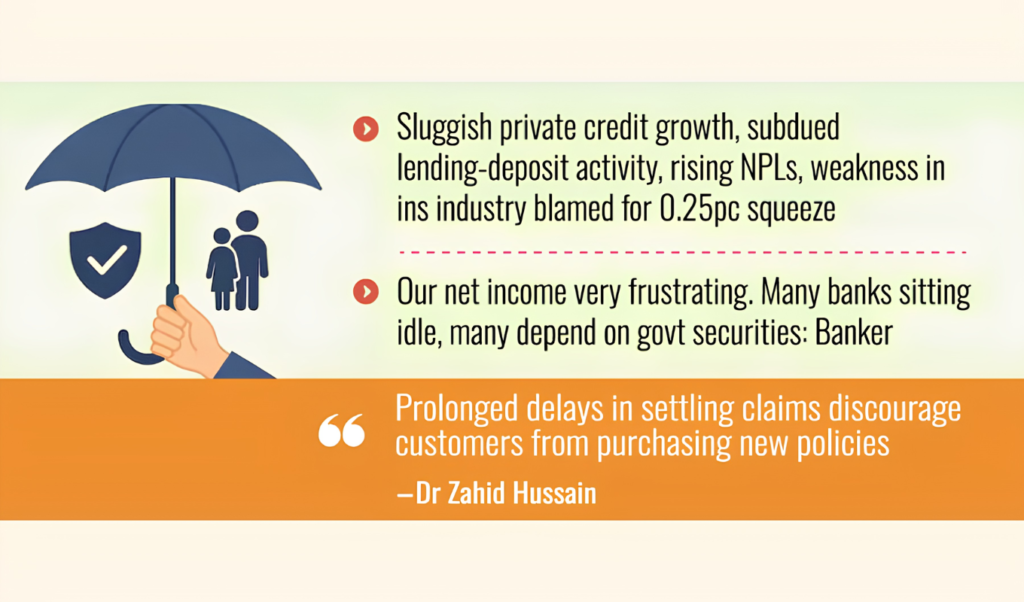
Independent economists and senior bankers attribute the real-term contraction to several compounding structural hurdles. Private sector credit growth remained subdued throughout the year, weighed down by sluggish lending activity, reduced deposit mobilization, and declining fee-based income across commercial banks. Rising non-performing loans (NPLs) have placed additional strain on balance sheets. Independent economist Dr Zahid Hussain observed that the escalation in distressed assets compelled commercial lenders to set aside significant portions of their operating income to meet mandatory provisioning requirements, severely dampening net profitability.
Macroeconomic headwinds, particularly persistent inflation, have further complicated the operating environment. Elevated living costs forced household depositors to draw down personal savings, forcing financial institutions to offer higher deposit rates to retain liquidity. This shift driven by funding costs squeezed interest margins further. Simultaneously, the insurance industry faced systemic headwinds. Long-standing delays in settling policy claims severely undermined consumer trust, deterring new policyholders and stunting premium growth across the sector.