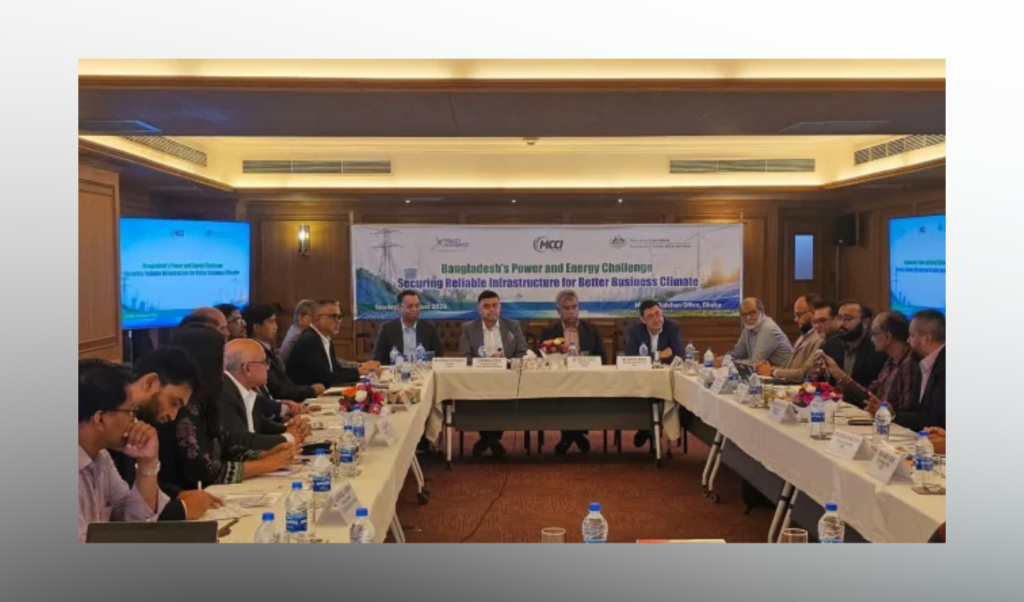
Leading Bangladeshi industrialists and commercial experts have issued a stark warning regarding the nation’s severe power and gas shortage, asserting that without an immediate resolution to the ongoing energy crisis, securing new domestic or foreign investment will remain impossible. Speaking at a roundtable discussion titled “Challenges of Energy Security: Bangladesh on the Path to Competitive Business”, trade leaders stressed that preserving existing operations must take precedence over soliciting new capital, urging the government to adopt realistic short- and long-term energy strategies.
The roundtable, held on Sunday, 30 August, at the Metropolitan Chamber of Commerce and Industry (MCCI) office in Gulshan, Dhaka, was jointly organised by MCCI and Policy Exchange Bangladesh. Fazlul Hoque, Administrator of the Federation of Bangladesh Chambers of Commerce and Industry (FBCCI), attended as the chief guest, with the session moderated by Policy Exchange Bangladesh Chairman M Masrur Reaz and opened by MCCI Secretary General Faruq Ahmed.
Presenting the keynote paper, Hasib Hasan, Senior Associate at Policy Exchange Bangladesh, highlighted the critical supply deficit crippling industrial hubs. Bangladesh currently faces a daily natural gas demand of roughly 3.8 billion cubic feet against an average supply of just 2.42 billion cubic feet—a staggering 42 per cent shortfall affecting industrial and residential sectors alike. Furthermore, the national grid suffers an average peak-hour electricity deficit of 3,664 megawatts every day. This persistent shortage has directly suppressed manufacturing output, causing sector growth to drop from 3.71 per cent in the 2024–25 financial year to 2.86 per cent in the subsequent fiscal period.
Expressing deep frustration over the business climate, Mohammad Iqbal Chowdhury, Director and Chief Executive Officer of LafargeHolcim Cement, implored policymakers to refocus their priorities. “We hold countless meetings and seminars about attracting new investments. My humble request is: please save existing investors first. Supply them with energy, and only then invite new investors,” he stated. Chowdhury pointed out that energy serves as a core raw material for heavy industries like cement and steel. He revealed that gas price hikes of nearly 150 per cent combined with supply cuts have made domestically produced clinker more expensive than imported alternatives, threatening his company’s half-billion-dollar manufacturing infrastructure.
Other major conglomerates echoed these concerns, reporting severe operational cutbacks:
-
PRAN-RFL Group: Sumaiya Tabassum Ahmed, Head of Sustainability, reported that gas shortages have forced their flagship industrial parks in Habiganj and Narsingdi to operate at merely 50 to 70 per cent of their total installed capacity.
-
Ceramic Sector: Moynul Islam, President of the Bangladesh Ceramic Manufacturers and Exporters Association (BCMEA), highlighted that entrepreneurs invested heavily after past official assurances that the country had abundant gas. “We do not know how many days we can survive,” he remarked, emphasizing that ceramic production is impossible without uninterrupted gas.
-
Textile Sector: Showkat Aziz Russel, President of the Bangladesh Textile Mills Association (BTMA), alleged that business leaders raising genuine industrial concerns are unfairly branded as adversaries by high-level government quarters. Calling for an end to political blame games, he urged authorities to consider spot-market Liquefied Natural Gas (LNG) purchases over expensive long-term contracts and to intensify domestic gas exploration.
Offering technical solutions, Ejaz Hossain, former professor at Bangladesh University of Engineering and Technology (BUET), observed that industrial planning had created artificial demand without first securing power generation. He advised immediately running coal-fired power plants at 90 to 95 per cent capacity while rapidly scaling up renewable installations, particularly solar power.
Concluding the discussions, FBCCI Administrator Fazlul Hoque stressed that survival must come before long-term forecasting. “If I cannot survive today, I do not need to know what happens ten years from now. That is the hard truth,” Hoque remarked. He confirmed that the FBCCI will synthesize recommendations from industry experts into a formal proposal for government action, expressing hope that state authorities will act swiftly to safeguard the nation’s industrial backbone.