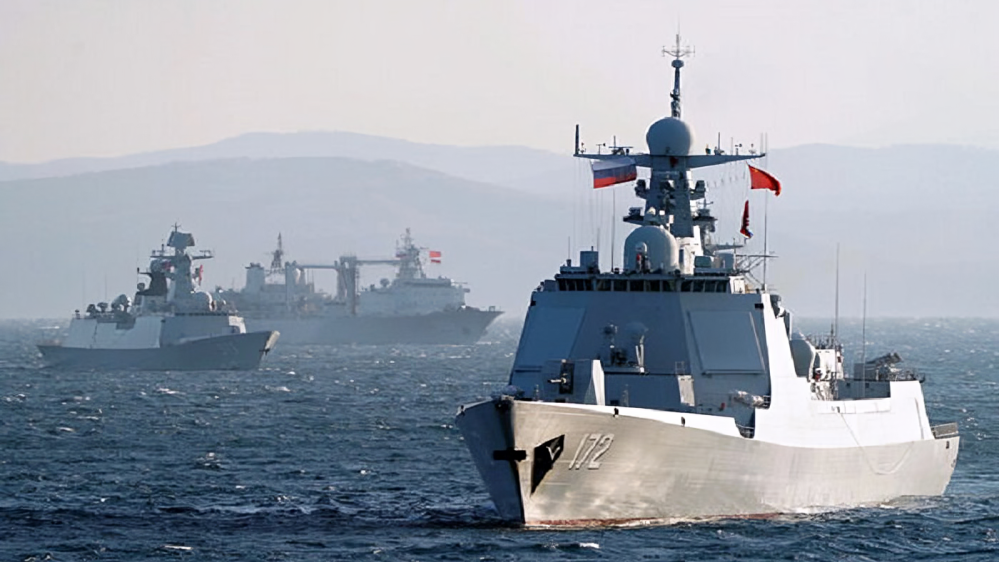
The military alliance between Beijing and Moscow is set to deepen significantly next week as the navies of China and Russia launch a large-scale joint military exercise. Scheduled to take place in the waters and airspace around the strategic Chinese coastal city of Qingdao, the drills come amid escalating geopolitical tensions globally. The official confirmation of the maritime exercise was provided on Sunday (5 July) by both the Chinese Ministry of Defence and Russian state-controlled media networks.
According to a formal statement released by China’s Ministry of Defence, the primary operational goals of the upcoming bilateral exercise are rooted in collective security and deterrence. The ministry stated that following the completion of the live-fire tactical drills near Qingdao, several joint naval surface groups from both nations will deploy to designated areas within the Pacific Ocean to conduct coordinated maritime patrols. The overarching aim of the strategic deployment is to improve capabilities for jointly addressing contemporary security challenges whilst actively preserving regional peace and stability.
Russian Pacific Fleet Ships Arrive in Qingdao
Russian state news agency RIA Novosti reported that advanced naval assets from the Russian Pacific Fleet have already completed their transit and arrived off the coast of Qingdao to prepare for the operational deployment. The Russian contingent features a diverse task group designed for multi-domain warfare. The fleet sent to the Chinese coast includes a guided-missile cruiser, a versatile corvette, a stealthy diesel-electric attack submarine, and a specialized naval rescue vessel to handle logistics and emergency response protocols.
The extensive joint military manoeuvres are formally scheduled to commence on 6 July and will run consecutively until 13 July. For years, the waters around Qingdao have served as a critical operational headquarters for the People’s Liberation Army Navy (PLAN) North Sea Fleet, making it a highly symbolic and logistically perfect base for high-level foreign military collaboration.
Expanding Strategic Cooperation in the Pacific
Western defence analysts suggest that the timing and location of these drills reflect a calculated effort by both powers to project power across the Indo-Pacific theatre. Over recent years, Moscow and Beijing have significantly intensified their “no limits” partnership, frequently organising joint long-range bomber patrols and naval missions to counter what they perceive as Western encirclement.
By integrating a diesel-electric submarine alongside surface warships and rescue elements, the week-long exercise will focus heavily on anti-submarine warfare, maritime interdiction, and joint air defence protocols. The transition from localized drills in Qingdao to expansive joint patrols in the open waters of the Pacific Ocean underscores a shared desire to establish a unified naval presence capable of challenging existing security frameworks.