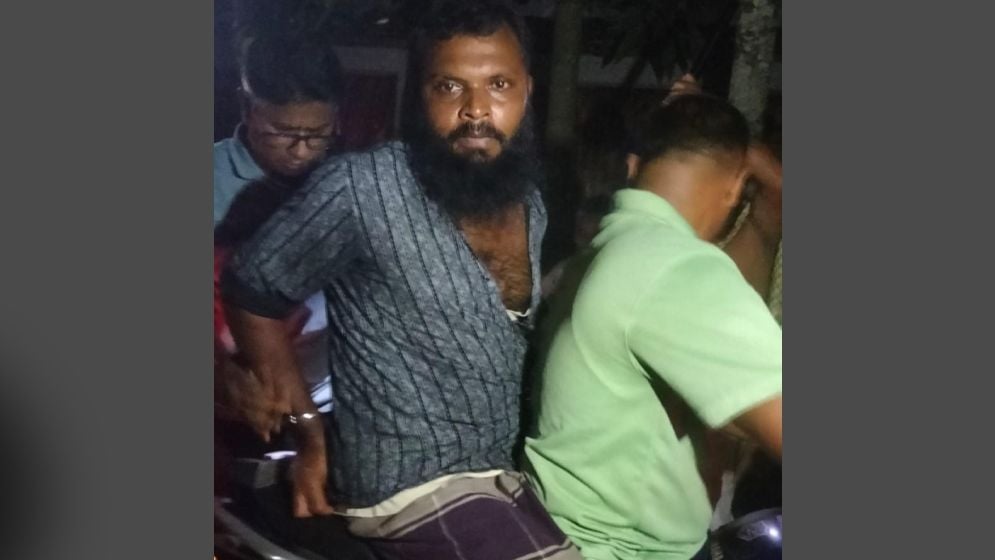
The Criminal Investigation Department (CID) of police has arrested Haridas Chandra Tarani Das, a highly controversial figure from the Palashbari upazila of Gaibandha. The arrest was officially confirmed at 10:00 am on Monday, 13 July 2026, by Sarwar Alam Khan, the Officer-in-Charge of Palashbari Police Station.
A specialised operational team dispatched from the CID headquarters in Dhaka executed the raid at approximately 11:30 pm on Sunday. The detectives managed to locate and secure Haridas following a coordinated effort with local police units.
According to Sarwar Alam Khan, Haridas was wanted in connection with a high-profile money laundering case filed at the Uttara West Police Station in Dhaka. He had been evading law enforcement for a considerable period. Following his apprehension on Sunday night, the joint forces took him into specialised custody and immediately transferred him to the capital for further interrogation and legal proceedings.
Haridas has long been a subject of intense scrutiny in Gaibandha due to his history of unlawful activities. Local law enforcement officials revealed that the suspect systematically exploited religious sentiments to orchestrate complex fraudulent schemes. Recently, he drew significant public notoriety for his involvement in a deceptive idol-related incident, which sparked widespread outrage across the sub-district.
This is not the first time Haridas has faced severe criminal charges. On 8 November 2022, the Rapid Action Battalion (RAB) arrested him for his involvement in a massive embezzlement ring. Investigators discovered that he had amassed millions of takas by posing as senior government officials and cabinet ministers. Through these fake identities, he operated illicit transfer rackets and manipulated public procurement tenders.
After securing bail in the embezzlement case, Haridas breached his legal conditions and fled the jurisdiction. He remained in hiding until the aftermath of the recent mass uprising, when he returned to Palashbari to exploit the transitional period. Upon his return, he quickly established new fraudulent operations revolving around religious artefacts and idols.
A review of his background reveals a pattern of shifting identities used to evade detection and exploit different communities. Prior to his initial arrest, he had formally converted to Islam, changing his name to Tauhid Islam, and subsequently married a woman named Sumi Islam. Authorities are examining whether his multiple identities were used to facilitate financial fraud. The CID plans to seek a formal remand to investigate his financial networks and uncover the full extent of his fraudulent operations.