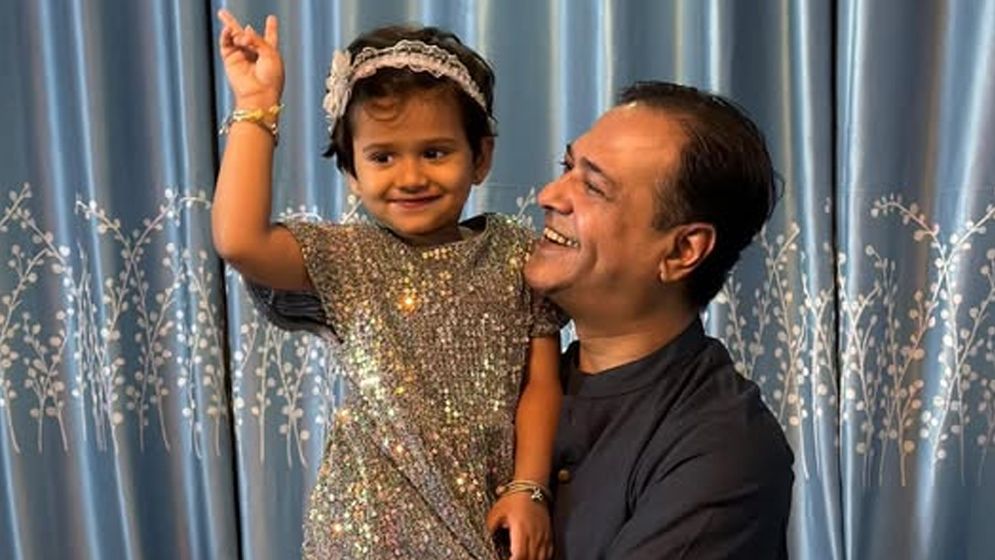
Bangladeshi music icon Asif Akbar has shared a deeply personal and reflective moment from his family life, revealing how an innocent question from his young daughter led him to reconsider identity, perception, and even broader societal attitudes.
The celebrated “youth icon” of Bangla music is widely known for his active presence on social media, where he frequently comments on his career, personal experiences, and contemporary issues. In his latest post, he recounted an unexpected exchange with his four-year-old daughter, which left him both surprised and contemplative.
According to his narration, the incident took place at home when he entered his daughter’s room and greeted her politely. After returning the greeting, the child suddenly asked him a direct question about his name. When he replied by introducing himself, she firmly corrected him, asserting that his true and ultimate identity was associated with a higher spiritual reference, while insisting that his everyday identity was simply “Asif, father.”
The singer expressed astonishment at the child’s confident tone and innocent conviction. He noted that, despite her very young age, the remark carried a purity and certainty that made him pause and reflect deeply. He also expressed hope that his daughter would continue to grow up in a well-guided and thoughtful environment.
Beyond the personal anecdote, the singer extended his reflection into a broader philosophical direction. He recalled a childhood memory involving a humorous observation by Indian comedian Bhanu Bandyopadhyay, which satirised the endless pursuit of education and status. At the time, he admitted, it was simply amusing. However, in his current perspective, shaped by years of observing social and political dynamics, he suggested that the underlying message now appears more relevant than ever.
He implied that society often complicates identity, learning, and hierarchy, whereas simplicity—much like a child’s straightforward understanding—may hold a deeper form of truth. His reflection also hinted at how humour and childhood innocence can sometimes offer clearer insights than complex adult reasoning.
Key Moments from the Reflection
| Moment | Description | Significance |
|---|---|---|
| Greeting at home | Singer enters daughter’s room and greets her | Normal family interaction |
| Unexpected question | Daughter asks his name directly | Triggers identity reflection |
| Child’s response | She asserts a simplified identity distinction | Symbol of innocence and conviction |
| Singer’s reaction | Surprise and emotional reflection | Personal introspection |
| Childhood memory recalled | Reference to Bhanu Bandyopadhyay’s humour | Connection between past and present insight |
The singer concluded his reflection with an implicit appreciation for the purity of a child’s worldview, suggesting that such moments often serve as reminders of simplicity in an increasingly complex world. His post quickly resonated with followers, who engaged with the emotional and philosophical undertones of the anecdote.