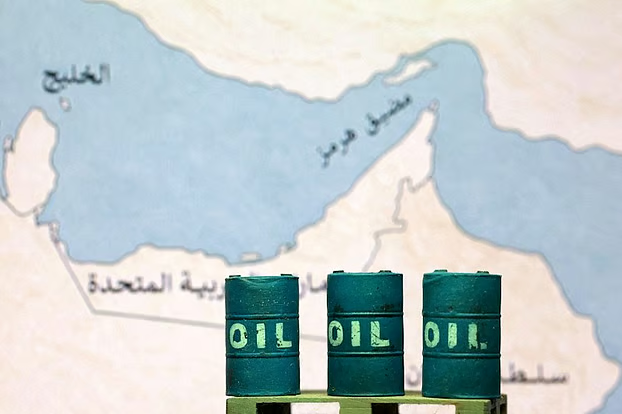
The global energy market is increasingly showing signs of severe strain amid heightened geopolitical tensions around the Strait of Hormuz, one of the world’s most critical oil transit routes. Despite temporary market optimism, underlying supply disruptions and tightening inventories suggest that the system is edging closer to a sustained shock.
On 17 April, following remarks by Iran’s foreign minister declaring the Strait of Hormuz “fully open”, Brent crude prices fell sharply by around 10 per cent to approximately 90 dollars per barrel. However, this relief was short-lived. Within hours, reports of an Iranian attack on an Indian oil tanker reversed market sentiment, pushing prices up by around 5 per cent the following day. Brent crude later climbed back above 100 dollars per barrel, peaking at around 119 dollars after the outbreak of hostilities, before stabilising near 105 dollars at the time of reporting.
Although current prices remain below the March peak by roughly 15 dollars, the broader supply picture is deteriorating. Over a 50-day period of conflict, global supply from the Gulf has reportedly fallen by about 550 million barrels—nearly 2 per cent of global annual output. Liquefied natural gas flows are also under pressure, with estimates suggesting that prolonged disruption could remove around 7 million tonnes per month from global supply chains.
Key Market Indicators
| Indicator | Pre-conflict level | Current level | Change |
|---|---|---|---|
| Brent crude price | ~$90–95/bbl | ~$105/bbl | ↑ Significant volatility |
| Peak price during conflict | — | ~$119/bbl | — |
| Gulf oil supply loss | — | 550 million barrels | ~2% of global output |
| Asia crude inventories | Baseline | -11% | Rapid depletion |
| Jet fuel price (Asia) | ~$94/bbl | >$200/bbl | More than doubled |
| Diesel price (Asia) | ~$93/bbl | ~$175/bbl | Sharp increase |
Despite these disruptions, Western economies have so far avoided severe immediate impacts. Fuel prices have risen, but transport systems remain largely operational. However, analysts warn that this apparent stability is misleading. Much of the buffer supply that once absorbed shocks has already been depleted, particularly floating oil inventories that were heavily drawn down during the early phase of the conflict.
The timing is particularly sensitive. The United States is entering its peak summer driving season, a period that typically drives a surge in fuel demand. Any additional supply shock during this period could amplify price pressures significantly.
Tightening Supply Chains
The crisis is being driven by three converging factors: rapidly declining trade flows, reduced refinery output, and artificially sustained demand in Europe. Floating storage levels have fallen to historic lows, while sanctions-related adjustments involving Iranian and Russian crude have already been absorbed into the market.
Asia has been the most affected region. Around four-fifths of Gulf exports traditionally flow to Asian markets, where inventories are now rapidly depleting. South Korea has begun drawing down strategic reserves, while Japan’s stocks are projected to last only until May. Regional crude inventories outside China have reportedly fallen by 67 million barrels in a single month, a decline of about 11 per cent.
Refinery activity across Asia has also contracted significantly, with output cuts exceeding 3 million barrels per day, or roughly 10 per cent of capacity. Some projections suggest this shortfall could widen to 10 million barrels per day if disruptions persist into mid-summer.
In contrast, China has so far refrained from releasing significant volumes from its estimated 1.3 billion barrels of reserves, while simultaneously restricting refined fuel exports. This policy stance has further tightened regional supply conditions.
Europe’s Contrasting Position
Europe has taken a different approach by attempting to shield consumers from price shocks through subsidies and tax reductions. Around 16 European Union member states have implemented such measures, helping to maintain relatively stable consumption levels. However, refiners are increasingly under pressure, purchasing crude at elevated spot prices while facing weakening margins.
A key concern is the widening gap between futures prices and near-term delivered crude, signalling acute short-term scarcity. This “backwardation” structure has eroded refining profitability, with some facilities now operating at losses when crude prices exceed 130–150 dollars per barrel.
If current conditions persist, refinery output cuts in Europe may become unavoidable, further tightening global supply. Additional pressure is expected from seasonal demand in the United States and Europe’s need to rebuild gas inventories ahead of winter, increasing competition for liquefied natural gas cargoes.
Outlook
Although futures markets have not fully priced in the scale of disruption, physical supply indicators suggest a growing imbalance. Analysts estimate a potential global shortfall of up to 1.5 billion barrels over time—around 5 per cent of annual production—which could double if the Strait of Hormuz remains constrained.
The system currently lacks sufficient spare capacity or inventories to absorb prolonged disruption. While an immediate resolution could stabilise conditions, continued instability risks pushing the global energy market towards a broader structural crisis reminiscent, though not identical, to previous supply shocks.
Without a rapid easing of tensions, the world may be heading into a prolonged period of elevated energy prices, constrained supply, and heightened economic pressure across both developed and developing economies.