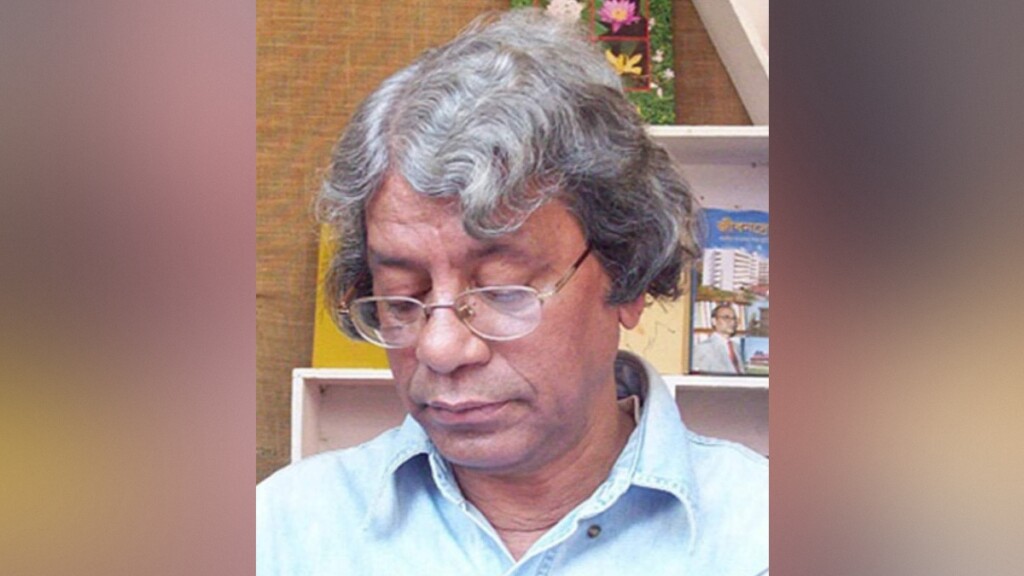
“I speak of human liberation,
I speak of human freedom
I long for that liberation where a person
Can live on their own terms.”
He did not allow himself to float along the conventional currents of Bengali literature. Guided instead by logic, a scientific mindset, free thought, and fearless expression, he forged a distinct path for himself. He was a poet, novelist, essayist, researcher, linguist, critic, and academic—in short, a uniquely multifaceted genius in Bengali letters.
He was Humayun Azad.
Born on 28 April 1947 in Rarikhal, Bikrampur, to Abdur Rashed, a schoolteacher, and Jobeda Khatun, a homemaker, his birth name was Humayun Kabir. He officially adopted the name ‘Humayun Azad’ on 28 September 1988.
He completed his secondary education at the Rarikhal Sir Jagadish Chandra Bose Institution and his higher secondary studies at Dhaka College, before earning both his BA (Honours) and MA in Bengali Literature from the University of Dhaka. In 1976, he obtained his PhD in Linguistics from the University of Edinburgh in Scotland.
His academic career began in 1970 as a lecturer in the Department of Bengali at the University of Chittagong. Later that same year, he joined the Department of Bengali at Jahangirnagar University. Over a long career spent in teaching and research, he wrote tirelessly on the Bengali language, literature, and society.
His pen served as an instrument of reason, protest, and free thought.
His voice rang clear and fearless against religious bigotry, fundamentalism, superstition, patriarchy, social inequality, political hypocrisy, and institutional corruption. This candid stance earned him the devotion of countless readers, even as it placed him at the centre of intense debate.
His notable works include Nari (Woman), Ditiyo Linga (The Second Sex), Pak Sar Jamin Sad Bad, along with numerous collections of poetry, novels, essays, research papers, and linguistic studies. Nari and Ditiyo Linga created a profound stir in Bengali society by challenging patriarchal structures and examining gender relations and women’s rights.
In recognition of his outstanding literary contributions, he was awarded the Bangla Academy Literary Award in 1986. He was posthumously conferred the Ekushey Padak for his lasting contributions to literature and linguistics.
His commitment to free thought eventually made him the target of a horrific assault.
On 27 February 2004, upon leaving the Ekushey Book Fair, he was brutally attacked by terrorists in the area between the Bangla Academy and the Teacher-Student Centre (TSC) of Dhaka University. He sustained severe knife wounds. Though he survived after a precarious fight for his life, the attack altered his existence forever.
Living under constant threat, he subsequently moved to Germany on a fellowship from PEN Germany, where he engaged in research on the life and poetry of the German poet Heinrich Heine.
Fate, however, took a tragic turn.
On 12 August 2004, he died suddenly in Munich at the age of 57.
The passing of a thinker who had raised so many foundational questions within Bengali language and literature, shaken so many dogma-bound beliefs, and lit the torch of reason against darkness was a profound loss. It marked the abrupt silence of a sharp, inquisitive, and courageous voice.
Humayun Azad believed that one must question because knowledge originates from inquiry, and that established beliefs must be tested because blind allegiance does not liberate humanity.
Death has not erased his presence; he remains accessible through his books, his logical arguments, his inquiries, and his spirit of dissent.
A writer may pass away, but their ideas endure.
Whenever superstition rears its head, whenever fundamentalism seeks to block the path of free thought, and whenever blind faith attempts to supplant reason, Humayun Azad’s writings remind us that the struggle for free intellect never ceases.
He stood courageously against convention, taught society how to question, and lit the lamp of logic amidst darkness.
Humayun Azad is more than a name; he remains an indispensable chapter in the history of free thought in the Bengali language.
On the anniversary of his passing, deep respect is offered to this unconventional, fearless, and multifaceted intellectual.
Tribute.
Humayun Azad (28 April 1947 — 12 August 2004)
“Teach a person to question,
And only then will they become truly human.”