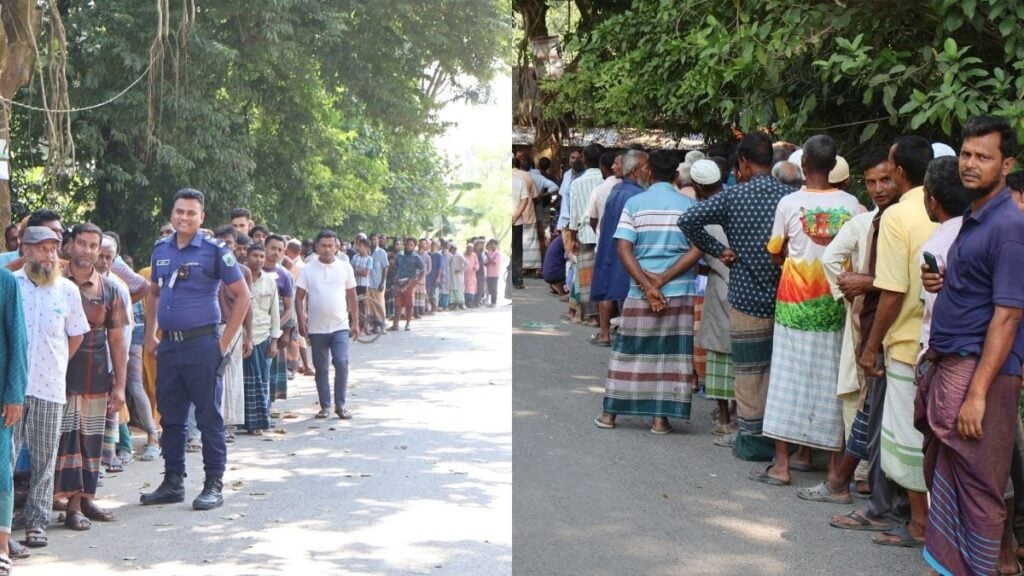
Desperate farmers in the Singra upazila of Natore district are facing severe hardship as the Rabi and Boro cultivation seasons commence across the Chalanbeel region. Agriculturalists in the area have expressed deep resentment after being forced to join lengthy queues from the early hours of the morning, often waiting all day merely to secure a single sack of fertiliser. Despite spending hours in line, a significant number of farmers are ultimately forced to return home empty-handed.
The situation has become particularly critical regarding Triple Super Phosphate (TSP) fertiliser, which local growers describe as virtually unobtainable. Although the sowing season for essential Rabi crops—including mustard, maize, and potatoes—is well underway, many landholders have been unable to prepare their fields. Consequently, substantial tracts of agricultural land remain uncultivated due to the acute shortage of necessary soil nutrients. While official sources maintain that there is no structural deficit of domestic Urea, obtaining even this basic chemical feed has turned into a protracted ordeal.
On Monday morning, more than five hundred farmers gathered outside M/s SR Traders in the Baman Majhgram Market under Lalor Union. Many had been standing in line since dawn hoping to purchase Urea. Although individual farming operations typically require between four and ten sacks, distributors are restricting sales to just one or two sacks per person. This rationing comes despite explicit assertions from the Department of Agricultural Extension that overall market supplies of Urea remain adequate.
The distribution system has drawn intense criticism from local residents who describe the process as deeply inefficient and unnecessarily burdensome. Farmers are currently required to queue at multiple separate locations to purchase different types of nutrients, including TSP, Di-ammonium Phosphate (DAP), Muriate of Potash (MoP), and Urea. The complex procedure has created particular difficulties for households without adult male members, forcing female farmers to navigate the crowded distribution centres themselves over several consecutive days just to secure minimal supplies.
The logistical bottleneck stems largely from administrative measures introduced by local government authorities. Dealers from M/s SR Traders confirmed that distribution is being strictly managed under the direct instructions of the Upazila Agriculture Officer. Rather than allowing growers to procure their full requirement of various fertilisers from a single warehouse, official directives mandate that different products be collected from separate locations on designated days. Local farmers report that this fragmented approach has significantly increased both their transport costs and working hours lost.
Addressing the disruption, Upazila Agriculture Officer Mahmudul Hasan explained that the stringent controls were implemented to prevent irregularities and curb illicit hoarding among commercial dealers. He assured the community that adequate stocks exist, explaining that allocations are being released in phases, which has coincided with a sudden surge in demand as farmers arrive simultaneously. Supporting this view, Assistant Agriculture Officer Binoy Kumar attributed the massive queues to widespread public anxiety regarding potential shortages, while Upazila Executive Officer (UNO) Abdullah Al Rifat and local Member of Parliament Anwarul Islam both stated that administrative action would be taken against any dealer found engaging in malpractice or causing improper harassment to the farming community.