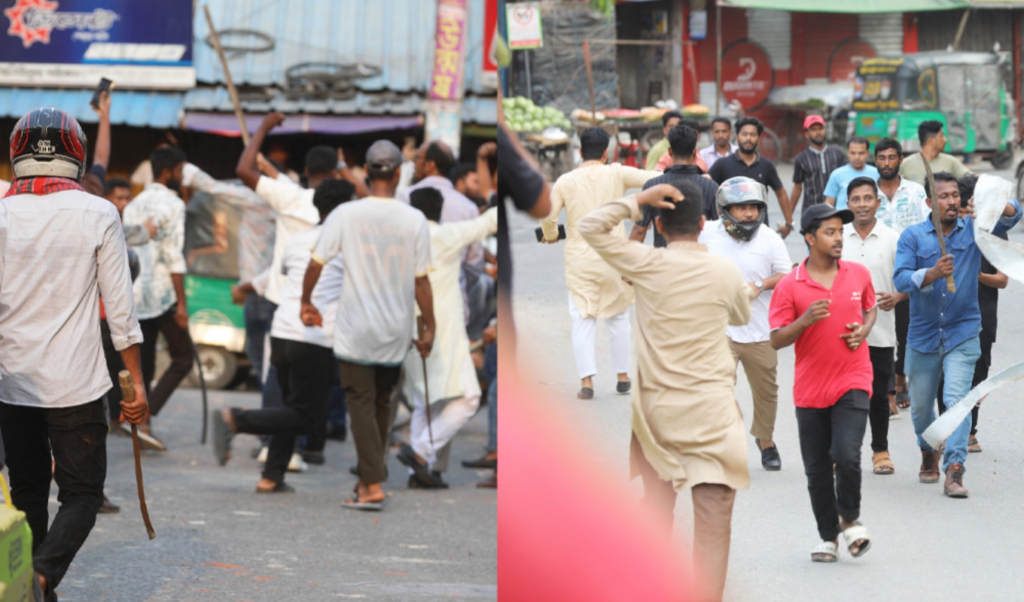
The political climate in Bangladesh’s strategic port city has reached a fever pitch following a series of violent skirmishes between the Bangladesh Jatiotabadi Chhatra Dal (JCD) and Bangladesh Islami Chhatra Shibir at Chattogram City College. Addressing the unrest in the National Parliament, Home Affairs Minister Salahuddin Ahmed issued a robust appeal for sobriety, urging political stakeholders and the public to refrain from “unilateral blame-shifting” until a thorough and impartial investigation is concluded.
Parliamentary Allegations and Heightened Tension
The debate was ignited by Shahjahan Chowdhury, the Member of Parliament for Chattogram-15 representing Bangladesh Jamaat-e-Islami. During a scheduled discussion regarding the President’s address, Chowdhury drew the House’s attention to the severity of the clashes occurring near the city’s prominent New Market precinct.
Chowdhury made the provocative assertion that the perpetrators of the assault were the same “vested interests” who had targeted demonstrators during the anti-discrimination student movement earlier this year. His claims took a more harrowing turn as he reported that a student had allegedly suffered a severed limb during the fray. Consequently, he demanded an immediate executive crackdown and a formal ministerial explanation.
The Deputy Speaker, Kaysar Kamal, intervened to maintain order, advising that such grave allegations require a formal notice under parliamentary protocol to allow for a structured response from the Ministry.
The Home Secretary’s Call for Due Process
Minister Salahuddin Ahmed, taking the floor to address the escalating rhetoric, adopted a measured tone. He acknowledged that while intelligence agencies provide constant briefings, the fluid nature of the Chattogram City College incident necessitates a meticulous verification process before any definitive conclusions can be drawn.
Ahmed was particularly critical of the reflexive “culture of finger-pointing” that has long-characterised the nation’s political discourse.
“I have no desire to cast unilateral aspersions, and it is equally incumbent upon the Honourable Member to abstain from vilifying specific political organisations without the benefit of a completed inquiry,” the Minister stated.
He further clarified that the government would issue a formal statement under Rule 300 once the facts are solidified. He emphasised that justice must follow the rule of law, urging aggrieved parties to lodge formal police complaints rather than seeking retribution in the streets.
Comparative Overview: Conflicting Party Narratives
As the official police inquiry continues, both student bodies have presented divergent accounts of the events leading to the violence.
| Feature | Bangladesh Jatiotabadi Chhatra Dal (JCD) | Bangladesh Islami Chhatra Shibir |
| Alleged Catalyst | Provocation regarding college murals and graffiti | Aggression directed at a peaceful student assembly |
| Primary Theatre | Chattogram City College Campus | New Market Precinct & Main Gates |
| Reported Injuries | Several activists admitted to hospital | Multiple workers injured; one severe limb injury reported |
| Official Stance | Calls for the arrest of “external infiltrators” | Demands justice against “identified miscreants” |
| Internal Action | Review committee established to investigate | Formal complaint lodged with college administration |
The ‘Gupta’ Dispute and Regional Stability
The spark that reportedly ignited this powder keg was a dispute over the word ‘Gupta’ inscribed on the college walls. Though seemingly a minor act of graffiti, it served as the flashpoint for a confrontation that rapidly transitioned from verbal hostility to physical combat involving sticks and improvised weapons.
This incident represents a significant test for the current administration. Both the JCD (the student wing of the BNP) and Chhatra Shibir were instrumental allies during the recent mass uprising that reshaped the country’s political landscape. The Minister’s cautious approach highlights the government’s delicate balancing act: maintaining the fragile coalition of student forces while ensuring educational institutions do not return to being battlegrounds for partisan warfare.
Minister Ahmed concluded his parliamentary address by reiterating that the “toxic political culture of the past”—where parties were tried in the court of public opinion before a court of law—must be dismantled. He reaffirmed the government’s unwavering commitment to a transparent investigation and the safety of the student population in Chattogram.