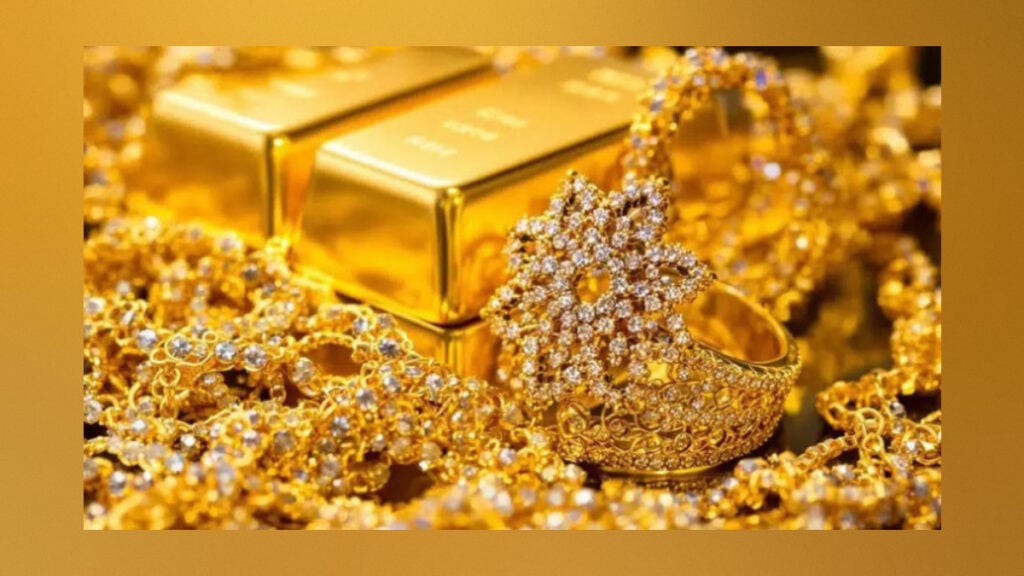
Gold prices fell in global markets on Monday as a sharp rise in oil prices fuelled concerns over inflation and strengthened expectations that the US Federal Reserve could raise interest rates at its policy meeting this week.
At around 9:30am Bangladesh time on Monday (14 September), spot gold was down 0.3 per cent at $4,334.31 an ounce. The decline came after gold recorded its third consecutive weekly fall on Friday. US gold futures also weakened, dropping 0.8 per cent to $4,375 an ounce.
Tim Waterer, chief market analyst at KCM Trade, said the prevailing conditions were unfavourable for gold. Rising energy costs, combined with expectations of higher interest rates ahead of meetings by the Federal Reserve and the Bank of Japan, have increased pressure on the precious metal.
Gold does not generate interest or a fixed return, unlike many interest-bearing financial assets. As a result, expectations of higher interest rates can reduce its appeal among investors, particularly when returns on other assets become more attractive.
However, Waterer said a decline in gold prices could encourage fresh buying interest, particularly because uncertainty surrounding monetary policy and geopolitical developments remains high. Investors often turn towards gold when concerns over economic stability, inflation or international tensions intensify.
Recent US economic data have strengthened expectations about the Federal Reserve’s next policy move. Data released last week showed that consumer inflation in the United States increased in August. The country’s core inflation measure also recorded its largest rise in four months.
According to the CME FedWatch tool, markets were pricing in an 86.5 per cent probability of an interest-rate increase at the Federal Reserve’s policy meeting scheduled for Tuesday and Wednesday. Before the latest inflation figures were released, the probability had stood at around 67 per cent.
The shift in expectations highlights the importance of inflation data for financial markets. When inflation remains elevated, central banks can face pressure to maintain or tighten monetary policy. Such expectations can influence bond yields, currencies and commodity prices, including gold.
The Bank of Japan is also expected to raise interest rates on Friday, according to prevailing market expectations. Persistent inflation and steady economic growth, together with higher energy prices and continuing tensions in the Middle East, have raised the possibility of further monetary tightening by major central banks.
Gold is traditionally regarded as a safe-haven asset and is often sought as a hedge against inflation and periods of uncertainty. Yet its appeal can weaken when interest rates rise because holding gold does not provide an interest payment. Investors may instead favour assets that offer income or higher yields.
Oil markets have added another layer of uncertainty. Crude prices rose by more than 2 per cent on Monday amid concerns over potential disruptions to supplies. New Houthi attacks in Saudi Arabia and an Iranian attack on a vessel in the Gulf increased worries about energy security.
The closure of a key Saudi oil pipeline has also heightened concerns about supply constraints. Any prolonged disruption in the region could add to pressure on global energy markets and, in turn, complicate efforts by central banks to contain inflation.
Diplomatic efforts surrounding the Strait of Hormuz have also suffered a setback. A planned meeting between Iran and Gulf countries was postponed, adding to uncertainty over the already tense situation in the Middle East. The waterway is strategically significant for global energy trade, meaning developments around it can have an immediate impact on market sentiment.
Other precious metals also traded lower or remained broadly stable on Monday. Spot silver fell 0.7 per cent to $64.02 an ounce. Platinum was almost unchanged at $1,796.90 an ounce, while palladium stood at $1,298.80 after only a marginal change.
For gold investors, attention is now focused on central-bank decisions, inflation figures and geopolitical developments. Expectations of higher interest rates may continue to weigh on the metal, while renewed geopolitical tensions or a deterioration in economic confidence could revive demand for gold as a safe-haven asset.