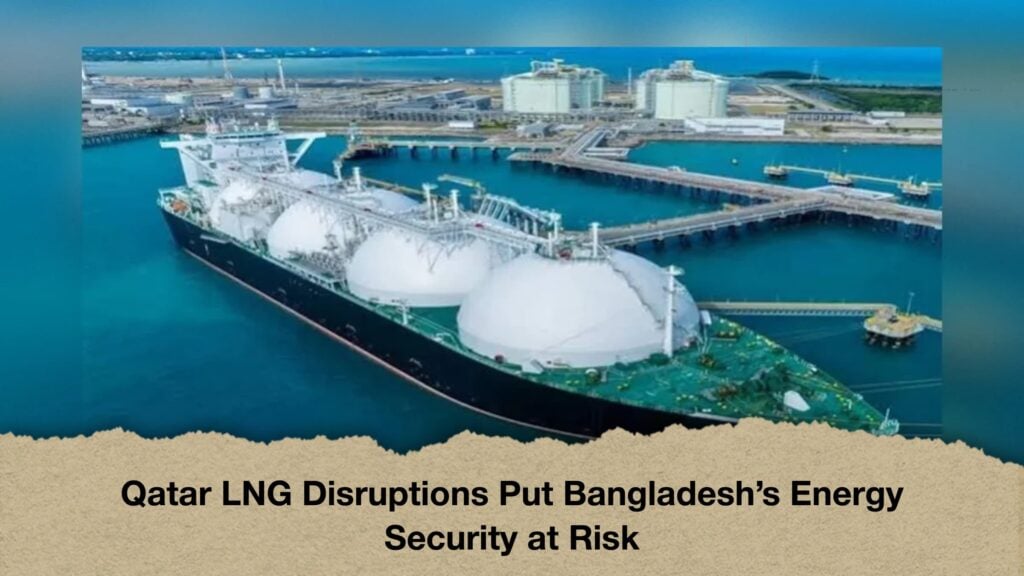
Qatar Energy has extended the duration of the force majeure situation affecting its liquefied natural gas (LNG) supplies, prolonging uncertainty for buyers across Asia and Europe. Bangladesh is among the countries considered particularly exposed to the disruption as the crisis surrounding the Strait of Hormuz continues to restrict the normal movement of LNG cargoes.
LNG shipments through the Strait of Hormuz remain severely disrupted, making it increasingly difficult for buyers that depend on Qatari supplies to secure their contracted cargoes. Qatar Energy has notified buyers in Pakistan that deliveries could remain cancelled through October, while LNG supplies earmarked for Bangladesh are also expected to face disruption beyond September. Several European buyers have reportedly received similar notices.
According to a report by Euronews, the latest cancellations by Qatar Energy have now extended into the first half of November. The prolonged disruption has forced buyers in Europe and Asia to look for alternative sources of LNG, reduce gas consumption or switch to other fuels where possible.
The uncertainty is particularly significant because Qatar is one of the world’s major LNG exporters and a key supplier to several Asian markets. Any prolonged interruption therefore has consequences beyond individual contracts, potentially tightening competition for cargoes in the international market.
Contracted supplies face prolonged disruption
Under its agreement with Italian energy company Edison, Qatar Energy has cancelled 29 LNG cargoes since April. The cancelled shipments were expected to contain around 3.8 billion cubic metres of natural gas.
Edison said it had managed to secure alternatives for 21 of those cancelled cargoes, representing approximately 2 billion cubic metres of gas. The company said the replacement supplies have enabled it to continue meeting its commitments to customers despite the disruption to Qatari deliveries.
Qatar Energy first declared force majeure over the Strait of Hormuz situation in March. As conditions deteriorated, the period was repeatedly extended from month to month.
Ann-Sophie Corbeau, an expert at Columbia University’s Centre on Global Energy Policy, said the disruption could continue for some time if no political solution emerges.
She said Qatar Energy had not provided a firm indication of when LNG exports could return to normal. As a result, the force majeure period has continued to be extended on a monthly basis.
Qatar Energy did not respond to Euronews’ request for comment on the matter.
Global buyers search for replacement gas
The disruption has sharply reduced Qatar’s presence in the global LNG market. Data from ICIS show that Qatar exported only 18 LNG cargoes during the first six months of the war, compared with 509 cargoes during the same period a year earlier.
The dramatic fall in exports has also affected Qatar’s income from gas sales. The reduction has been estimated at around $24 billion.
Other LNG exporters are attempting to compensate for part of the shortfall. Corbeau said supplies from the United States and Canada had increased, while new production facilities that came online during the past year were also contributing additional volumes. LNG production has also risen in Nigeria and Malaysia.
Those additional supplies, however, have not been sufficient to completely replace the volumes lost from Qatar.
Some Asian markets have responded by reducing gas consumption or switching to alternative fuels. European buyers, meanwhile, have sought to avoid intensifying competition for expensive LNG in the spot market by drawing more heavily on gas already held in storage.
Corbeau said the cargoes that remain available are increasingly going to buyers capable of paying higher prices. Despite elevated LNG prices, some buyers in South-East Asia remain active in the market.
She also warned that LNG supplies from Qatar and the United Arab Emirates could remain disrupted for an extended period. Although production elsewhere is increasing, global LNG trade could still decline in 2026 if the disruption persists.
Bangladesh faces particular exposure
The impact of the crisis is not uniform across LNG-importing countries. The European Union imported less LNG between April and August than during the same period of the previous year, while China’s imports also declined.
For Bangladesh, however, prolonged disruption to contracted LNG supplies presents a significant challenge because imported LNG forms an important part of the country’s broader gas supply system. The fuel is used extensively for electricity generation as well as by industries and other gas-dependent sectors.
A prolonged shortage could therefore put additional pressure on the country’s energy supply arrangements. If contracted cargoes fail to arrive, buyers may need to seek replacement supplies on the international market, where competition can be intense when available cargoes are limited.
The problem is not simply the availability of gas. The price at which replacement LNG can be secured is also crucial. When several countries compete for a limited number of cargoes, buyers with greater financial flexibility can have an advantage. For economies that need to balance energy security with import costs, securing alternative supplies can become considerably more difficult.
The situation also highlights Bangladesh’s exposure to disruptions along major international energy routes. The Strait of Hormuz is a critical maritime passage for global energy trade, and prolonged restrictions on LNG transportation can quickly affect supply chains far beyond the immediate region.
For Bangladesh, the immediate concern will be whether the disrupted Qatari cargoes can be replaced without creating a significant gap in gas availability or placing additional pressure on energy import costs. With Qatar Energy yet to provide a definite timetable for a return to normal exports, uncertainty is likely to remain over the country’s LNG supply in the coming months.
The broader international market is also facing a difficult balancing act. Rising output from several exporters is providing some relief, but it has not fully offset the loss of Qatari supplies. If disruptions involving Qatar and the United Arab Emirates continue for an extended period, competition for LNG could remain intense and global trade volumes could come under further pressure during 2026.