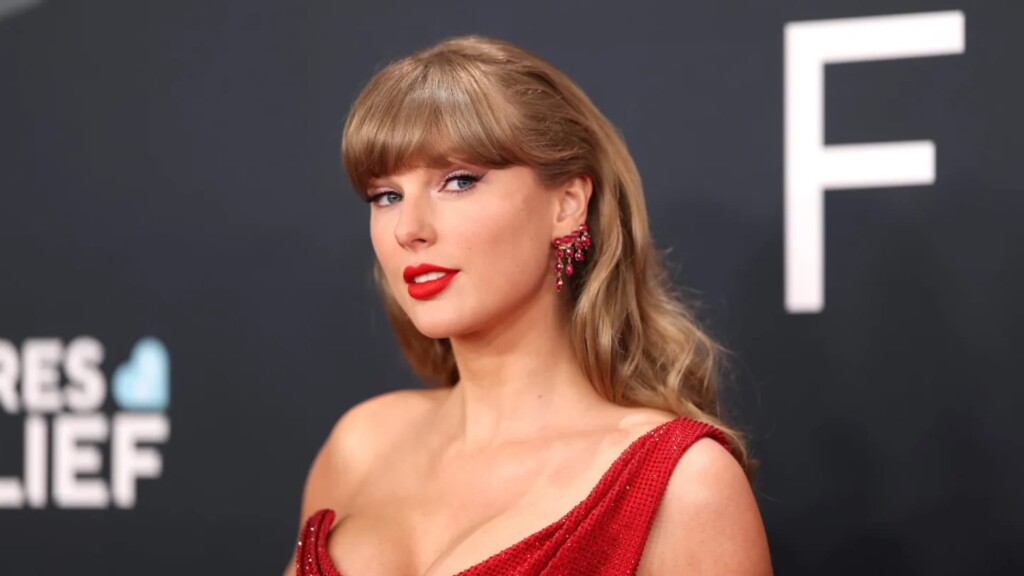
The rapid advancement of artificial intelligence has intensified concerns across the entertainment industry regarding the unauthorised replication of celebrities’ voices, likenesses and personas. In response to these growing risks, Taylor Swift has initiated new legal measures aimed at strengthening control over the use of her identity.
According to reports published by the organisation Variety, Swift’s legal entity, TAS Rights Management, submitted three trademark applications to the United States Patent and Trademark Office on 24 April. These filings are designed to secure protection over both vocal expressions and a distinctive visual representation associated with the artist.
Two of the applications focus specifically on voice-related phrases commonly associated with Swift, namely “Hey, it’s Taylor Swift” and “Hey, it’s Taylor”. The third application relates to a stylised visual trademark depicting Swift performing on stage with a pink guitar and wearing a glittering outfit. The intention is to safeguard recognisable elements of her public persona from unauthorised commercial or artificial intelligence-driven replication.
Legal commentator Josh Gerben has highlighted the significance of this approach, noting that modern artificial intelligence systems are increasingly capable of generating highly realistic synthetic voices and images without consent. He emphasised that existing legal protections were not originally designed to address full-spectrum digital replication of identity.
Trademark Applications Filed by Taylor Swift
| Application Type | Subject Matter | Filing Date | Filing Entity |
|---|---|---|---|
| Voice Trademark | “Hey, it’s Taylor Swift” phrase | 24 April | TAS Rights Management |
| Voice Trademark | “Hey, it’s Taylor” phrase | 24 April | TAS Rights Management |
| Visual Trademark | Stage image with pink guitar | 24 April | TAS Rights Management |
While traditional trademark law does not fully encompass protection of a person’s complete voice or likeness, this strategy may complement existing “right of publicity” laws. Such laws are designed to prevent unauthorised commercial exploitation of an individual’s identity, though they vary significantly across jurisdictions.
In the United States, states such as New York and California have established right of publicity statutes. However, trademarks provide an additional advantage, as they can be enforced at the federal level, allowing legal action across the entire country.
Swift has previously been affected by AI-generated content misuse, including manipulated images circulating online and unauthorised use of her likeness in automated systems. Notably, during the 2024 United States election cycle, misleading artificial intelligence-generated images were shared by Donald Trump suggesting false political endorsement.
A similar legal strategy has been adopted by other public figures. In 2025, actor Matthew McConaughey secured trademark protections covering aspects of his vocal identity, reflecting a broader trend among celebrities seeking stronger safeguards against synthetic media misuse.
As artificial intelligence tools become more sophisticated and widely accessible, the entertainment industry is expected to see further expansion in legal efforts designed to preserve personal identity rights in digital environments.