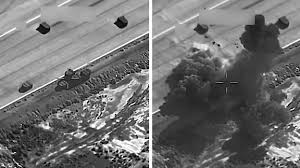
The United States military has announced that it carried out precision strikes against at least 140 military targets across Iran in response to what it described as Iranian attacks on commercial shipping in the strategically vital Strait of Hormuz. The operation, confirmed by the US Central Command (CENTCOM) on Saturday, marks Washington’s third round of military action against Iran within a single week, highlighting a rapid deterioration in regional security.
According to CENTCOM, the latest operation was launched after Iran’s Islamic Revolutionary Guard Corps (IRGC) allegedly attacked a Cyprus-flagged commercial vessel transiting the Strait of Hormuz. The US military said the strikes were conducted using a combination of land-based and carrier-based combat aircraft, armed drones and naval platforms equipped with precision-guided missiles.
In its statement, CENTCOM said American forces targeted approximately 140 military sites across Iran. These reportedly included missile and drone launch facilities, naval infrastructure, ammunition storage depots, communications networks and coastal surveillance installations believed to support Iranian military operations. The United States described the campaign as a direct response aimed at degrading Iran’s capability to threaten international maritime traffic and regional stability.
The latest strikes began on Sunday in Iran, corresponding to Saturday night in the United States, and represent the third phase of US military operations since the current confrontation intensified. The growing cycle of military action has raised fresh concerns about the possibility of a broader conflict across the Middle East.
Iran has already declared the Strait of Hormuz closed to what it describes as unauthorised maritime traffic. Tehran maintains that one commercial vessel had entered the waterway through an unauthorised route and was intercepted and halted by Iranian forces. Iranian officials have warned that any retaliatory action against the country would be met with a “firm and decisive” response.
The situation escalated further when the IRGC claimed responsibility for disabling a second vessel in the Strait of Hormuz. Iranian authorities have portrayed the actions as part of efforts to enforce their security measures in the strategically sensitive waterway.
In response to the latest American strikes, the IRGC also claimed it had launched attacks against US military facilities located in Jordan, Qatar and Oman. While the extent of any damage or casualties has not been independently confirmed, the claims underscore the widening geographical scope of the confrontation.
The Strait of Hormuz remains one of the world’s most important maritime chokepoints, linking the Persian Gulf to international waters. A significant share of global crude oil and liquefied natural gas exports passes through the narrow passage each day. Any disruption to navigation in the strait has the potential to affect global energy markets, commercial shipping and international trade, making the current escalation a matter of worldwide concern.
With both Washington and Tehran signalling their willingness to respond forcefully to further developments, regional tensions remain exceptionally high. The exchange of military strikes, attacks on commercial shipping and competing claims from both sides have fuelled fears that the crisis could expand beyond the Gulf unless diplomatic efforts succeed in preventing further escalation.