Monday, 6th April 2026

Khabor Wala Desk
Published: 13th February 2026, 8:13 AM
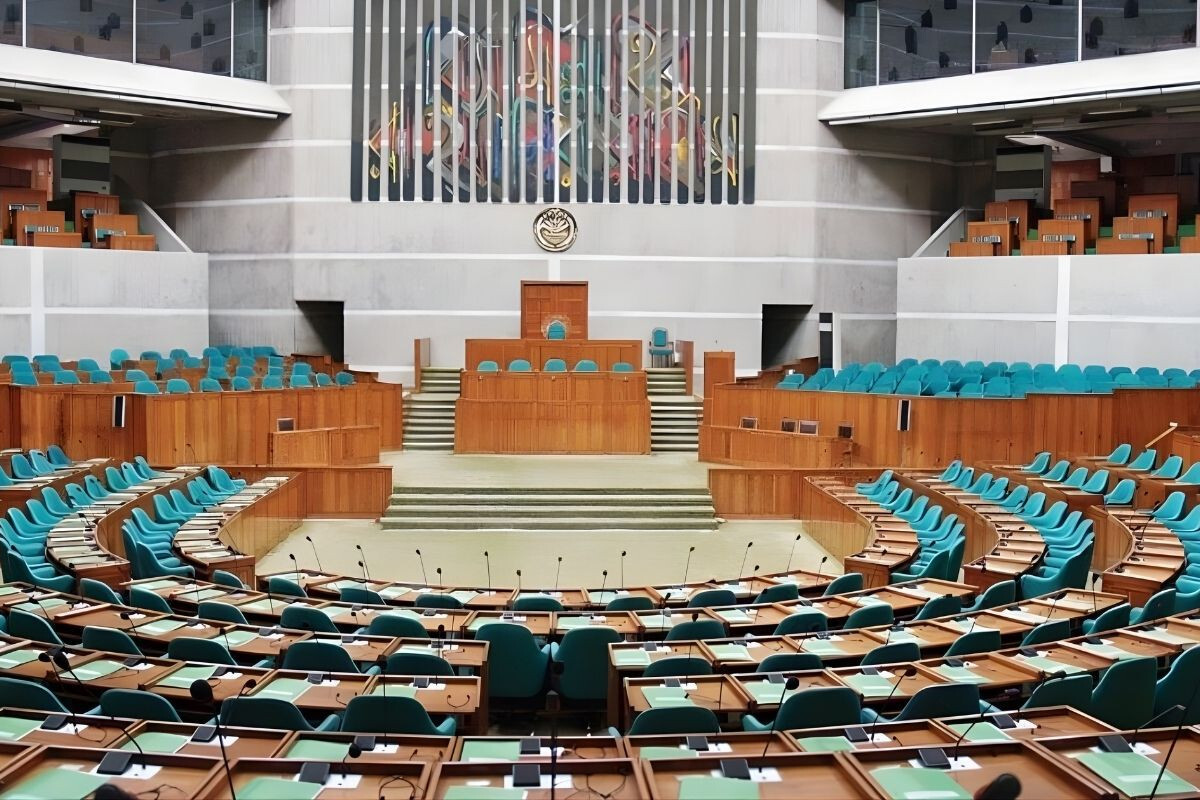
Following the general election, attention has swiftly shifted from vote counting to the constitutional mechanics of government formation. The central political question—who will form the next government—appears largely settled. According to unofficial results released by the Election Commission, the Bangladesh Nationalist Party (BNP) has secured more than 150 parliamentary seats, surpassing the simple majority threshold in the 300-seat Jatiya Sangsad and thereby positioning itself to form the next administration.
Yet while the arithmetic of victory may be clear, the procedural path to assuming office has prompted considerable public interest and some uncertainty.
Under Article 148 of the Constitution of Bangladesh, newly elected Members of Parliament (MPs) must take their oath within three days of the publication of the election results in the official government gazette. Crucially, unofficial results—often announced within 24 to 48 hours of polling—do not trigger this constitutional countdown. The formal timeline begins only once the results are officially gazetted.
This distinction means that, although preliminary results may be known quickly, several additional days may elapse before the constitutional process formally begins.
The Press Secretary to the Chief Adviser indicated in a media briefing on 5 February that the swearing-in of MPs was unlikely to be delayed beyond 18 February. He suggested that, if administrative procedures proceed smoothly, the oath-taking could occur as early as 15 or 16 February. This would imply that the government formation process could commence within six days of polling—a notably swift transition by regional standards.
| Stage | Constitutional Basis | Timeframe |
|---|---|---|
| Publication of official results in gazette | Article 148 | After final verification |
| Oath of MPs | Article 148 | Within 3 days of gazette publication |
| If designated authority fails to administer oath | Article 148 | Chief Election Commissioner acts within next 3 days |
| Appointment of Prime Minister | Article 56 | After majority confidence is established |
Traditionally, newly elected MPs are sworn in by the Speaker of Parliament. However, following the political upheavals associated with the 2024 student-led mass movement, Parliament currently stands dissolved. There is no sitting Speaker, and the Deputy Speaker is reportedly incarcerated.
Article 148 anticipates such contingencies and provides two alternative mechanisms:
The President may designate an appropriate person to administer the oath.
If that person fails to do so within three days, the Chief Election Commissioner must administer the oath within the subsequent three days, as though constitutionally designated.
Asif Nazrul, Legal Adviser to the interim government, stated on 5 February that the authorities are keen to expedite the transfer of power. He noted that the President could nominate a respected constitutional office-holder—such as the Chief Justice—to conduct the ceremony. However, if that option proves unworkable, the Chief Election Commissioner would assume the responsibility, albeit with a short procedural delay.
Once MPs are sworn in, the formal process of government formation begins. Under Article 56 of the Constitution, the President appoints as Prime Minister the Member of Parliament who appears to command the confidence of the majority of MPs.
In practical terms, this means that the leader of the party or coalition securing at least 151 seats in the 300-member Parliament will be invited to form a government. Upon taking the oath of office, the Prime Minister and members of the Council of Ministers immediately assume their constitutional authority.
Article 148 further clarifies that where an oath is required before assuming office, the office-holder is deemed to have entered into their duties immediately upon taking that oath.
Thus, once the majority leader is sworn in as Prime Minister and the Cabinet is constituted, the transfer of power from the outgoing administration is considered complete. If current projections hold, Bangladesh may witness one of its most rapid post-election transitions in recent years, underscoring the constitutional framework’s built-in mechanisms for continuity and stability.



Comments