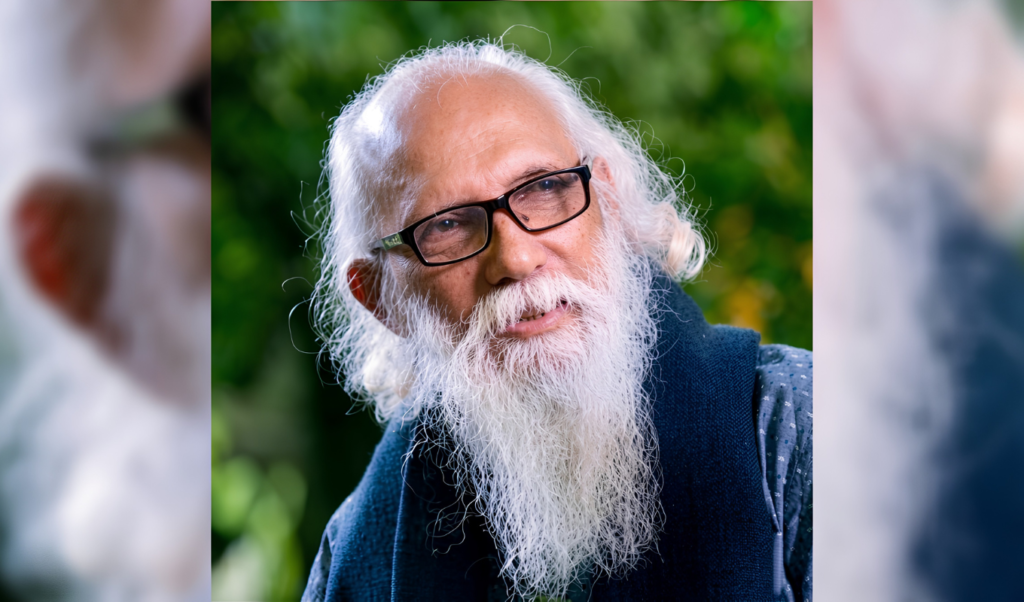
Among those who have illuminated generation after generation in the sky of Bengali poetry with their unique brilliance, Poet Nirmalendu Goon stands as one of the most prominent figures. Love, rebellion, people’s rights, the spirit of liberation, and deep devotion to Bangabandhu are the central themes of his poetry. He is not merely a poet; he is a living history and a voice of courageous expression.
The literary little magazine Lok has aptly honoured him with the title “Poet of Bangabandhu,” as in his poetry, Bangabandhu, Bangladesh, and the aspiration for Bengali liberation become inseparable.
He was born on 21 June 1945 in Kashbon village of Barhatta upazila in Netrokona. His full name is Nirmalendu Prokash Goon Chowdhury, though he is universally known as Nirmalendu Goon in the literary world. His father was Sukhendu Prokash Goon and his mother was Binapani Devi. He was the youngest among three sisters and two brothers. He lost his mother at the age of four, and his early education began under the care and affection of his stepmother Charubala.
His childhood and adolescence were spent amidst the natural beauty of Netrokona. He passed his matriculation examination in 1962 from Coronation Krishnaprasad Institution in Barhatta with distinction. His interest in literature developed deeply during his student life. Even before his matriculation exam, his first poem, “Nutan Kandarī” (New Helmsman), was published in the Netrokona-based magazine Uttar Akash.
Later, while studying at Ananda Mohan College in Mymensingh, he received a residential scholarship. In the 1964 ISC examination, he was one of the only students from Netrokona College among the 119 first-division achievers under the Dhaka Board. Although he had the opportunity to study Pharmacy at the University of Dhaka for higher education, communal unrest prevented him from fulfilling that dream. These hardships made him stronger and more determined.
The turbulent political reality of the 1960s, mass uprisings, the struggle for liberation, and the lives of ordinary people deeply influenced his poetic consciousness. Before independence, he was actively involved in socialist politics and journalism.
In 1970, his first poetry collection, Premangshur Rokto Chai (I Demand the Blood of Love Rays), created a sensation in the world of Bengali poetry. The historic poem “Hulia” included in this collection brought him immense popularity. Later, filmmaker Tanvir Mokammel made an experimental film titled Hulia based on this poem.
His immortal poem “How Did We Get This Word: Independence” still holds a place in Bangladesh’s educational curriculum. Poems such as “Why Are Your Eyes So Red” and “I Have Not Come to Demand Anyone’s Blood Today” remain treasured assets of Bengali literature.
Alongside poetry, he has shown equal mastery in prose, memoirs, travel writing, and novels. His works strongly express themes of love, class struggle, humanism, social inequality, and anti-autocratic sentiment.
In recognition of his outstanding contribution to Bengali literature and culture, he has received several prestigious awards, including the Bangla Academy Literary Award (1982), the Ekushey Padak (2001), and the Independence Award (2016), among the highest civilian honours of the country. Recently, he has also been awarded a lifetime achievement honour, marking a fitting recognition of his long literary journey.
His popular novel Deshantar has also been adapted into a film, which received appreciation from both audiences and critics.
On his birthday today, we extend deep respect, heartfelt love, and sincere wishes. May this beacon of Bengali poetry remain healthy and creatively active for many years to come. May his pen continue to speak of humanity, freedom, love, and resistance.
Happy Birthday, Poet Nirmalendu Goon.
Stay well and live long. May your poetry, which has awakened our conscience, continue to enlighten the minds of future generations for eternity.