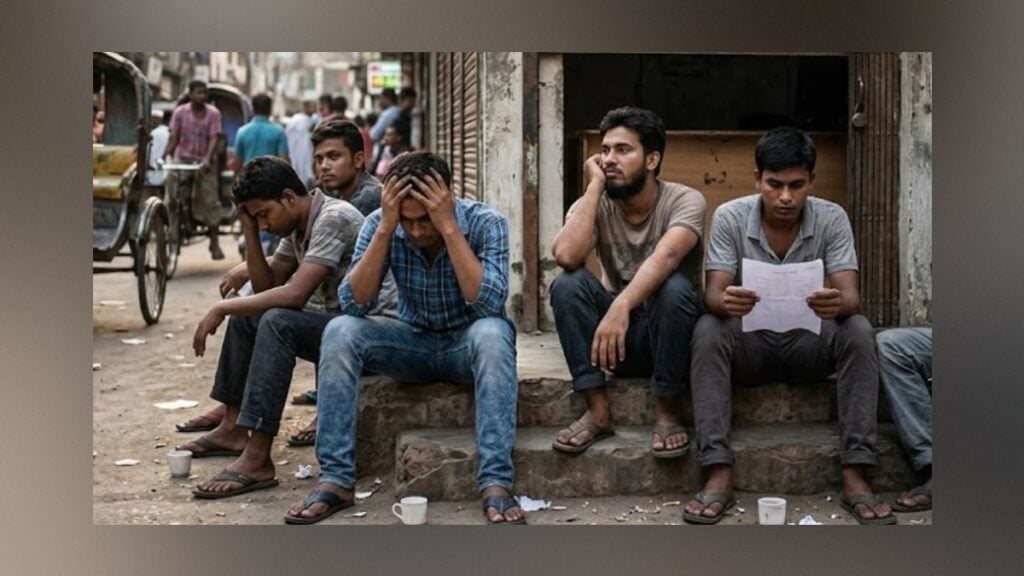
Nearly 29 per cent of highly educated young people in Bangladesh are unemployed, while almost half of highly educated workers are employed in positions that do not make full use of their qualifications and skills, according to a report by the International Monetary Fund (IMF). The findings highlight persistent weaknesses in the country’s labour market, including a mismatch between education and employers’ requirements, limited access to quality jobs and the growing impact of technological change.
The findings appear in the IMF’s Regional Economic Outlook: Asia and Pacific, released on Thursday, 15 October. The report uses information available up to 2 October and examines economic conditions, labour market challenges and the effects of artificial intelligence (AI) across the Asia-Pacific region.
According to the report, one of the main obstacles facing young graduates entering Bangladesh’s job market is the gap between the skills they acquire through education and those required by employers. Although many jobseekers hold university degrees, their qualifications do not always match the practical requirements of available positions.
As a result, some graduates remain unemployed for extended periods, while others accept jobs that fall below their educational qualifications or professional capabilities. This limits their career development and prevents the economy from making full use of its skilled workforce.
Informal employment presents further challenges
Across many Asian countries, a substantial proportion of workers are employed in agriculture and the informal sector. Such jobs often lack formal employment contracts, reliable job security and clear opportunities for career progression.
Consequently, being employed does not necessarily mean that a worker has access to secure or satisfactory working conditions. The quality of employment is an important factor in assessing the overall health of a labour market.
The IMF argues that unemployment rates alone cannot fully capture these weaknesses. It is also necessary to consider the nature of available jobs, whether workers’ qualifications match their responsibilities and whether they have opportunities to improve their skills and advance professionally.
The issue is particularly important for Bangladesh, where the working-age population is expected to expand in the coming years. If this growing workforce can be absorbed into productive employment, it could create substantial opportunities for economic development.
However, the country may struggle to realise this demographic potential if suitable jobs remain scarce or workers cannot use their skills effectively.
Expanding quality employment in manufacturing, production and services will therefore be essential. Education and training systems also need to become more responsive to labour market requirements. Greater emphasis on practical learning, technical knowledge and vocational training could help young people make a smoother transition from education to employment.
Artificial intelligence is reshaping employment
The rapid expansion of artificial intelligence is creating additional challenges for workers and jobseekers. Technological advances are changing the way many occupations operate, while increasing demand for employees who can use AI-related tools and systems.
The IMF analysed approximately 40 million online job advertisements across 19 Asian economies. The analysis found that demand for workers in occupations highly exposed to AI had declined by around 10 per cent. At the same time, demand for workers with AI-related skills had increased.
These findings point to a changing employment landscape in which academic qualifications alone may not be sufficient to secure a job. The ability to work with emerging technologies, solve problems and adapt to new professional requirements is becoming increasingly important.
The IMF has also warned that countries where AI currently has a relatively limited impact may face similar challenges in the future. Even as new jobs emerge in manufacturing and services, the tasks involved and the skills required to perform them could change significantly as AI becomes more widely adopted.
For Bangladesh, preparing young people for these changes will be crucial. Alongside conventional academic education, students need opportunities to develop digital literacy, technical expertise and practical workplace skills.
Training programmes that reflect employers’ needs could help reduce the gap between what students learn and what businesses require. Greater cooperation between educational institutions and employers may also improve graduates’ employment prospects.
IMF projects modest economic growth for Bangladesh
Alongside its assessment of labour market weaknesses, the IMF has issued a cautious growth forecast for Bangladesh. The organisation projects that the country’s gross domestic product (GDP) will expand by 3.2 per cent in the 2026–27 financial year.
Economic growth, employment creation and labour productivity are closely connected. When a substantial proportion of highly educated young people remain unemployed or work in positions that do not match their qualifications, the economy may fail to realise its full productive potential.
By contrast, the IMF has raised its overall growth forecast for the Asia-Pacific region. Countries benefiting from technology-driven economic activity and the expansion of AI-related industries have seen their growth prospects improve.
However, lower-income countries continue to face pressure from high energy costs and inflation. These factors can complicate efforts to maintain economic growth and improve living standards.
Turning a growing workforce into an economic advantage
Bangladesh faces two closely linked challenges: creating enough quality jobs for its expanding young workforce and developing the skills needed to compete in a rapidly changing technological environment.
Closer coordination between education providers and employers, greater investment in workforce training and the expansion of productive industries could help address these challenges. Ensuring that graduates acquire relevant skills would also make it easier for businesses to recruit workers suited to their needs.
The employment prospects of educated young people are not merely an individual concern. They have wider implications for national productivity, innovation and long-term economic development.
Unless Bangladesh can create suitable opportunities for young people to apply their education and expertise, it risks losing a significant part of the economic benefit that its growing working-age population could provide.