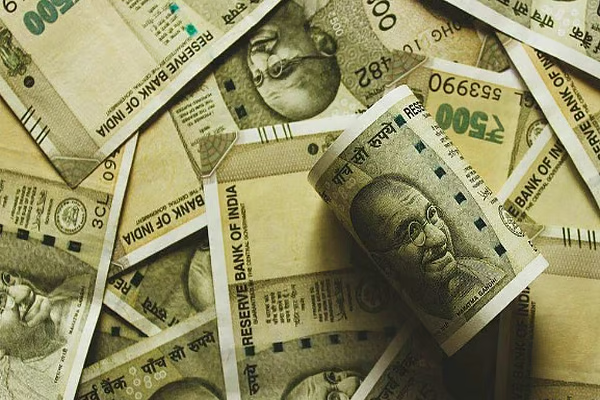
The Indian Rupee has experienced a significant decline, reaching an all-time low against the US Dollar as rising global crude oil prices continue to exert pressure on India’s economy. On Thursday, the currency plummeted to an unprecedented level of 95.33 per dollar. Although there has been a marginal recovery since that low, the exchange rate remains volatile, consistently trading above the 94 mark.
The Impact of Global Oil Prices
The primary driver behind this depreciation is the surge in international energy costs. On Thursday, Brent crude prices climbed to $126 per barrel, the highest level recorded since 2022. As a nation heavily reliant on energy imports, India faces a dual challenge: rising inflation and a threat to its projected economic growth. The increased cost of crude necessitates higher dollar outflows, further weakening the Rupee.
Capital Outflows and Market Sentiment
The current decline is not an isolated event but part of a prolonged downward trend. A major contributing factor is the persistent withdrawal of foreign institutional investors (FIIs) from the Indian equity markets. According to data from Anindya Banerjee, Head of Commodities and Currencies Research at Kotak Securities, foreign investors withdrew $7.5 billion from Indian markets in April alone. Over the previous fiscal year (running from 1 April to 31 March), total capital outflows exceeded $20 billion.
Historically, the level of 90 per dollar was considered a significant psychological barrier; however, this threshold has been breached. Analysts now express concern that the Rupee could potentially slide toward the 100 mark in the near future if current conditions persist.
Comparative Economic Data: Oil and Currency Trends
| Period | Brent Crude Price (per barrel) | USD/INR Exchange Rate (Approx.) |
| February 2026 | $72 | ~88.00 |
| Early 2026 | $108 | ~92.00 |
| May 2026 (Peak) | $126 | 95.33 |
| Current Trading | $115+ | > 94.00 |
Regional and Global Context
In 2025, the Indian Rupee depreciated by approximately 5%, earning it the title of Asia’s weakest-performing currency. This weakness is not limited to its standing against the US Dollar; official statistics from Business Standard indicate that the Rupee is also losing value against other major global currencies, including the British Pound (GBP), the Euro (EUR), the Japanese Yen (JPY), and the Chinese Yuan (CNY).
Several external factors have contributed to this sustained pressure:
-
Trade Tensions: Uncertainty regarding US-India trade agreements persists. Last year, the US imposed tariffs of up to 50% on certain Indian goods, which were later reduced to 18%.
-
Geopolitical Instability: Tensions surrounding the Strait of Hormuz have disrupted global supply chains. Analysts suggest that if Brent crude exceeds $125 due to these tensions, the Rupee could fall further toward the 97 level.
-
Capital Flight: The exodus of foreign capital creates a “circular reaction” where high oil prices lead to decreased investor confidence, which in turn spikes dollar demand.
Regulatory Response
The Reserve Bank of India (RBI) has intervened in the foreign exchange markets to manage volatility. However, experts note that the RBI’s objective is not to maintain a specific exchange rate but to prevent sudden, erratic movements. To stabilise the currency, the central bank may consider tightening monetary policy, restricting oil-related transactions, or reducing gold imports to manage dollar demand.
According to market analysts, a significant recovery for the Rupee—specifically dropping below the 94.50 level—would require a substantial decrease in oil prices, which currently seems unlikely without a diplomatic resolution to Middle Eastern supply disruptions. Under current conditions, the level of 96 remains the next critical point of resistance for the currency.