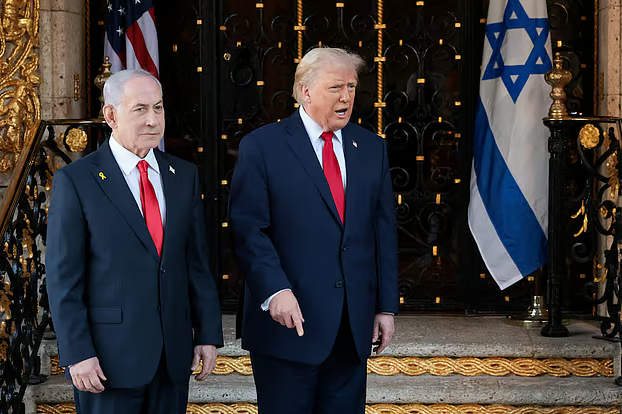
Israeli Prime Minister Benjamin Netanyahu had reportedly expected that a joint military and strategic approach with US President Donald Trump against Iran would weaken Tehran’s clerical leadership and strengthen his own political standing ahead of upcoming elections in Israel. He had also sought to present himself as the architect of a transformative US–Israel alliance capable of reshaping the political order of the Middle East.
However, those expectations have not materialised. Instead, Netanyahu—Israel’s longest-serving prime minister—now finds himself moving towards an open disagreement with Trump, as the US president appears to be stepping back from sustained military escalation. This shift comes at a time when neither leader has achieved their stated objectives, while Israeli military operations in Lebanon have also been constrained in the context of ceasefire-related discussions.
Israeli officials have adopted a publicly cautious tone in order not to provoke Washington, Israel’s most critical ally. Privately, however, frustration over the emerging US–Iran understanding has been significant. A senior Israeli official, speaking anonymously, described the initial framework as “terrible for Israel”, adding that no level of Israeli leadership, including the prime minister and military command, viewed the arrangement positively.
Washington has stated that negotiations for a comprehensive agreement will continue within a 60-day ceasefire window, focusing on addressing concerns from both the United States and Israel, particularly regarding Iran’s nuclear programme. Israeli officials, however, believe this timeline is likely to be extended, potentially limiting Israel’s ability to undertake independent military action while leaving core security concerns unresolved.
Key Developments in the US–Israel–Iran Situation
| Event | Description |
|---|---|
| Initial US–Iran framework | Ceasefire-linked agreement announced, with 60-day negotiation window |
| Israeli assessment | Officials believe timeline may extend to 90 days |
| Lebanon operations | Israeli military activity constrained amid ceasefire discussions |
| Beirut strike dispute | Trump reportedly opposed Israeli strikes during talks |
| Public tensions | Exchange of criticism following strikes and missile responses |
| Negotiation scope | Nuclear and regional security concerns to be discussed |
Tensions between Netanyahu and Trump have also surfaced over Israeli military operations against Hezbollah in Lebanon, an Iran-aligned group. The ceasefire proposal reportedly includes a halt to hostilities in Lebanon, a key Iranian demand. Earlier this month, during a reported phone call, Trump allegedly reacted strongly to planned Israeli strikes in Beirut, describing Netanyahu as “completely crazy”. The strike was temporarily halted but later resumed, prompting further regional escalation and mutual criticism among involved parties.
Despite periodic cooperation in the past—including US recognition of Jerusalem as Israel’s capital and support for the Abraham Accords during Trump’s earlier presidency—current developments indicate growing divergence. Analysts cited in Israeli media suggest that Netanyahu’s political positioning, previously strengthened by close ties with Trump, is now under strain due to the emerging US–Iran diplomatic track.
Public opinion in Israel also appears to be shifting. Recent polling indicates declining confidence in US commitment to Israeli security under Trump’s leadership, adding further domestic pressure on Netanyahu ahead of the October elections.
Netanyahu has acknowledged differences with Trump while emphasising that Israel will continue to act independently in line with its security interests. He has stated that Israel will not withdraw forces from southern Lebanon and will retain operational freedom against Hezbollah-related threats.
Meanwhile, Israeli officials believe the interim 60-day framework may be extended to 90 days, allowing the US to pursue a broader regional agreement while maintaining its military presence. However, concerns remain in Israel that such an extension would delay concrete resolution of key issues, particularly Iran’s nuclear capabilities.
The evolving diplomatic landscape has therefore placed Netanyahu in a politically sensitive position, balancing domestic electoral pressures, regional security concerns, and a shifting relationship with Washington.