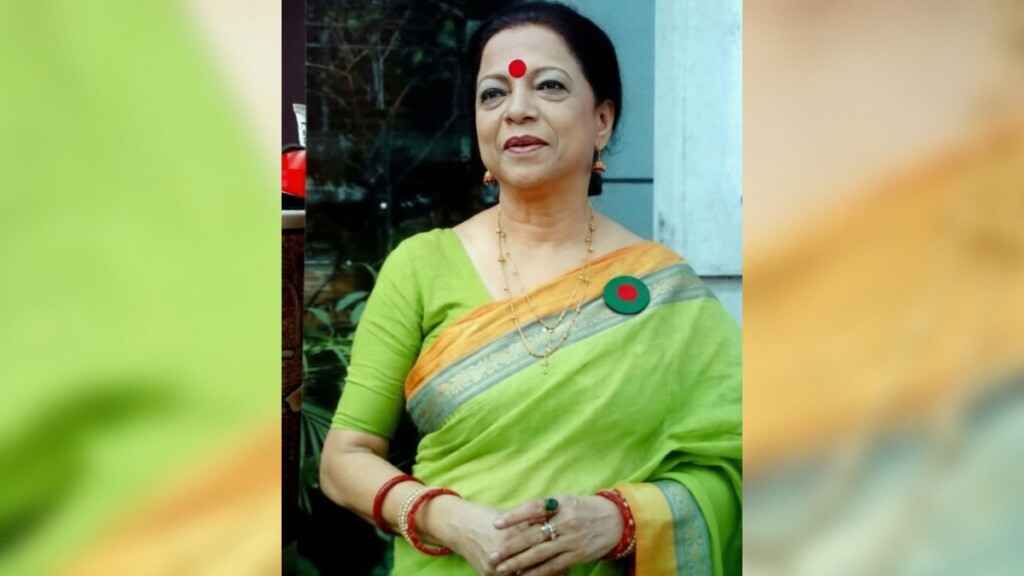
A remarkable fusion of music, struggle, and patriotism finds expression in the voice of Kalyani Ghosh. Raised in a culturally enriched environment from birth, this distinguished artist is not only a master of melody but also a courageous voice-soldier of our Great Liberation War.
She was born on 5 May 1946 in Rahmatganj, Chattogram. Her ancestral home is in Binajuri village of Rauzan Upazila. Nurtured under the affectionate care of her mother, Lilabati Chowdhury, she was introduced to music, dance, and acting at a very early age. Her father, Manomohan Chowdhury, was also a culturally minded individual, playing a significant role in shaping her artistic sensibilities.
Her academic life was equally impressive. After studying at Khastagir Government Girls’ High School, Chittagong Government College, and the University of Chittagong, she completed a Master’s degree in Bengali Literature. She later pursued studies in Library Science at the University of Dhaka. Her artistic career began in 1962 with her first musical performance on Chattogram Radio.
The year 1971 marked a bloody chapter in the history of Bengal. During that time, her voice from the Swadhin Bangla Betar Kendra became a source of inspiration for freedom fighters. Her songs not only boosted morale on the battlefield but also ignited the spirit of independence among countless people in refugee camps and across borders.
She was actively involved with the Bangladesh Muktijuddho Shilpi Sangstha, working alongside eminent cultural personalities such as Sanjida Khatun, Waheedul Haq, and Zahir Raihan. She also became a member of Ruma Guha Thakurta’s “Calcutta Youth Choir” in Kolkata, performing across various parts of India to uplift the spirits of freedom fighters.
Her brother, Bir Muktijoddha Prabal Chowdhury, and fellow artist Uma Khan stood beside her as co-performers. Together, their voices created a unique and powerful resonance during the Liberation War.
Even after independence, her contributions did not cease. For over 59 years, she has continued performing on Bangladesh Betar, television, and stage. In addition, she served the Bangla Academy with dedication for 32 years, retiring as Deputy Director. She has also made significant contributions to lexicography and various fields of literature and culture.
Her published works include Regional Songs of Chattogram, Patriotic Songs, Introduction to Bangladeshi Writers, Children’s Dictionary, and Biographical Dictionary, among others.
Honoured with numerous national and international awards, she received one of the country’s highest civilian honours—the Ekushey Padak—in 2024, a prestigious recognition of her lifelong contributions.
On this special day, we extend our deepest respect and heartfelt wishes to this legendary voice warrior. May her songs of liberation continue to inspire generations to come.
Happy Birthday.