The death toll from the powerful twin earthquakes that struck Venezuela has risen to 164, while at least 971 people have been injured, according to the country’s interim President, Delcy Rodríguez. Rescue teams continue to search through collapsed buildings and debris, raising fears that the number of casualties could increase further in the coming days.
The twin earthquakes, measuring 7.2 and 7.5 on the Richter scale, struck on Wednesday and are being described as among the most powerful seismic events to hit Venezuela in more than a century. The tremors were felt across large parts of the country and reportedly extended beyond Venezuela’s borders, causing alarm in neighbouring regions.
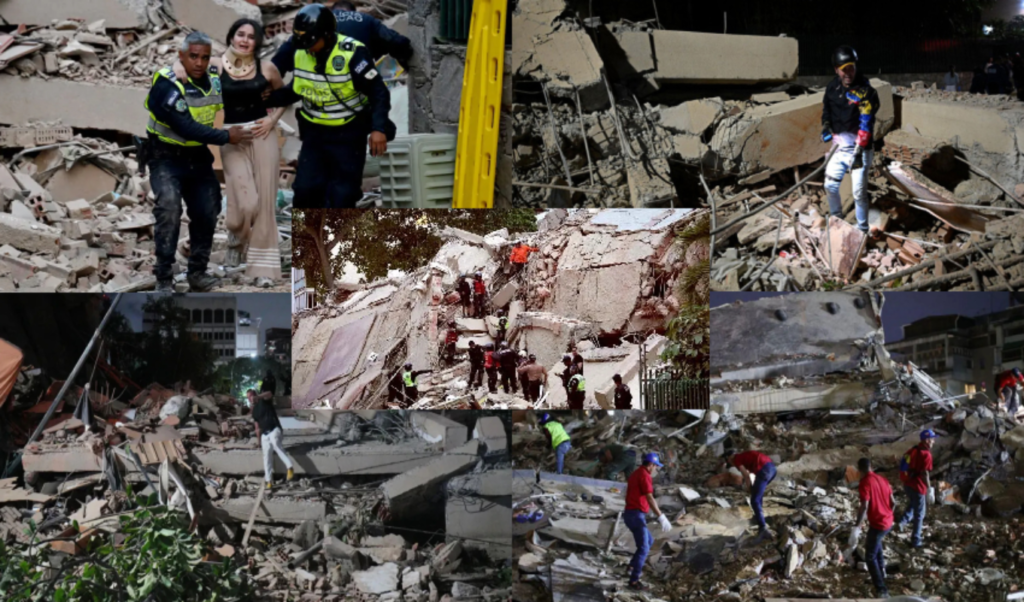
The worst-hit area has been La Guaira state, where extensive structural damage has been reported. Numerous residential and commercial buildings collapsed under the force of the earthquakes, leaving many people trapped beneath the rubble. Emergency services, military personnel and volunteers have been working around the clock in an effort to locate survivors and recover victims.
Interim President Rodríguez described the situation in the affected areas as a “disaster zone”, underscoring the scale of the destruction and the challenges facing rescue and recovery operations. Authorities have warned that casualty figures remain provisional, as many people are still believed to be missing and inaccessible beneath collapsed structures.
The earthquakes have caused widespread devastation across several regions, including the capital, Caracas, where damage to buildings and infrastructure has disrupted daily life. Roads, utility services and communication networks have been affected in some areas, complicating rescue efforts and the delivery of emergency assistance.
The disaster has triggered a large-scale humanitarian response. Emergency shelters have been established for displaced residents, while medical teams continue treating hundreds of injured people. Hospitals in some affected regions have reportedly come under significant pressure as the number of casualties has increased.
Venezuela is not typically regarded as one of the most seismically active countries in Latin America compared with nations located along the Pacific Ring of Fire. As a result, earthquakes of this magnitude are relatively rare, making the latest disaster particularly significant. Seismologists have noted that the combined impact of two major earthquakes occurring within a short period amplified the level of destruction.
Families across the country are anxiously awaiting news of missing relatives as rescue workers continue painstaking searches through damaged neighbourhoods. Heavy machinery is being used to clear debris in some locations, while specialised teams are conducting operations in areas where survivors may still be trapped.
The human cost of the disaster continues to unfold. Thousands of residents have been displaced from their homes, and many communities are struggling to cope with the aftermath of the powerful tremors. Authorities have urged citizens to remain vigilant and follow emergency guidance as aftershocks remain a possibility.
Key Figures From the Disaster
| Category | Number |
|---|---|
| Magnitude of first earthquake | 7.2 |
| Magnitude of second earthquake | 7.5 |
| Confirmed deaths | 164 |
| Confirmed injuries | 971 |
| Worst-affected state | La Guaira |
| Capital affected | Caracas |
| Earthquakes struck | Wednesday |
| Buildings damaged or collapsed | Numerous |
| Rescue operations | Ongoing |
| Missing persons | Still being assessed |
As search-and-rescue efforts continue, authorities remain focused on reaching those still trapped and providing support to affected communities. With many areas yet to be fully assessed, officials fear the final human toll from one of Venezuela’s strongest earthquakes in more than a century could be significantly higher.