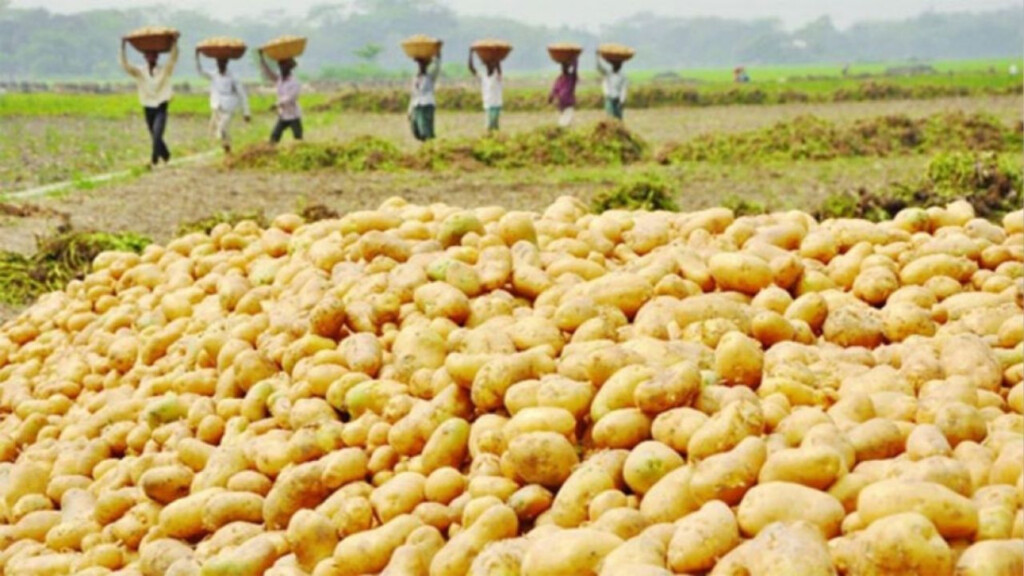
While the fields of Thakurgaon have yielded a “bumper” harvest this season, the agricultural abundance has brought nothing but financial ruin to local farmers. A catastrophic collapse in market prices has left growers unable to cover even the basic costs of harvesting, let alone their initial investments. In several pockets of the district, a 60kg sack of potatoes is currently failing to fetch even 200 BDT, translating to a staggering low of just over 3 BDT per kilogram.
From Bumper Harvest to Financial Ruin
On Tuesday morning, in the Nutanpara area of Begunbari Union, the gravity of the crisis was visible. Mansur Ali, a local farmer, cultivated the ‘Granula’ variety of potato on ten bighas of land. Despite hiring labourers to lift the crop, the bagged produce sits idle by the roadside; there are simply no wholesalers willing to buy.
“I spent approximately 40,000 BDT per bigha on fertilisers, seeds, pesticides, and irrigation,” Mansur explained. “At current rates, I won’t even recover 10,000 BDT. To make matters worse, wholesalers are demanding an extra 3kg per sack as a ‘bonus’ for taking the stock off our hands.”
Another farmer, Nurul Alam, noted that a premature blight caused the plants to wither early, resulting in smaller potatoes. This lack of size has further diminished their marketability, leaving farmers in a dilemma over whether to pay for cold storage or let the crop rot in the fields.
Market Dynamics and Infrastructure Gaps
The crisis is compounded by a severe lack of storage infrastructure. According to the Department of Agricultural Extension (DAE), the district’s production vastly exceeds its storage capacity.
With less than 21% of the total yield able to fit into cold storage, farmers are forced into “fire sales” at the farm gate. Wholesale traders, such as Rafiqul Islam, argue that the market is stagnant due to oversupply and the current political climate, which has dampened consumer demand during the month of Ramadan.
A Plea for Crop Diversification
Mazedul Islam, Deputy Director of the DAE in Thakurgaon, remarked that farmers had been advised to limit their potato acreage following last year’s volatility. However, the lure of potential profit led to over-cultivation. He urged farmers to consider “planned alternative cropping” in future seasons to avoid such market gluts and ensure long-term sustainability.