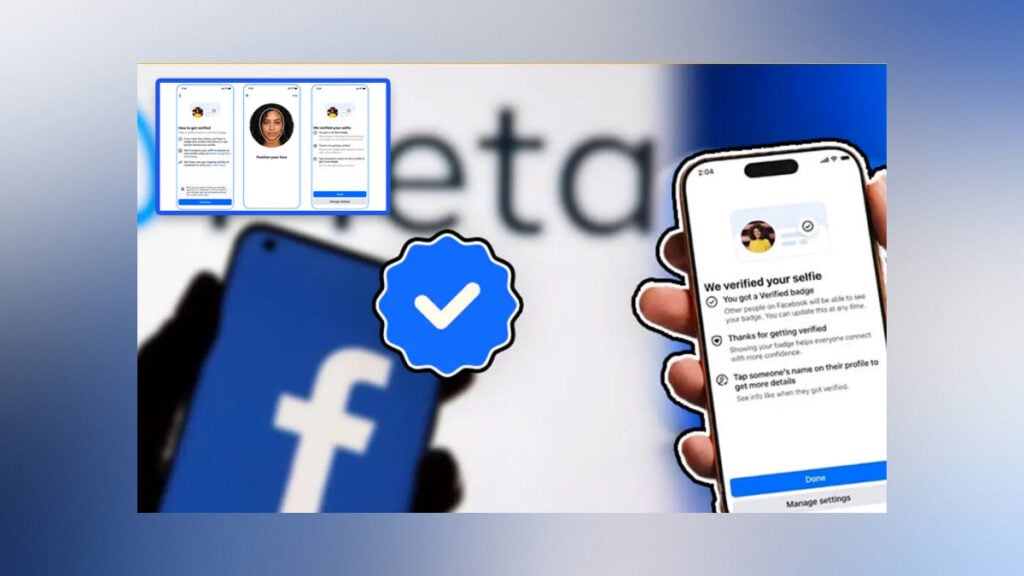
Facebook is preparing to introduce a free verification badge designed to help users distinguish genuine individuals from fake accounts, as the spread of artificial intelligence (AI)-generated profiles, images and videos raises growing concerns about online fraud and misinformation.
The initiative, reported by technology news outlet Engadget, is intended to strengthen identity verification on the social media platform. Under the proposed system, eligible users will be required to complete a video selfie verification process to establish that their profile represents a real person.
The move comes as advances in AI technology make it increasingly easy to create convincing fake identities and realistic-looking digital content. Such material can be used to impersonate individuals, mislead other users, spread false information and facilitate financial scams. Both individuals and organisations face growing risks from these forms of online deception.
Meta, Facebook’s parent company, is introducing the proposed badge as a separate offering from its existing subscription service, Meta Verified. Unlike the paid subscription, the new initiative is intended to provide ordinary users with a way to verify their identities without paying a fee.
How will Facebook’s free verification process work?
Under the proposed system, users will need to record a video selfie as part of the verification procedure. The video will be assessed against the photograph associated with the account to determine whether the person seeking verification matches the profile image.
Users who successfully complete the process may receive a verification badge on their Facebook profiles. According to the report, the badge could also be visible in other areas of the platform, including Marketplace, Groups and Facebook Dating.
The process is intended to offer users an additional indication that the person behind an account has undergone identity verification. This could prove useful when interacting with unfamiliar people, particularly in online communities and marketplace transactions where establishing someone’s identity can be difficult.
However, the badge should not be interpreted as a guarantee that an account holder is honest or that every interaction with them is safe. It indicates that an identity verification process has been completed; it does not establish a person’s intentions or guarantee their future behaviour.
Who will qualify for the free badge?
The proposed verification system will be subject to several eligibility requirements. Users will need to meet the age threshold, maintain an account in good standing and successfully complete the identity checks.
The principal requirements outlined in the report include:
Minimum age of 18: Users must be at least 18 years old to qualify for the free verification facility.
An account in good standing: The Facebook account must comply with the platform’s Community Standards. Accounts associated with serious or relevant policy violations may not qualify.
Successful identity verification: Users must complete the video selfie process successfully. If the system cannot establish a sufficient match between the video and the profile photograph, verification may not be granted.
No relevant history of fraudulent activity: Accounts associated with impersonation, deception or suspicious behaviour may be excluded from the programme.
These conditions are intended to help ensure that the badge serves its primary purpose: providing an additional means of identifying genuine account holders rather than simply rewarding users who request verification.
Who will not receive the verification badge?
Although the proposed facility is intended to be free, it will not initially be available to every type of Facebook account.
According to the report, the following categories will be excluded from the scheme:
- Users under 18: Anyone who has not reached the minimum age requirement will be ineligible.
- Facebook Page owners: The new verification facility is not currently intended for Facebook Pages.
- Profiles with Professional Mode enabled: Personal profiles operating with Professional Mode will not qualify under the reported arrangements.
- Accounts that violate platform policies: Accounts that breach Facebook’s Community Standards through fraud, deception or misleading activity may be refused verification.
- Accounts linked to false identities: Users whose accounts contain evidence of impersonation or other identity-related irregularities may fail the eligibility checks.
- Users who fail the video selfie check: If the video selfie does not sufficiently match the profile photograph, the identity verification process may be unsuccessful.
These exclusions mean that users should not assume that every personal profile, creator account or business presence will automatically become eligible once the feature is introduced.
How is the new badge different from Meta Verified?
Meta already operates a subscription-based verification service known as Meta Verified. The proposed free Facebook verification badge is intended to serve a different purpose and audience.
Meta Verified is a paid subscription product that offers verification-related benefits to eligible subscribers. The new initiative, by contrast, is intended to make identity verification accessible to ordinary Facebook users without requiring a subscription fee.
The two services should not be treated as interchangeable. Receiving the free badge would not necessarily provide access to all the benefits associated with Meta Verified, and the eligibility criteria and verification arrangements may differ.
For users who simply want an additional indication that an account has undergone identity checks, the proposed free option could offer an alternative to a paid subscription. Its practical value, however, will depend on how the feature is implemented and how widely it becomes available.
Why identity verification matters in the age of AI
AI-generated images, synthetic videos and convincing digital identities have made it harder for internet users to determine whether the content they encounter is authentic. Fake profiles can imitate real people, while fabricated images and videos can make misleading claims appear credible.
These techniques can be exploited in a range of ways, from impersonating friends and relatives to promoting fraudulent offers and circulating misinformation. In some cases, scammers use a familiar person’s name and photograph to persuade victims to transfer money or disclose sensitive information.
A verification badge could help users make more informed decisions about whom they interact with. It may also provide an additional layer of reassurance in online spaces where people regularly communicate with strangers.
Nevertheless, identity verification is only one part of the wider challenge of online safety. A genuine account can still share misleading information, fall victim to hacking or be used for fraudulent purposes. Likewise, a verified identity does not automatically establish that a seller, buyer or potential contact can be trusted.
Users should therefore continue to exercise caution when making payments, sharing personal information or responding to urgent requests for money. Where a friend or relative appears to be asking for financial assistance through Facebook, confirming the request through another trusted communication channel can help prevent impersonation scams.
When will the feature become available?
Meta is expected to introduce the free verification feature gradually, beginning with selected countries before considering a wider international rollout.
However, the report does not specify which countries will receive access first or provide a confirmed timetable for availability in other markets. It is therefore not possible to establish when users in Bangladesh or elsewhere will be able to apply.
Until the feature becomes available in a user’s account, eligibility requirements and application instructions should be checked through Facebook’s official in-app announcements and guidance.
The proposed initiative represents a potential step towards improving identity transparency on social media. As AI tools continue to make fake profiles and manipulated content more convincing, accessible verification systems could help users assess online identities with greater confidence.
Their effectiveness will ultimately depend on the accuracy of the verification process, the platform’s ability to detect misuse and users’ understanding of what a badge does—and does not—mean. A free verification badge may offer useful reassurance, but remaining alert to suspicious behaviour will continue to be essential for anyone using Facebook.