Bangladesh’s National Poet, Kazi Nazrul Islam, is being remembered today on the 50th anniversary of his death. The poet died in Dhaka on 12 Bhadra 1383 in the Bengali calendar, bringing to an end the life of one of Bengal’s most influential literary figures. Five decades after his death, his poetry and songs continue to speak powerfully against injustice, exploitation, oppression and social inequality.
Nazrul died at the then Postgraduate Medical Hospital in Dhaka, now known as Bangabandhu Sheikh Mujib Medical University. He was later laid to rest beside the Central Mosque on the Dhaka University campus, a location that has since become an important place of remembrance for admirers of his work.
Born on 24 May 1899, corresponding to 11 Jaistha 1306 in the Bengali calendar, in the village of Churulia in what was then Burdwan district of West Bengal, Nazrul grew up amid severe financial hardship. His early life was marked by poverty and struggle, yet those circumstances did not prevent him from developing into a remarkably versatile writer, musician and cultural figure.
Nazrul’s creative career lasted only around 23 years, but within that relatively short period he made a lasting contribution to Bengali literature and music. He wrote poetry, fiction, plays and essays, while also producing a vast body of songs, including ghazals, Islamic devotional music, Shyama Sangeet and other forms. His work brought together different strands of Bengali cultural life and gave expression to themes of freedom, equality, love, human dignity and communal harmony.
His reputation as the ‘Rebel Poet’ emerged from his uncompromising literary voice. Nazrul repeatedly challenged oppression and social injustice, giving literary form to the aspirations of people seeking freedom from exploitation and discrimination. His writings were not confined to the world of literature. He was also involved in the political and anti-colonial currents of his time, and his activism eventually brought him into conflict with the colonial authorities.
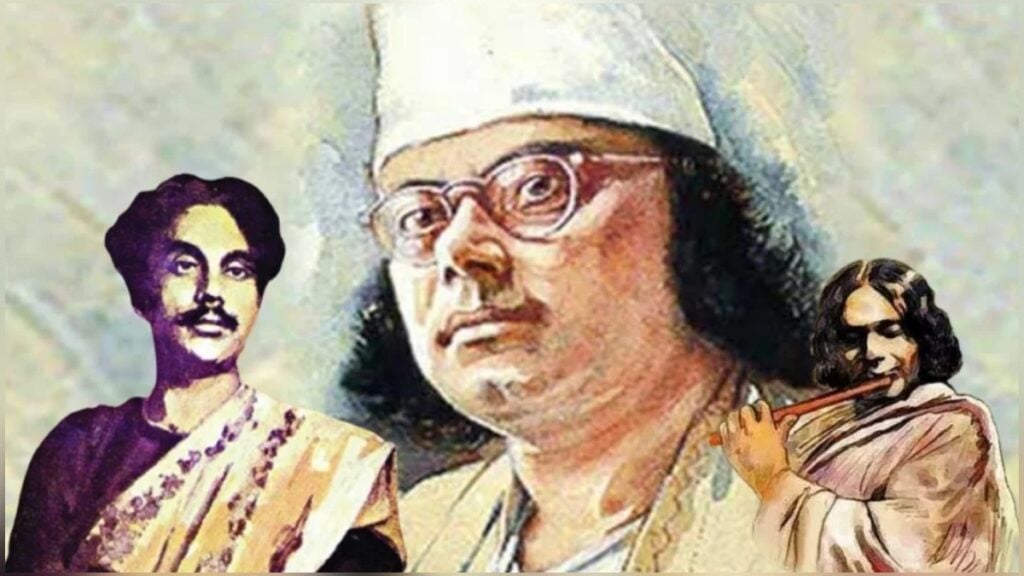
The duality of Nazrul’s artistic identity is reflected in his own famous imagery of holding a flute in one hand and a war trumpet in the other. His work could be intensely lyrical and romantic, yet it could also carry a forceful call for resistance and liberation. That range helped establish him as a distinctive figure in Bengali cultural history.
Nazrul’s connection with Bangladesh took on a new significance after the country achieved independence in 1971. With permission from the Government of India, he was brought to Bangladesh with his family on 24 May 1972. He was subsequently recognised as the country’s National Poet, and arrangements were made for him to live in Dhaka, including a residence in Dhanmondi.
The poet’s contribution was formally recognised by Dhaka University in 1974, when the institution awarded him an honorary Doctor of Letters degree. In 1976, the Government of Bangladesh granted him citizenship of the country. He was also awarded the Ekushey Padak on 21 February that year.
Nazrul’s later years were overshadowed by serious health difficulties, which prevented him from continuing his literary activities in the way he had earlier done. Even so, his existing body of work continued to circulate widely and became an enduring part of Bengali literature, music and cultural life.
His death anniversary therefore remains more than a ceremonial occasion. For generations of readers and listeners, Nazrul’s works have provided a language for confronting injustice while also celebrating love, humanity and cultural diversity. His songs remain widely performed, while his poetry continues to be studied and recited across Bangladesh and beyond.
Dhaka University has once again arranged programmes to mark the anniversary. On the morning of 12 Bhadra, teachers, students, officers and employees of the university are scheduled to take part in a procession from the foot of Aparajeyo Bangla to Nazrul’s grave. After floral tributes and the recitation of Fateha, a discussion meeting will be held at the graveside.
Fifty years after his death, Nazrul’s physical presence may be gone, but his literary voice remains firmly rooted in Bengali culture. His enduring appeal lies in the breadth of his creativity and, above all, in his insistence that literature and music can speak for freedom, equality and human dignity.