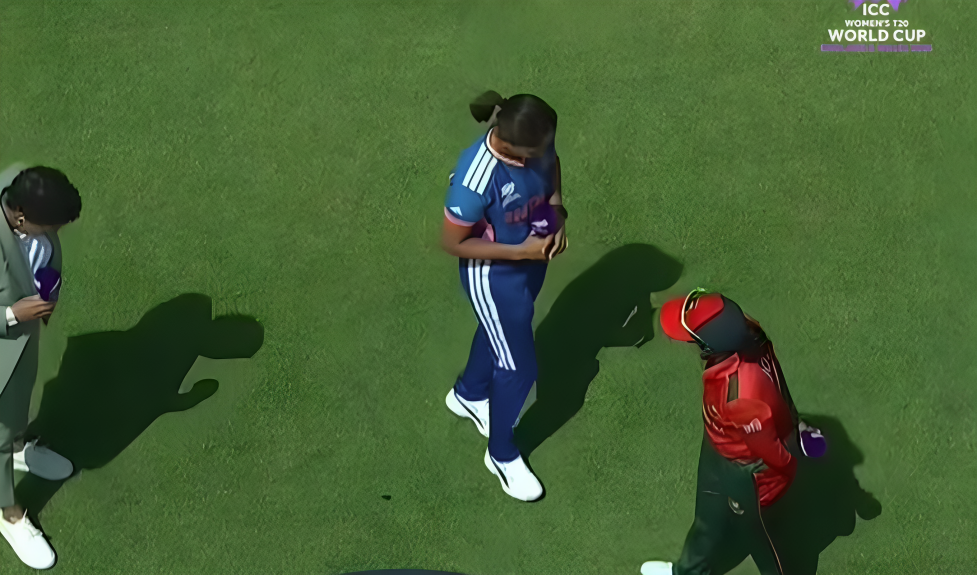
A familiar pre-match moment once again drew attention before a crucial Bangladesh-India encounter, as Bangladesh captain Nigar Sultana Joty and India captain Harmanpreet Kaur did not exchange a handshake during the toss ahead of their Women’s T20 World Cup match in Manchester.
The incident echoed a similar episode from January this year during the ICC Under-19 World Cup in Bulawayo, where Bangladesh captain Jawad Abrar and India captain Ayush Mhatre also did not shake hands during the toss ceremony. The latest occurrence quickly became a talking point among cricket followers, particularly given the importance of the match and the long-standing sporting rivalry between the two neighbouring nations.
At the toss, Harmanpreet Kaur flipped the coin, with Joty winning and opting to bat first. While a handshake between captains is a customary gesture before international matches, television footage showed that the ritual did not take place on this occasion. Neither team made any official comment regarding the matter.
The match itself carried significant implications for Bangladesh’s hopes of reaching the semi-finals. Entering the contest, Bangladesh needed victories in their remaining group-stage matches to strengthen their chances of progressing to the knockout stage. Any defeat would leave their qualification hopes dependent on a complex combination of results and net run rate calculations.
After choosing to bat, Bangladesh once again struggled to produce a commanding total, posting 136 for eight from their allotted 20 overs. The innings showed flashes of promise but ultimately lacked the momentum required to put India under substantial pressure.
Bangladesh suffered an early setback when opener Dilara Akter was dismissed for four runs with just eight runs on the board. India’s Renuka Singh struck in the second over to break the opening partnership and hand her side an early advantage.
The most productive period of Bangladesh’s innings came through a 51-run partnership between Juwairiya Ferdous and Sobhana Mostary. The pair added valuable runs for the second wicket, stabilising the innings after the early loss. Their stand, which came from 42 deliveries, proved to be Bangladesh’s highest partnership of the match.
However, regular wickets prevented the innings from gaining sustained momentum. A collapse in the latter stages proved particularly costly, with Bangladesh losing four wickets for just 14 runs as the fifth to eighth wickets fell in quick succession.
Juwairiya top-scored with 33 runs from 31 deliveries, striking five boundaries during her innings. Captain Nigar Sultana contributed 32 runs, making her the second-highest scorer for Bangladesh.
India’s bowling attack maintained pressure throughout the innings. Left-arm spinner Radha Yadav was the standout performer, claiming three wickets for 28 runs from her four overs and playing a key role in restricting Bangladesh to a below-par total.
The Group One standings underline the importance of the contest. Australia lead the group with eight points and have already established themselves as the dominant side. India, South Africa and Bangladesh each entered the round with four points from three matches, but net run rate separated the teams.
| Team | Matches | Points | Net Run Rate |
|---|---|---|---|
| Australia | 4 | 8 | – |
| India | 3 | 4 | +2.511 |
| South Africa | 3 | 4 | -0.546 |
| Bangladesh | 3 | 4 | -0.641 |
| Pakistan | 3 | 0 | – |
| Netherlands | 3 | 0 | – |
Pakistan and the Netherlands, both without a point after three matches, had already been eliminated from semi-final contention. The top two teams from each group will advance to the tournament’s semi-finals.
For Bangladesh, the challenge remains straightforward but demanding: win and stay firmly in contention. Anything less risks leaving their World Cup ambitions dependent on mathematics rather than performances on the field. The pre-match handshake may have attracted headlines, but it was the battle for a semi-final place that ultimately carried the greatest significance in Manchester.