Published: 15 Mar 2026, 01:50 pm

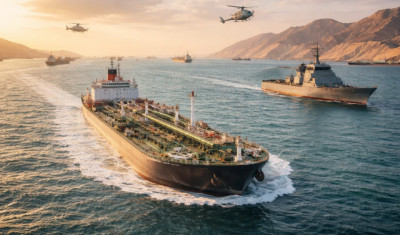
Japan has indicated that it is unlikely to dispatch naval warships to the strategically vital Strait of Hormuz to protect oil tankers, citing legal constraints and longstanding constitutional limitations on the use of military force abroad. The position underscores Tokyo’s cautious approach to security issues in the Middle East despite growing calls from its allies to help safeguard one of the world’s most critical energy transit routes.
The Strait of Hormuz, located between Iran and Oman, serves as the principal maritime passage linking the Persian Gulf to the Arabian Sea and the wider global shipping network. A substantial portion of the world’s crude oil and liquefied natural gas shipments passes through the narrow channel each day, making it one of the most geopolitically sensitive waterways in the international energy system.
Takayuki Kobayashi, policy chief of Japan’s ruling Liberal Democratic Party, acknowledged that the government faces significant legal barriers in considering any direct naval deployment. Speaking in a broadcast interview with Japan’s public broadcaster NHK, Kobayashi explained that current Japanese legislation sets extremely strict criteria for sending naval vessels into areas where tensions are high or conflict may occur.
He noted that while the possibility cannot be entirely ruled out under Japanese law, any such move would require careful deliberation and adherence to stringent legal standards. According to Kobayashi, the present regional tensions mean that Tokyo must proceed with exceptional caution before making decisions involving military assets abroad.
The remarks come after United States President Donald Trump urged allied nations, including Japan, to take greater responsibility for protecting their own commercial vessels operating in the Gulf region. Washington has repeatedly called for international partners to contribute to maritime security efforts in the Strait of Hormuz amid concerns about attacks on tankers and escalating tensions involving regional powers.
Japan, however, remains constrained by its post-war constitution, particularly Article Nine, which renounces war and restricts the country’s ability to maintain military forces for offensive purposes. Although Japan maintains Self-Defence Forces capable of conducting limited operations, deployments to overseas conflict zones are subject to strict legal interpretation and parliamentary oversight.
These constitutional principles have shaped Japan’s security policy for decades, encouraging the country to prioritise diplomacy, economic engagement and international cooperation rather than direct military involvement in overseas disputes.
The strategic importance of the Strait of Hormuz highlights why the issue has attracted global attention. Key statistics illustrating the significance of the waterway are presented below.
| Category | Details |
|---|---|
| Location | Between Iran and Oman, connecting the Persian Gulf to the Arabian Sea |
| Approximate Length | Around 160 kilometres |
| Narrowest Width | Roughly 33 kilometres |
| Share of Global Oil Trade | About 20 percent of global petroleum consumption transported daily |
| Key Exporters Using Route | Saudi Arabia, Iraq, Kuwait, United Arab Emirates, and Iran |
| Major Importers | China, Japan, India, South Korea, and European states |
Japan is among the countries most dependent on Middle Eastern energy supplies. A large share of its crude oil imports originates from Gulf producers and is transported through the Strait of Hormuz. Any disruption to the shipping lane could therefore have significant consequences for Japan’s energy security and broader economy.
Despite this dependence, Japanese policymakers have consistently favoured a restrained security posture. Analysts suggest that Tokyo is likely to continue supporting maritime safety through diplomatic engagement, intelligence cooperation and possible non-combat logistical support rather than direct naval patrols in the region.
For now, Japan appears determined to maintain its cautious stance, balancing its alliance obligations with the United States against the legal and constitutional constraints that shape its defence policy. The government’s approach reflects a broader strategy aimed at avoiding direct military entanglement while still safeguarding the economic interests tied to the uninterrupted flow of energy through the Strait of Hormuz.

> Unified Social Safety Net Initiative Announced
> Opposition MP Criticises Parliamentary Audio System
> Juthi Akhi Releases Two Festive Eid Songs
> Corporate Tax Return Deadline Extended by One Month
> Pooja Cherry Confirms Engagement and Personal Priorities
> Golmaal 5 Sparks Fresh Bollywood Excitement
> Sujan’s Journey: Lessons from True Mentors
> MetLife Bangladesh and GP Join Forces Nationwide
> IMF Pledges Continued Support to Bangladesh
> Iran Conditions Hormuz Passage on Chinese Yuan
> Kings Surge Ahead with Victory Over Fortis
> U.S. Military Refuelling Aircraft Crash in Iraq


One of Bollywood’s most beloved comedy franchises is preparing for a vibrant return as filmmaker Roh...

Authorities in Iran have announced the arrest of twenty individuals in the country’s north-western r...

For more than two decades, Canadian singer and songwriter Avril Lavigne has remained a significant f...

Despite escalating conflict across parts of the Middle East and calls to postpone the fixture, Iraq’...

Recent scientific research suggests that the length of a day on Earth is gradually increasing as the...

British singer‑songwriter Sienna Spiro has unveiled her latest single, The Visitor, via Capitol Reco...

Israeli authorities reported on Sunday that multiple ballistic missiles were launched from Iranian t...

The intensifying confrontation between the United States, Israel, and Iran is testing the resilience...
The United States has launched a $20 billion government-backed maritime reinsurance programme to sec...

Arsenal midfielder Max Dowman has made history by becoming the youngest goalscorer in Premier League...

In a recent telephone interview with NBC, United States President Donald Trump asserted that while I...

The recent Israeli military strikes in Lebanon have claimed the lives of at least 826 people, the Le...


Availabe for iphone & ipads

Available in google play
 বাংলা
বাংলা