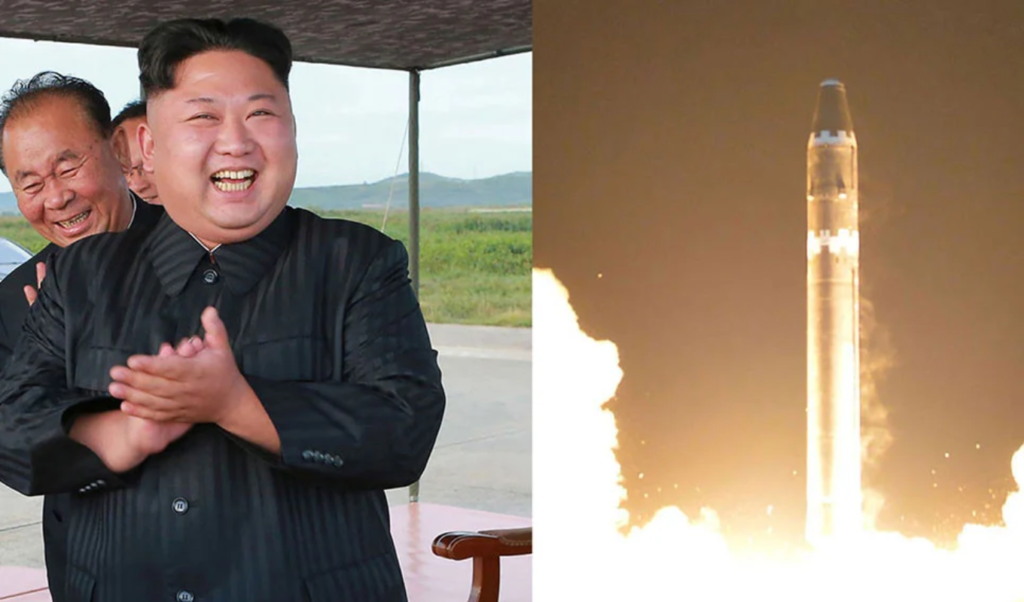
North Korea has successfully conducted the experimental test-firing of its first-ever cruise missiles integrated with artificial intelligence (AI) technology. The state-run Korean Central News Agency (KCNA) confirmed on Wednesday, 27 May 2026, that the high-profile military launch was executed under the direct personal supervision of the country’s supreme leader, Kim Jong-un.
According to the official dispatch issued by KCNA, the weapons trials took place on Tuesday, 26 May 2026. The comprehensive military exercise involved the successful test-firing of tactical ballistic missiles, advanced artillery rockets, and the newly developed AI-driven precision cruise missiles.
Technical Performance and Project Objectives
Following the conclusion of the weapons testing, Kim Jong-un expressed his formal satisfaction with the performance parameters of the hardware. The supreme leader verified that the AI-guided precision cruise missiles successfully engaged and neutralised simulated targets positioned up to 100 kilometres away.
KCNA detailed that these advanced weapon systems were engineered under the auspices of the state’s proprietary “Special Mission Warhead” project. The primary objective of Tuesday’s live-fire launches was to rigorously evaluate the explosive yield, structural durability, and pinpoint terminal guidance capabilities of the automated guidance systems under realistic operational conditions.
Strategic Modernisation and Border Force Deployment
The integration of artificial intelligence into North Korea’s conventional cruise missile inventory marks a significant shift in the country’s defence acquisition strategy. Having previously demonstrated substantial advancements in long-range intercontinental ballistic missiles (ICBMs) and nuclear delivery systems, Pyongyang has pivoted toward modernising its short-range tactical and conventional arsenals.
| Missile Classification | Guidance Mechanism | Maximum Target Range | Strategic Deployment Zone |
| Tactical Ballistic Missile | Inertial / Satellite | Classified | Inter-Korean Border Sector |
| Precision Cruise Missile | Artificial Intelligence | 100 Kilometres | Inter-Korean Border Sector |
| Advanced Artillery Rocket | Unguided / Precision | Multi-range | Inter-Korean Border Sector |
In conjunction with the successful test-firing, the Pyongyang administration officially announced its strategic intention to mass-produce these newly vetted modern weapons systems. The state plans to deploy these advanced assets along its frontline military installations located in close proximity to the heavily fortified border shared with South Korea.
Nuclear Expansion Warnings Directed at Washington
The latest weapons demonstration follows a series of policy statements delivered by Kim Jong-un regarding North Korea’s overarching strategic doctrine. The supreme leader recently reiterated his administration’s commitment to aggressively expanding the country’s sovereign nuclear weapons inventory and widening its global operational reach.
Korean Central News Agency: “The supreme leader has made clear our unwavering intent to continuously reinforce our nuclear deterrence capabilities. The United States must fully recognise, adapt to, and respect the undeniable reality of our advanced nuclear statehood, rather than pursuing obsolete policies of isolation and confrontation.”
International defence analysts note that the introduction of AI-driven precision cruise missiles is specifically timed to project technological parity in regional military dynamics. By placing these low-altitude, radar-evading autonomous weapons near the demilitarised zone, Pyongyang intends to enhance its tactical battlefield superiority and increase the complexity of regional missile defence frameworks currently operated by joint US-South Korean command structures.