Published: 03 Mar 2026, 07:02 am

Stargazers across Bangladesh and the wider world are set to witness a breathtaking celestial phenomenon today, Tuesday, 3 March. A total lunar eclipse will grace the night sky, transforming the moon into a striking crimson orb—a spectacle popularly known as a "Blood Moon." This event is of particular significance as it marks the only total lunar eclipse occurring in 2026.
According to a press release from the Inter-Services Public Relations (ISPR), those who miss today's event will have to wait until late 2028 to witness a similar total eclipse. The rarity of the event has prompted significant interest among both amateur astronomers and the general public, providing a brief moment of cosmic wonder amidst a tumultuous global news cycle.
A total lunar eclipse occurs when the Earth aligns perfectly between the Sun and the Moon, casting its shadow across the lunar surface. While the Earth completely blocks direct sunlight, the Moon does not vanish into darkness. Instead, it assumes a copper-red hue.
This vivid coloration is caused by Rayleigh scattering—the same atmospheric effect that makes sunsets appear red. As sunlight passes through the Earth’s atmosphere, shorter blue wavelengths are scattered away, while longer red wavelengths are refracted around the edges of the planet and onto the Moon. The intensity of the red can vary depending on the amount of dust and clouds in the Earth's atmosphere at the time of the eclipse.
The ISPR has provided a precise schedule for the eclipse stages. While the initial penumbral phase begins in the afternoon, the most dramatic visual changes will occur as the sun sets and the moon rises.
| Phase of Eclipse | Time (Bangladesh Standard Time) |
|---|---|
| Penumbral Phase Begins | 14:42:36 |
| Partial Eclipse Begins | 15:52:12 |
| Total Eclipse Begins | 17:03:54 |
| Maximum (Greatest) Eclipse | 17:33:42 |
| Total Eclipse Ends | 18:03:30 |
| Magnitude of Eclipse | 1.115 |
Unlike solar eclipses, which require specialised eye protection, a lunar eclipse is perfectly safe to view with the naked eye. For the best experience, observers in Bangladesh are advised to find a location with a clear view of the eastern horizon. While binoculars or a small telescope will enhance the view of the lunar craters bathed in red light, the sheer scale of the event makes it visible to anyone with a clear sky.
With the next total eclipse not scheduled until 31 December 2028, tonight offers a final opportunity for several years to witness the Moon's dramatic transformation into a "Blood Moon."

> Rio Ferdinand Converts Dubai Studio Into Wartime Bunker
> Selena Gomez Confirms Taylor Swift Wrote Songs About Her
> Central Zone Dominate Lacklustre BCL One-Day Final
> Crop Insurance: A Safety Net for Farmers?
> Mojtaba Khamenei Ascends as Iran’s New Supreme Leader
> Tehran Claims Major US Casualties as Carrier Retreats
> China Vows Support for Iranian Sovereignty Amid Conflict
> Two Years Ago, Iqra Found Out that Alvi was Involved with Another Woman
> Tariq Ramadan Faces Rape Trial in Paris
> UCB and EY Forge Strategic Sustainability Partnership
> Violence Erupts at Dhaka Polytechnic Between Student Factions
> Celestial Spectacle: Rare Total Lunar Eclipse Visible Today


In a final that failed to live up to the high-stakes drama expected of a title decider, Central Zone...
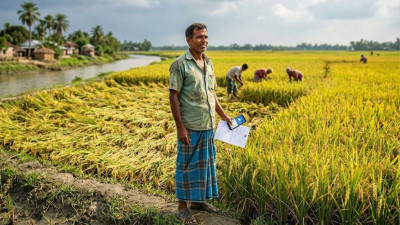
In the volatile landscape of modern agriculture, Bangladeshi farmers find themselves on the front li...

A fleet of Bangladeshi merchant vessels is currently navigating a perilous security crisis near the...
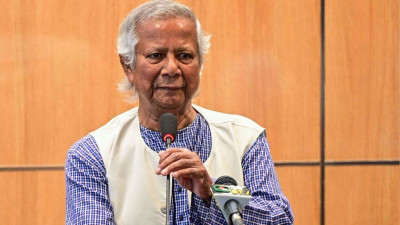
A significant controversy has emerged regarding the post-tenure security arrangements for Professor...

In the heart of Old Dhaka, flanking the banks of the Buriganga River, lies the century-old Badamtali...

In a significant shift within Bangladesh’s premier graft-fighting agency, the Chairman of the Anti-C...
In a significant policy pivot aimed at bolstering the private sector, Bangladesh Bank has announced...

In a significant move toward financial transparency, the Bangladesh Financial Intelligence Unit (BFI...
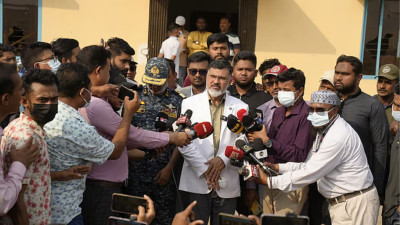
The Dhaka North City Corporation (DNCC) has announced that its ambitious waste-to-energy project rem...

In Sirajganj’s Ullapara area, a mobile court has sentenced two local YouTubers to one month in priso...
Popular singer and BCB director Asif Akbar has formally declared his innocence in a case filed under...
_1772550570.jpg)
Passengers travelling by metro rail and long-distance trains will now be eligible for a 25% fare dis...


Availabe for iphone & ipads

Available in google play
 বাংলা
বাংলা