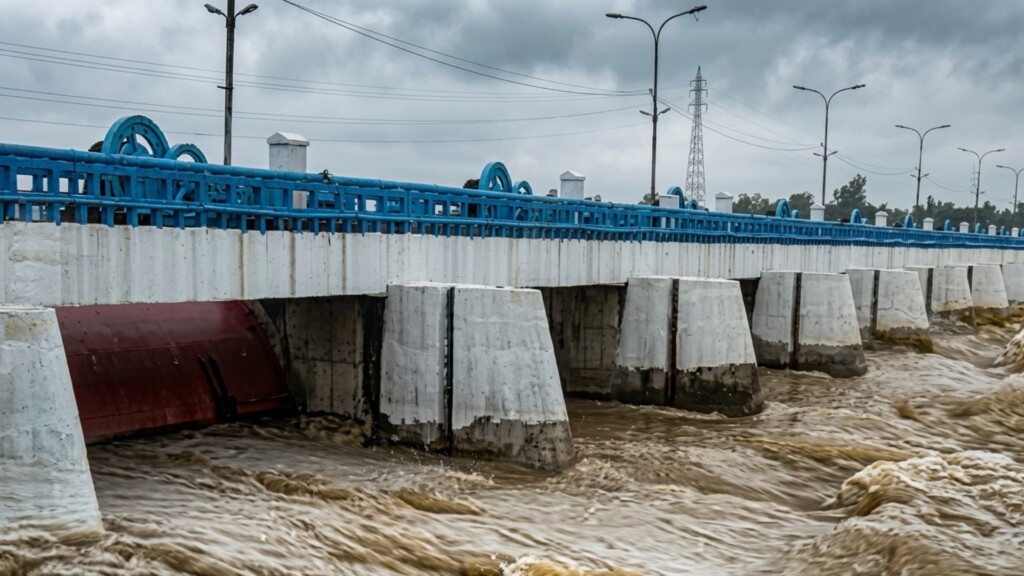
Persistent heavy to very heavy rainfall since Tuesday has significantly heightened the risk of flooding across at least five districts, with early inundation already reported in low-lying areas of Moulvibazar and Netrokona. The Flood Forecasting and Warning Centre (FFWC), operating under the Bangladesh Water Development Board, has warned that Sylhet, Habiganj, and Sunamganj may also face flooding as river levels continue to rise steadily.
Officials at the FFWC confirmed on Wednesday morning that continuous rainfall has led to a sharp increase in water levels across multiple river basins, particularly in the north-eastern region. Sub-Divisional Engineer Partha Pratim Barua stated that low-lying floodplains in the affected districts are highly vulnerable under the current conditions. Flooding has already begun in parts of Moulvibazar and Netrokona, raising concerns about further deterioration if rainfall persists.
The Meteorological Department had earlier issued a forecast predicting heavy to very heavy rainfall across all eight divisions over a 96-hour period. Observations indicate that rainfall intensified overnight and has continued intermittently in various regions, including the capital.
Rainfall statistics over the past 24 hours highlight the severity of the situation:
| Location | Recorded Rainfall (mm) |
|---|---|
| Nikli, Kishoreganj | 161 |
| Bhola | 151 |
| Feni | 148 |
Meteorologist Muhammad Abul Kalam Mallick explained that rainfall is unlikely to remain constant in any single area but will occur intermittently across different regions. However, the overall weather pattern suggests that wet conditions may persist until at least 4 May.
Meanwhile, water levels in four rivers—the Bhugai-Kangsha, Manu, Someshwari, and Mogra—are currently flowing above their designated danger levels. With the exception of the Manu River, the others pass through Netrokona district, making the area particularly susceptible to flooding. Additionally, water levels in the Surma and Kushiyara rivers have risen by more than one to one and a half metres, further increasing the risk of overflow into adjacent floodplains.
Hydrological experts attribute the rapid rise in water levels to the relatively small capacity of these river systems, which respond quickly to intense rainfall. When precipitation is heavy, water accumulates rapidly, often exceeding river channel capacity within a short time.
Authorities have indicated that any improvement in the flood situation will depend largely on a significant reduction in rainfall. Until then, monitoring efforts will continue, and residents in vulnerable areas have been advised to remain alert and prepared for possible further flooding.