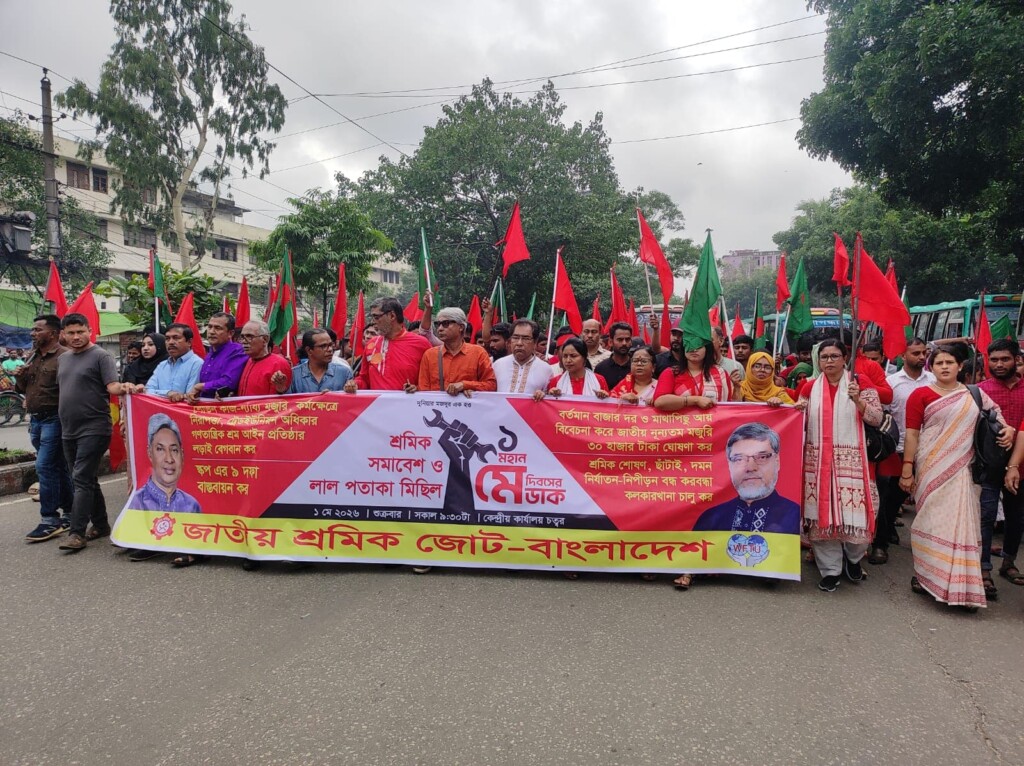
On the occasion of International Workers’ Day, May 1, 2026 (Friday), the central committee of the Jatiya Sramik Jot–Bangladesh organized a large workers’ rally at 10:00 AM at Bangabandhu Avenue in the capital. Following the rally, a colorful red flag procession was held.
Thousands of workers and employees from various factories and informal sectors participated in the event, led by different basic unions and craft federations. After the rally, the procession marched through major roads including Bangabandhu Avenue, Gulistan, Paltan, and Topkhana, eventually joining a gathering organized by the Workers-Employees Unity Council in front of the National Press Club.
The rally was presided over by the President of the labor alliance, freedom fighter Saifuzzaman Badsha, and conducted by Organizational Secretary Kanak Barman.
Speakers at the event included General Secretary Noimul Ahsan Jewel. A solidarity speech was delivered by Shafiuddin Molla, Vice President of Jatiya Samajtantrik Dal (JASAD). Other speakers included Vice President Abdur Razzak, President of Youth Alliance Shariful Kabir Swapan, Office Secretary of JASAD Sajjad Hossain, President of Garments Workers Alliance Sardar Khorshed, Assistant Organizational Secretary Shahin Akter Parvin, President of Transport Hawkers Alliance Mohammad Ali, Office Secretary Rajib Ahmed, International Affairs Secretary Monirul Kabir Milon, General Secretary of Garments Industry Workers Alliance Sheikh Shahnaz, General Secretary of Garments Workers Alliance Abdus Salam, Vice President Shirin Sikdar, President of Bookbinding Workers Alliance Jamil Bhuiyan, Decorators Workers leader Md. Alam Khan, and President of Bangladesh Disabled Working People Development Alliance Md. Alamgir Hossain, among others.
In their speeches, the leaders demanded an end to factory closures and worker layoffs, ensuring job security for workers. They also called for the formation of a National Wage Board and sector-wise wage boards to declare a minimum national wage of 30,000 taka in line with market prices. Additionally, they demanded the removal of legal barriers to forming trade unions in all factories and workplaces, ensuring decent and safe working conditions, and implementation of the nine-point demands of SCOP.