The United States is reportedly considering fresh military action against Iran, prompting Tehran to issue a stark warning of “long-term painful” retaliation against American installations across the Middle East. The escalating rhetoric comes amid an unresolved confrontation involving Iran, the United States, and Israel, which has already severely disrupted global energy flows and heightened fears of a wider regional conflict.
According to reports, former US President Donald Trump is expected to be briefed on potential new military options targeting Iran. The proposed strategy is intended to pressure Tehran into ending hostilities and returning to negotiations. Some officials suggest the plans include a series of limited but sustained strikes aimed at degrading Iran’s military capabilities.
Tehran, however, has responded defiantly. A senior commander of Iran’s Islamic Revolutionary Guard Corps warned that any renewed US attack would trigger prolonged retaliatory operations against American bases in the region. Iranian military officials have also suggested that US naval assets could be targeted if hostilities resume.
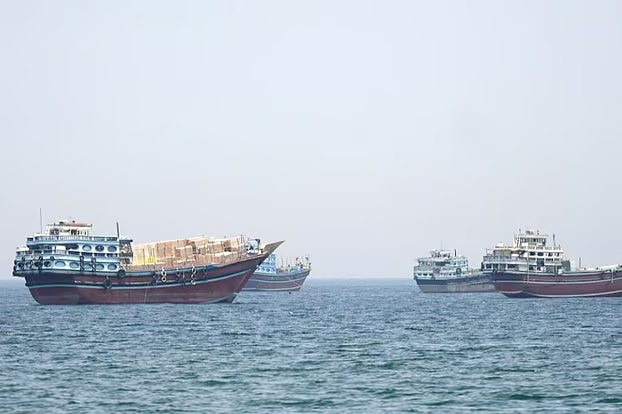
At the centre of the confrontation remains the Strait of Hormuz, a vital maritime chokepoint through which nearly one-fifth of the world’s oil and gas supplies pass. Although a ceasefire has been in place since early April, Iran has effectively maintained restrictions on maritime traffic, citing ongoing US naval pressure on its energy exports.
The resulting disruption has driven volatility in global energy markets, with Brent crude briefly surging above $120 per barrel before easing slightly. Economists warn that prolonged instability in the region could accelerate inflation and deepen global economic uncertainty.
Key Positions in the Escalation
| Actor | Position | Recent Development |
|---|---|---|
| United States | Considering new strikes | Military options under review for Trump briefing |
| Iran | Threatens retaliation | Warns of attacks on US bases if struck again |
| Islamic Revolutionary Guard Corps | Military escalation stance | Promises “painful long-term” response |
| United Nations | Warns of global impact | Alerts to inflation and growth risks |
| Mediators (Pakistan) | Diplomatic channel | Facilitating indirect US–Iran communication |
Iran’s Supreme Leader Ayatollah Mojtaba Khamenei has reiterated that the country will safeguard the Strait of Hormuz under a revised security framework, signalling an intention to maintain strict control over the strategic waterway. He emphasised that external forces travelling thousands of miles “have no place except beneath the sea”, a remark widely interpreted as a warning to foreign naval presence.
Meanwhile, the United Nations Secretary-General António Guterres has cautioned that prolonged disruption of maritime traffic through the strait could significantly damage global economic growth, increase inflation, and push millions into poverty. He described the waterway as an “artery of global trade” whose closure would have compounding long-term consequences.
Domestically in the United States, legal and political constraints are also shaping the debate. Under the War Powers Resolution of 1973, the 60-day limit on unilateral presidential military action without congressional approval is due to expire. However, administration officials argue that the April ceasefire may legally constitute an end to hostilities, potentially resetting the clock.
Despite intensified rhetoric, analysts remain sceptical that economic pressure alone will force rapid Iranian concessions. While sanctions and conflict have strained Iran’s economy, the country continues to demonstrate resilience amid restricted oil exports and regional isolation.
Diplomatic backchannels remain active, with Pakistan reportedly facilitating indirect communication between Washington and Tehran. Some discussions have reportedly included proposals for maritime security arrangements, though no breakthrough has been confirmed.