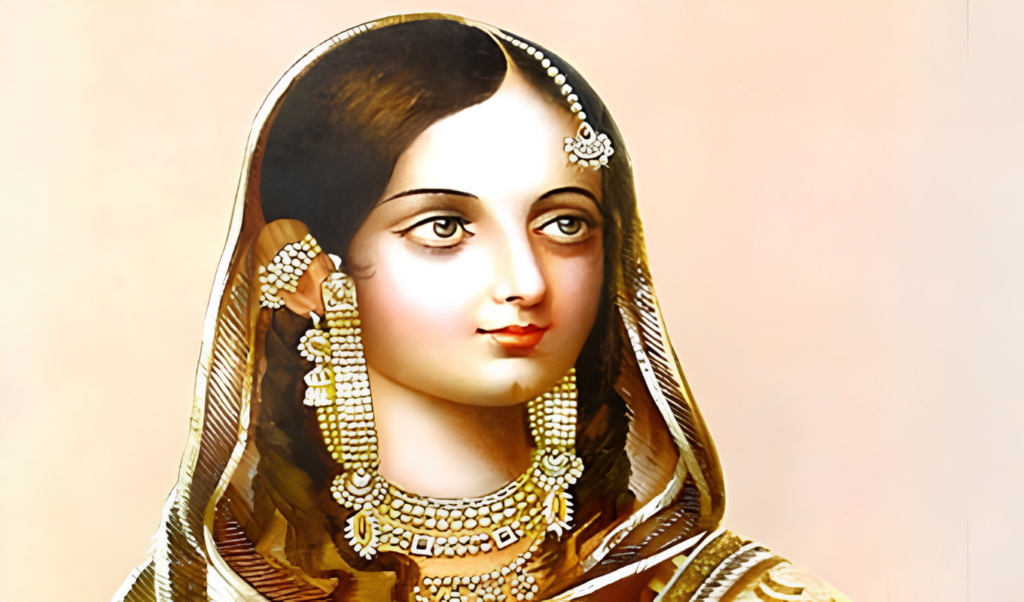
Empress Noor Jahan is regarded as one of the most remarkable female figures in Mughal history. Born as Mehr-un-Nissa, she was later bestowed the title “Noor Jahan” by Emperor Jahangir, meaning “Light of the World.” In the pages of history, she is remembered not only as an empress but also as a capable administrator, political strategist, courageous woman, and patron of culture.
She was born on 31 May 1577 into a noble Persian family. Due to political and social upheavals, her family migrated to India and eventually found refuge in the court of Emperor Akbar. It was in this royal environment that Mehr-un-Nissa grew up, receiving an elite education. From a young age, she excelled in poetry, music, literature, painting, and various intellectual pursuits.
Blessed with both beauty and intellect, she stood out among her contemporaries. According to legend, Prince Salim (later Emperor Jahangir) was deeply attracted to her at first sight. However, Emperor Akbar did not approve of their relationship for political and social reasons. As a result, Mehr-un-Nissa was married to Ali Quli Istajlu, who later became known as Sher Afgan.
After Akbar’s death, Prince Salim ascended the throne as Jahangir. He could not forget Mehr-un-Nissa. Following Sher Afgan’s death, she returned to Agra, and in 1611, she married Emperor Jahangir. It was after this marriage that she received the title Noor Jahan.
After becoming empress, she was not only the emperor’s consort but also an influential force in governance. Historians note that during Jahangir’s reign, Noor Jahan held significant influence over state affairs and major political decisions. The English envoy Sir Thomas Roe even remarked that real authority in the empire appeared to rest in her hands.
Noor Jahan was bold and self-confident. She participated in royal hunts alongside the emperor and earned a reputation as a skilled tigress hunter. Poets and writers of her time frequently celebrated her courage and personality in their works.
In politics, she demonstrated exceptional wisdom. During the later years of Jahangir’s reign, when Prince Khurram (later Emperor Shah Jahan) and the commander Mahabat Khan rebelled, Noor Jahan played a crucial role in managing the crisis. Her leadership, diplomatic skill, and determination remain highly significant in Mughal history.
Jahangir held Noor Jahan in great respect and affection. He once said:
“Noor Jahan is the master of my life, but not of my justice.”
This statement reflects the depth of their relationship and mutual respect.
However, her later life was marked by sorrow. After Jahangir’s death, her political influence gradually declined. She spent her remaining years in seclusion in Lahore and passed away on 17 December 1645 at the age of 72.
Noor Jahan was not only an empress but also a poet. The Persian verses engraved on her tomb were translated into Bengali by the poet Satyendranath Dutta:
“Light no lamp at the grave of the poor,
Offer no flowers, forget them no more;
Let the wings of the dark moth not burn,
Nor the bulbul be trapped in sorrow’s turn.”
In the history of the Mughal Empire, Noor Jahan remains a unique name. With her beauty, intellect, courage, political foresight, and leadership, she continues to be remembered as one of history’s most powerful and influential women.