Despite a historic legacy of success in international football, Germany do not currently occupy the top tier of most of pundits’ lists of favourites for the upcoming FIFA World Cup. The national team remains in a transitional phase, following the retirement of numerous stars from the 2014 World Cup-winning squad. This transition has been marked by consecutive group-stage exits in the 2018 and 2022 editions of the tournament, leading many to conclude that the squad has lost its traditional dominance. However, football history indicates that assessing Germany solely on paper metrics or recent form carries significant risk.
Squad Dynamics: Youth and Veteran Leadership
The current German squad features a distinct blend of emerging talent and established international veterans. The new generation is spearheaded by young players such as Jamal Musiala, Florian Wirtz, Kai Havertz, Deniz Undav, and Aleksandar Pavlovic. These footballers have demonstrated high technical speed, creativity, and a clear intent to perform on major international stages.
Complementing this youthful momentum is the veteran leadership of senior figures like Joshua Kimmich and Manuel Neuer. Neuer’s continued presence provides a vital psychological foundation for the squad’s defensive unit, whilst Kimmich serves as the tactical anchor in midfield, embodying on-pitch leadership and structural control.
Historically, Germany’s primary competitive advantage has not relied upon isolated individual brilliance. Instead, the national team’s success is built upon systematic collective play, tactical discipline, and structural resilience under pressure—qualities that frequently dictate outcomes in knockout tournament football.
Historical Precedents and the Underdog Advantage
The narrative of Germany succeeding as tournament underdogs is thoroughly documented. On four separate occasions, Germany secured the world title by defeating teams led by some of football’s most celebrated figures:
-
1954: Competing as clear underdogs, West Germany defeated the highly favoured Hungarian team, a fixture historically remembered as the “Miracle of Bern”.
-
1974: The team defeated the Netherlands, disrupting the famous “Total Football” system orchestrated by Johan Cruyff.
-
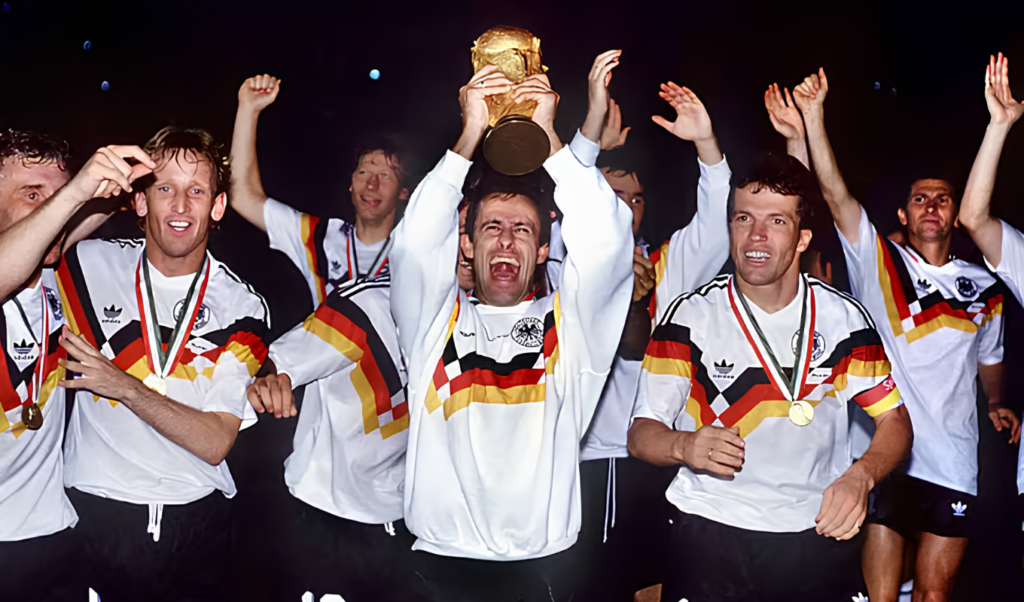
1990: Germany secured their third world title by overcoming Diego Maradona’s Argentina.
-
2014: The national team claimed their fourth title by defeating Lionel Messi’s Argentina in the final, an achievement preceded by a historic 7-1 semi-final victory against tournament hosts Brazil.
Conversely, the consecutive group-stage exits in 2018 and 2022 demonstrate that the German team is equally susceptible to failure. This mixed record explains why public expectations remain comparatively low ahead of the upcoming tournament. Within tournament football, diminished public expectation often operates to Germany’s tactical advantage, removing external pressure and allowing the team to focus entirely on tactical execution and organized counter-strategies.
Statistical Overview of Germany’s Historical Significance
The table below outlines the pivotal historical triumphs and recent structural setbacks that define Germany’s unique status ahead of the upcoming tournament:
| World Cup Edition | Primary Opponent / Context | Definitive Outcome | Historical Significance |
| 1954 | Hungary (Ferenc Puskás) | 3-2 Victory (West Germany) | Secured title as underdogs in the “Miracle of Bern”. |
| 1974 | Netherlands (Johan Cruyff) | 2-1 Victory (West Germany) | Neutralised the famous Dutch “Total Football” system. |
| 1990 | Argentina (Diego Maradona) | 1-0 Victory (Germany) | Claimed the nation’s third FIFA World Cup title. |
| 2014 | Argentina (Lionel Messi) | 1-0 Victory (Extra Time) | Won fourth title; included a 7-1 semi-final win over Brazil. |
| 2018 | Group Stage Competitors | Group-Stage Elimination | Failed to advance as the defending tournament champions. |
| 2022 | Group Stage Competitors | Group-Stage Elimination | Second consecutive failure to reach the knockout rounds. |
The empirical data illustrates that whilst Germany enter the tournament outside the absolute circle of favourites, their combination of tactical discipline, elite youth integration, and historical resilience maintains their position as a highly dangerous competitor.