Corruption in Bangladesh’s service sector has intensified significantly in 2025 compared with 2023, according to a new survey by Transparency International Bangladesh (TIB), raising fresh concerns over governance and accountability under the current interim administration.
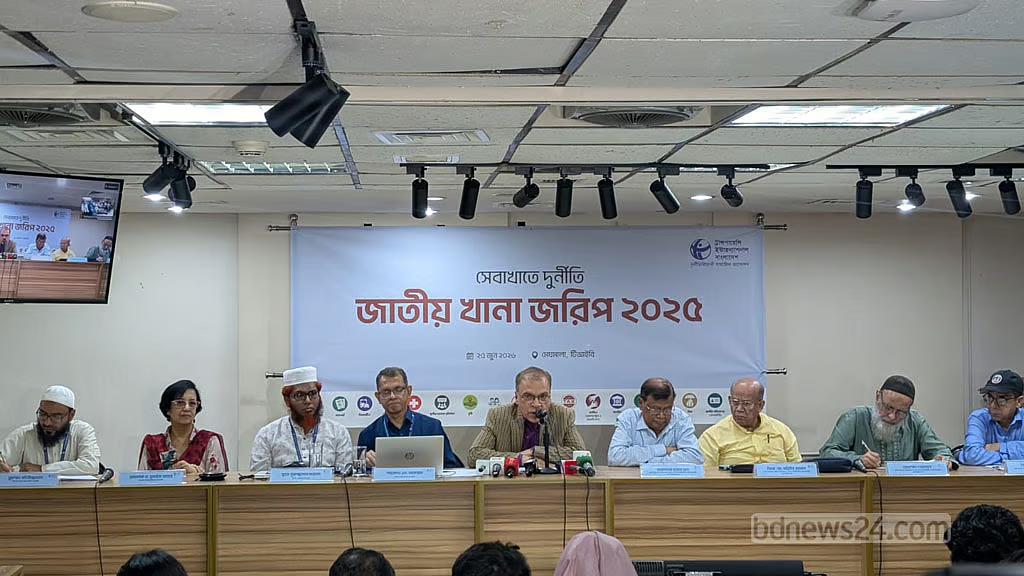
The organisation’s findings show that 81.6 per cent of service recipients experienced corruption in one form or another in 2025. This marks a steep increase from 70.9 per cent recorded in the 2023 survey conducted during the previous political administration. The results were published at a press briefing held at the MIDAS Centre in Dhaka’s Dhanmondi area.
TIB’s “Household Survey 2025 on Corruption in Service Sectors” highlights not only the growing prevalence of corruption but also its deepening nature across public services. The report suggests that informal payments and bribery have become increasingly embedded in everyday service delivery.
Speaking at the event, TIB Executive Director Iftekharuzzaman said Bangladesh has made progress in digital governance infrastructure and institutional readiness, particularly when compared with several South Asian countries. However, he noted that these systems have not been fully utilised to reduce corruption or improve transparency in service delivery.
He expressed concern over what he described as the institutionalisation of bribery, where service users feel compelled to pay unofficial fees to access basic services. Many respondents in the survey reported that services are effectively withheld unless informal payments are made.
The survey also underscores the unequal impact of corruption. According to TIB, people in rural areas bear a heavier burden than their urban counterparts. Women, indigenous communities, and other marginalised groups are disproportionately affected, facing greater barriers and higher exposure to corrupt practices in accessing essential services.
Economically, the study estimates that approximately Tk 12,363 crore was exchanged as bribes across service sectors. This figure is equivalent to about 1.58 per cent of the national budget, illustrating the scale of financial leakage and its broader implications for public welfare and development spending.
Attention was also drawn to the performance of the Anti-Corruption Commission. While around 26 per cent of respondents were familiar with the institution, only 0.9 per cent had ever filed a complaint with it. TIB described this gap as a clear indication of limited public trust and weak institutional accessibility.
Iftekharuzzaman further noted that the commission’s operational effectiveness is currently under strain, citing a leadership vacuum over the past several months. He urged the government to expedite the selection process for new leadership through the search committee mechanism, stressing the need for competent, experienced and ethically strong individuals to restore public confidence.
The report concludes with a set of recommendations aimed at strengthening prevention, enforcement, and institutional integrity across service sectors. TIB officials and researchers were also present at the briefing, underscoring the organisation’s continued monitoring of corruption trends in Bangladesh.