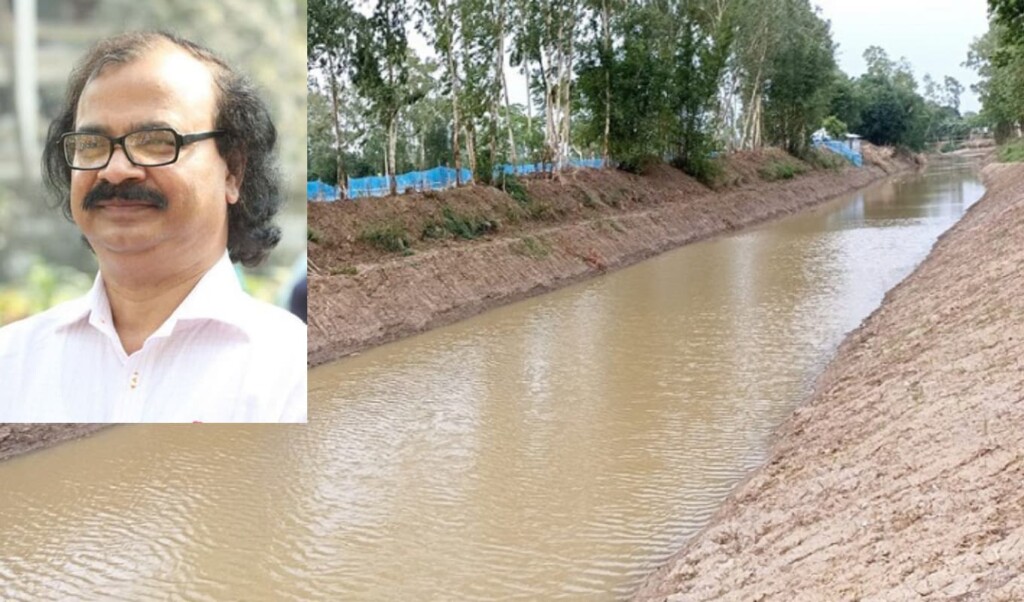
The Government of Bangladesh has designated canal excavation as a priority national programme to alleviate monsoon waterlogging, replenish groundwater reserves, secure natural water reservoirs for agricultural irrigation, maintain ecological balance, and generate rural employment. The administration has established a structural target to excavate 20,000 kilometres of canals over the next five years. Reflecting the historical and emotional resonance associated with canal digging in the national consciousness, the Head of Government formally inaugurated the countrywide scheme on 16 March 2026 in the Kaharole Upazila of Dinajpur District.
The Strategic Source Controversy
While macroeconomists view the rural employment generated by canal digging as a vital component of the national social safety net, hydrologists and water management specialists emphasise that canal excavation and river dredging must operate as interdependent initiatives. Experts caution that strategically, river dredging must take precedence.
In a technical analysis of the policy, Professor Dr Mizanur Rahman of the University of Dhaka observed that excavating canals while connected river systems remain dry is functionally equivalent to “creating veins in a bloodless body.” Rivers serve as the primary conduits and sources of water; if the primary source is obsolete, excavated canals will remain completely dry during the arid summer season. Conversely, if major rivers cannot efficiently discharge monsoon overflow due to siltation, localized canals will fail to mitigate waterlogging. Long-term efficacy depends entirely on a synchronized, integrated framework combining river dredging and canal clearing.
Historical Context and Institutional Foundations
The strategic focus on river maintenance began immediately after national independence. In 1972, Bangladesh’s founding leader, Bangabandhu Sheikh Mujibur Rahman, identified river dredging as vital to the nation’s infrastructure and secured seven industrial dredgers from the Netherlands through a combination of soft loans, grants, and technical assistance. Remarkably, several of these original 1972 units remain operational today.
To formalise this sector, Bangabandhu established a dedicated Dredger Directorate under the Bangladesh Inland Water Transport Authority (BIWTA) in 1974. He appointed the liberation war sector commander, Colonel Abu Taher, as its inaugural Director and established its headquarters in Narayanganj.
Fleet Expansion and Capital Investments
Public sector fleet expansion stagnated for more than three decades following 1972, with the state-owned dredger count remaining below ten until 2008. Over the last two decades, capital investment has expanded exponentially. The BIWTA currently operates a fleet of 80 state-owned dredgers, bolstered significantly by the acquisition of 73 new vessels by 2022.
The private sector has similarly emerged as a major operational stakeholder, commanding a fleet of 171 commercial dredgers. Despite this combined capacity, the aggregate public and private dredging output can fulfill only approximately half of the nation’s annual river dredging requirement, which is estimated at 165.51 million cubic metres.
The table below outlines the major state-sponsored capital expenditures and bilateral financial agreements executed to modernise the national dredging infrastructure:
| Project / Policy Phase | Operational Frame & Fleet Additions | Financial Structure & Budgetary Allocations |
| 1972 Post-War Procurement | 7 Initial Dutch Dredgers | Concessional loans, grants, and technical aid |
| Bangladesh Delta Plan 2100 | Major River Security Initiative | €4 million Dutch grant for water management |
| 2016 Mega Procurement | 11 New Industrial Dredgers | State-funded capital project |
| 2024 Active River Project | Dredging of 100 Rivers; 35 New Dredgers | Taka 4,489 Crore total project budget |
| Late-Phase Sino Contracts | 35 Specialized China-sourced Dredgers | Supplier’s credit: <2% interest, 5-year grace, 20-year repayment |
Hydrological Realities in the Haor Regions
The necessity of prioritizing river deepening over surface-level embankments is particularly acute in the northeastern haor (wetland) ecosystems. Agricultural output in these basins is perennially threatened by flash floods fueled by upstream mountain siltation, which has drastically raised riverbeds.
Hydrological principles dictate that temporary earthen dams cannot permanently protect winter crops if the adjacent river channels lose their volumetric carrying capacity. Unless the major rivers are systematically dredged to a depth below that of the agricultural plains, floodwaters will inevitably breach the highest artificial embankments to find their natural level. Consequently, the government must implement a fully integrated water resource strategy to ensure the 20,000-kilometre canal initiative yields permanent ecological and agricultural returns rather than temporary financial relief.
Writer: Dr. Mijanur Rahman
Professor. Dhaka University