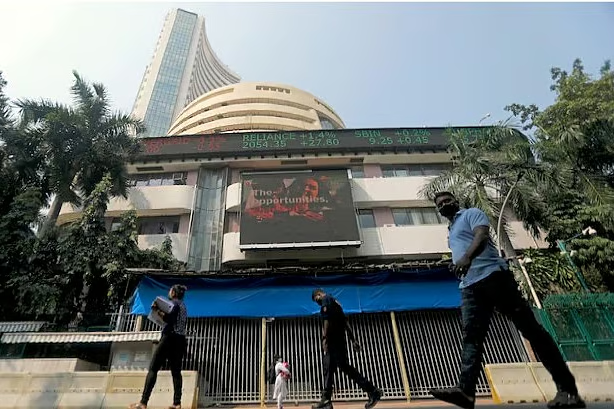
Foreign portfolio investors (FPIs) have continued to reduce their exposure to equity markets in India, extending a sustained selling streak for several months. The latest data for May shows a significant net withdrawal, reinforcing concerns about persistent global and domestic headwinds affecting investor sentiment.
According to market monitoring estimates, FPIs pulled out approximately ₹32,963 crore from Indian equities in May alone. This marks the third consecutive month of net outflows, highlighting an ongoing risk-off approach among global investors. Analysts attribute this behaviour primarily to heightened global economic uncertainty, volatile currency movements, and fluctuating international crude oil prices.
Earlier months also reflected considerable turbulence. In April, foreign investors offloaded nearly ₹60,847 crore, while March recorded the steepest monthly exit of the year so far at around ₹117,775 crore. In contrast, February briefly broke the trend, witnessing a net inflow of approximately ₹22,615 crore as investors selectively returned to the market. However, this recovery proved short-lived, as January had already seen an outflow of around ₹35,962 crore.
Overall, cumulative data for the January–May period indicates that FPIs have withdrawn nearly ₹224,932 crore from Indian equity markets. Despite the continued net selling trend, some analysts note that the pace of outflows appears to be moderating in recent weeks, which may suggest early signs of stabilisation in investor sentiment.
Monthly Foreign Portfolio Investment Flow
| Month | Foreign Portfolio Investment Flow |
|---|---|
| January | Net outflow of ₹35,962 crore |
| February | Net inflow of ₹22,615 crore |
| March | Net outflow of ₹117,775 crore |
| April | Net outflow of ₹60,847 crore |
| May | Net outflow of ₹32,963 crore |
Market experts point to a combination of global factors behind this sustained withdrawal. Geopolitical tensions in West Asia have contributed to concerns over energy supply stability, at one point pushing crude oil prices close to the $100 per barrel mark. Such levels typically raise import costs for energy-dependent economies and heighten inflationary pressures, prompting investors to reassess risk exposure in emerging markets.
Currency volatility has added another layer of caution. The weakening of the Indian rupee against the US dollar has made returns less attractive for overseas investors, particularly those seeking stable currency-adjusted gains. As a result, portfolio managers have increasingly opted for short-term profit booking—buying during dips and exiting during rallies—rather than committing to sustained positions.
At the same time, some domestic market segments continue to show resilience. Small and mid-cap companies, in particular, have demonstrated relatively strong earnings momentum, and several research reports maintain a constructive outlook on India’s medium-term growth trajectory. Nevertheless, the broader equity market remains sensitive to external shocks, and foreign capital flows are likely to remain volatile in the near term.
In summary, while the scale of monthly withdrawals appears to be easing, sustained uncertainty in global financial conditions suggests that foreign investor sentiment towards India will continue to fluctuate, shaping market direction in the months ahead.