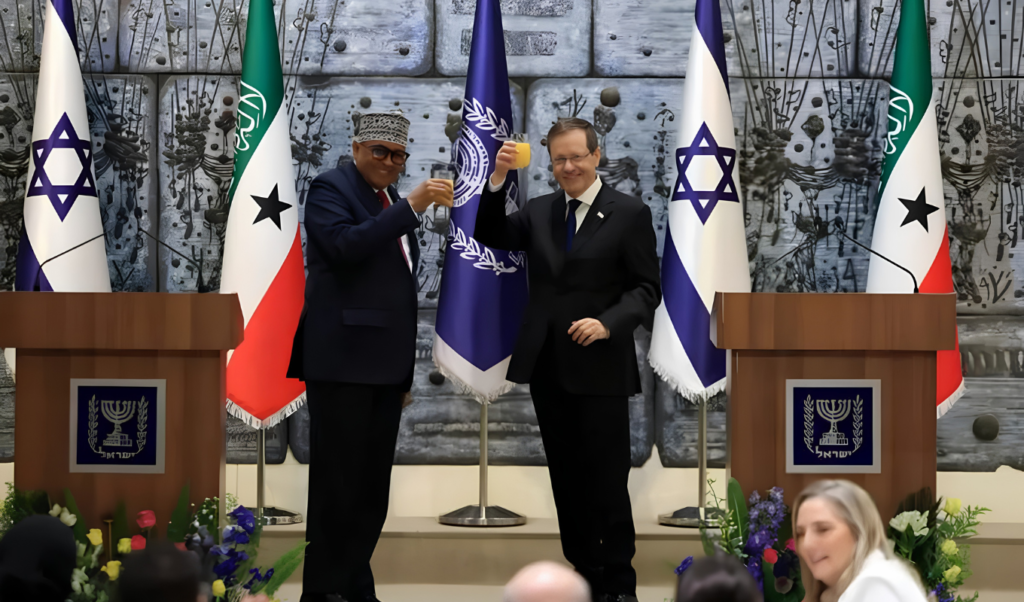
The official state visit of Somaliland President Abdirahman Mohamed Abdullahi “Irro” to Israel has initiated new diplomatic discussions across the Middle East and Africa. This marks the first time Israel has hosted a leader from Somaliland with full state honours. According to geopolitical analysts, the rationale behind this diplomatic engagement extends beyond bilateral relations, driven primarily by the strategic value of the Red Sea and the Bab al-Mandab Strait.
President Abdullahi arrived in Jerusalem on Sunday, marking the inaugural state visit by a Somaliland leader. During a bilateral meeting with Israeli Prime Minister Benjamin Netanyahu, President Abdullahi stated:
“I have come on the first state visit as the President of Somaliland. For 35 years, we have been calling on the world to grant us recognition. Israel and you yourself are the first to look at us and recognise us.”
Prime Minister Netanyahu compared this recognition to Jewish history, remarking:
“We too, as a small population, sought recognition of our rights from the world. Therefore, we have a natural sympathy towards you.”
Strategic Partnership and Maritime Security
During the state visit, the two nations signed a strategic cooperation agreement covering security, trade, agriculture, healthcare, and regional strategy. Geographically situated in the Horn of Africa along the Gulf of Aden, opposite Yemen, Somaliland occupies a vital position near one of the world’s busiest maritime shipping lanes.
Prime Minister Netanyahu highlighted that Somaliland’s territory is located near the Bab al-Mandab Strait, which connects the Red Sea to the Indian Ocean. This maritime corridor has become increasingly critical for Israel, following two years of disruptions to commercial shipping lanes caused by Yemen’s Houthi rebels, which have heightened Israel’s regional security concerns.
The core parameters of the diplomatic developments and regional positions are detailed below:
| Dimension | Key Structural & Strategic Factors |
| Principal Leadership | President Abdirahman Mohamed Abdullahi & PM Benjamin Netanyahu |
| Signed Agreement | Strategic Cooperation Agreement (Security, Trade, Agriculture, Health) |
| Maritime Focus | Red Sea security and the strategic Bab al-Mandab Strait |
| Key Infrastructure | Berbera coastal city and modernized airfield infrastructure |
| Diplomatic Milestone | Formal opening of the Somaliland Embassy in Jerusalem |
Security Implications and the Role of Berbera
Security cooperation remains the most intensely discussed component of the relationship. Israeli Foreign Minister Gideon Sa’ar previously indicated during a visit to Somaliland in January that both nations were advancing towards a strategic partnership and defence cooperation. Israel’s Defence Minister, Israel Katz, stated that the two entities have a history of covert cooperation, which is projected to expand into higher formal channels.
Somali federal officials have alleged that Israel seeks to develop military installations in Somaliland for potential operations against the Houthis in Yemen. While Somaliland officials have not confirmed a definitive stance on this, President Abdullahi stated in an interview with the Israeli media outlet i24 that there are currently no active plans to establish a military base. However, when questioned about future possibilities, he added, “I cannot completely rule it out.”
These discussions center on Berbera, Somaliland’s largest coastal city located on the Gulf of Aden. The city’s airfield, originally built by the Soviet Union and subsequently utilised by NASA, has recently been upgraded for potential military applications, according to international security analysts.
Regional Contestation and Domestic Debates
The Federal Government of Somalia has expressed deep concern over the Israel-Somaliland alignment. Ali Omar, Somalia’s Minister of State for Foreign Affairs, stated that their primary concern is the potential involvement of Somaliland in wider Middle Eastern conflicts. He warned that such interventions could introduce fresh instability into a region already facing existing challenges. While Mogadishu remains open to internal dialogue with Hargeisa, it maintains that the territorial integrity of Somalia is non-negotiable. Somaliland unilaterally declared independence from Somalia in 1991 following a civil war, but it lacks widespread formal international recognition.
During the visit, Somaliland officially opened its embassy in Jerusalem, an event attended by Foreign Minister Gideon Sa’ar. Because of the contested international status of Jerusalem, most foreign nations maintain their embassies in Tel Aviv. The establishment of the mission drew immediate condemnation from Palestine, the Arab League, and the Organisation of Islamic Cooperation (OIC).
Moses Crispus Okelo, a researcher at the South Africa-based Institute for Security Studies, observed that Israel’s core objective centers on securing a foothold along the Red Sea corridor due to its growing regional isolation.
The diplomatic shift has also sparked internal debates within Somaliland. Former Somaliland President Muse Bihi Abdi called on the government to disclose the full details of the agreement, expressing concern that the territory could be drawn into regional military altercations. He stated that the constitution does not permit actions that run contrary to religious values or harm Muslim populations. Somaliland’s Islamic scholars also remain divided on the policy.
While Somaliland hoped this move would pave the way for recognition from other nations, no Western powers, including the United States, have altered their diplomatic stance. Saudi Arabia, Turkey, Egypt, and the African Union have collectively expressed concern over Israel’s actions. Conversely, the Houthi movement in Yemen issued a direct warning, stating they would treat any Israeli military presence in Somaliland as a legitimate target.
Yossi Mekelberg, a Middle East analyst at Chatham House, concluded that while the relationship offers immediate tactical benefits to both sides, it does not resolve their fundamental dilemmas. He noted that Israel is attempting to bypass the Palestinian issue by expanding ties in Africa, while Somaliland maintains exceptionally high expectations regarding its pursuit of formal international recognition.