ABM Zakirul Haque Titon
Published: 28 Mar 2026, 09:13 am
A pressing question confronts policymakers today: how should poverty be defined in Bangladesh? Should it be measured purely by income, or by the broader reality of people’s lives?
Traditionally, the Bangladesh Bureau of Statistics (BBS) determines poverty based on food consumption, caloric requirements, and income-expenditure patterns. Internationally, the World Bank identifies individuals living below a specific daily income threshold as poor. Yet, do these conventional metrics capture the true complexity of human life?
Two contrasting realities illustrate this challenge. On one hand, consider a working-class family:
| Family Member | Occupation | Monthly Income (BDT) |
|---|---|---|
| Mother | Domestic worker | 13,000 |
| Father | Rickshaw puller | 18,000–20,000 |
| Daughter | Garment worker | 15,000 |
| Young son | Temp helper | 8,000 |
| Total Monthly Income | ≈50,000+ |
Despite modest incomes, low rent, partial food subsidies, and controlled spending, the family manages to save approximately 10,000 BDT per month. Over several years, they have even acquired land in their ancestral village.
In stark contrast, a highly educated young adult, holding a Master’s degree from the University of Dhaka, earns 28,500 BDT per month after a career setback. With high urban living costs—rent, utilities, health care, and daily necessities—he must rely on loans before the month ends and has already been forced to consider selling family assets.
Which of these two is truly poorer? The family with modest income but the ability to save, or the educated individual struggling to meet basic expenses?
A new social phenomenon is emerging in Bangladesh’s urban centres: the “working poor.” These individuals earn a steady income, yet the high cost of living—particularly housing, health care, education, and commodities—leaves them financially vulnerable. Many belong to the lower-middle class, invisible in official poverty statistics, yet barely surviving in reality.
The government has commendably extended subsidised food and cash support to nearly one million families through TCB cards and the new Family Card scheme. Yet, questions remain: are the truly needy benefiting, or only those who appear poor on paper?
Current poverty metrics, focused primarily on income, fail to account for household expenditure, dependent members, housing costs, health risks, and social obligations. Identical incomes can represent vastly different realities depending on context.
To better capture the lived experience of poverty, policy adjustments are essential:
A modern, technology-driven rationing system could provide a safety net for both low- and lower-middle-income households. Poverty is not a one-dimensional concept; it encompasses life quality, security, and future prospects. When a day labourer saves while a highly educated urban professional struggles under debt, it is clear that current definitions are misaligned with reality.
It is time to rethink our approach: is poverty merely about income, or does it reflect the lived reality of people’s lives? Policymakers must look beyond statistics and consider the human experience, creating a more inclusive and equitable society.
Writer: Editor and Publisher - Khaborwala and -GLive 24

> Fire at Sitakunda Farm Claims 23 Livestock
> Argentina’s Win Conceals Growing Concerns
> Measles Outbreak Strains Rajshahi Hospital Resources
> Dhoni Injury Hits Chennai Start
> Shariatpur July Memorial Set Ablaze by Chhatra League Member
> Dua Lipa Headlines A24 Comedy ‘Peaked’ Ensemble
> Insurance Leaders Accelerate AI Investment Amid Rising Cyber Risks and Skills Shortages
> Bangladesh Currency Exchange Rates Firm on 27 March
> Major Shake-Up Planned in 22 Banks
> Oil Prices Ease After US Delay
> Fraud Surge Threatens APAC Firms as Synthetic Identities Proliferate
> Chattogram Receives Major Fuel Shipment
> Bangladesh Arrive in Singapore Ahead of Final AFC Asian Cup Qualifier

A devastating fire broke out late on Friday night at a farm in the Goalini Gate area of Bhatiari Uni...
In a disturbing incident in Shariatpur, a portion of the July Memorial was deliberately set on fire,...

Recent incidents in Bangladesh’s insurance industry have revealed critical weaknesses, particularly...
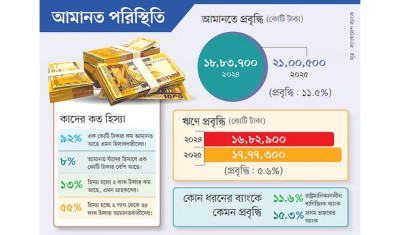
Small and medium-sized depositors continue to be the cornerstone of Bangladesh’s banking sector, und...
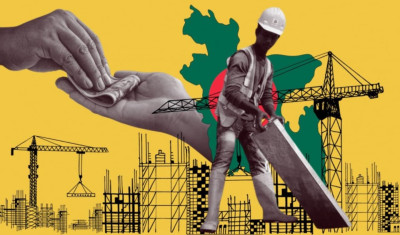
Bangladesh is likely to face mounting pressure on its remittance inflows as ongoing conflict in the...
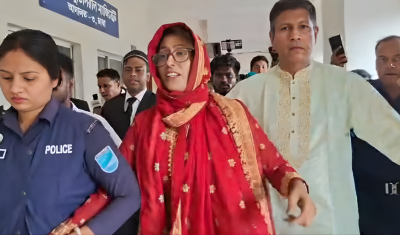
A Dhaka court has ordered the remand of a model and social media personality following her arrest at...
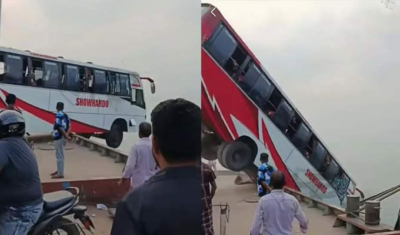
The Bangladesh Road Transport Authority (BRTA) has temporarily suspended the registration of a passe...
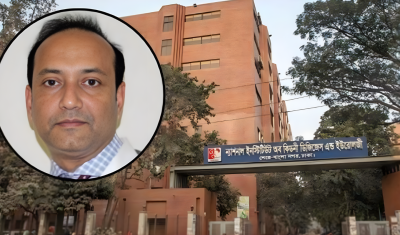
Distinguished nephrologist Dr Mohammad Rashed Anwar has been appointed as the new Director of the Na...
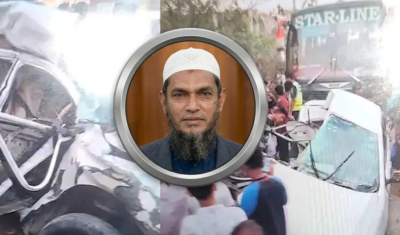
A profound sense of grief has enveloped a community in Lakshmipur after a madrasa teacher, his wife,...

A human skeleton has been recovered from a rubbish dump in the Kamarkuri area under Gacha Police Sta...
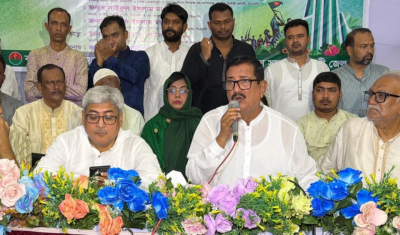
Land Minister Mizanur Rahman Minu has claimed that the so-called “helmet group”, which he alleged wa...

A local leader of the United People’s Democratic Front (Democratic) has been shot dead in a violent...


Availabe for iphone & ipads

Available in google play
 বাংলা
বাংলা