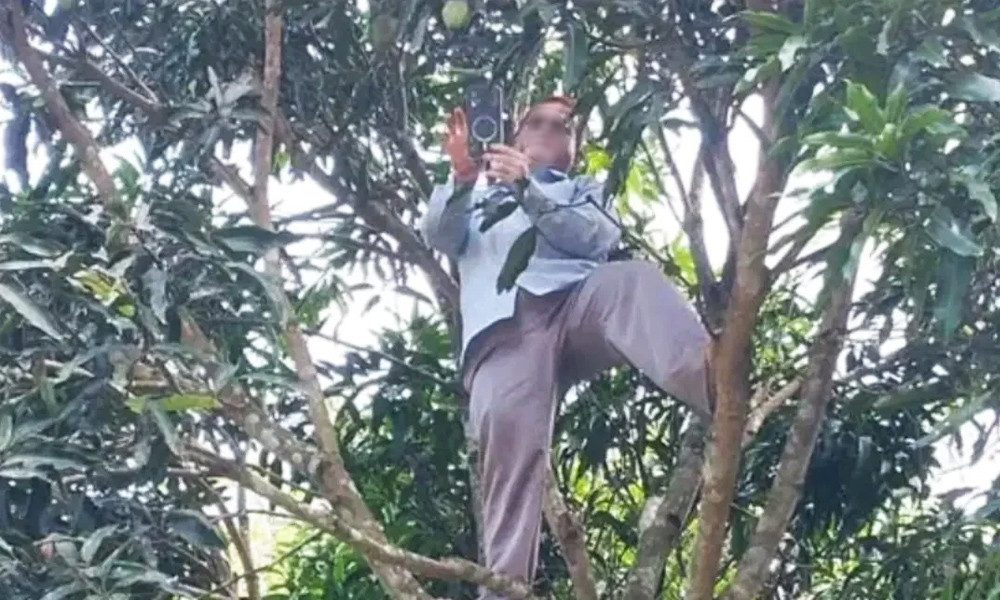
In a striking illustration of the digital connectivity challenges in remote regions, a primary school head teacher in the border area of Baghai Chari Upazila was compelled to climb an mango tree on a hilltop to submit his online attendance.
The incident involves Mohammad Abu Taher, head teacher of Pakujjuchhara Government Primary School in the remote Pakujjuchhara area of Baghai Chari Upazila. The episode came to public attention on Monday (15 June) when photographs circulated on social media showing the teacher attempting to access mobile network coverage from an elevated position.
The Government had recently introduced an online attendance reporting system for primary school teachers across the country, which came into effect on the same day. Under the directive, teachers must be present at school by 9:00 am and send a photograph of the attendance register via WhatsApp to the Upazila Primary Education Officer. The information is then forwarded to district-level education authorities and subsequently escalated to higher administrative levels for daily monitoring.
According to the account provided by Mohammad Abu Taher, the school is located on a hill approximately 300–400 feet above the surrounding terrain. On Monday morning, he attempted to send the attendance record from the school building roof but failed due to the absence of mobile network coverage. He later moved to higher ground on the hilltop, but still could not establish a stable connection. Ultimately, he climbed a mango tree and, from a branch, managed to obtain sufficient signal strength to send the attendance photograph via WhatsApp to the Upazila education officer.
He stated that he had to take the risk of climbing the tree in order to comply with the directive, adding that failure to do so could have had implications for his professional responsibilities and livelihood.
Officials have acknowledged widespread connectivity limitations in the region. Sanchayan Chakma, acting Upazila Primary Education Officer, stated that Baghai Chari Upazila has 116 government primary schools. Of these, attendance data from 88 schools were successfully received, while 28 schools, involving 83 teachers, could not submit attendance due to network unavailability.
At the district level, Nazir Ahmed Talukdar, President of the District Primary Head Teachers’ Association, noted that while teachers in plain land areas can comply with the online system with relative ease, those in hilly regions face significant challenges. He added that many areas in Rangamati District still lack stable mobile network coverage, and in some cases, electricity supply is also insufficient. He urged the authorities to consider the geographical and infrastructural constraints of hill tracts separately.
According to data from the District Primary Education Office, out of 708 schools in Rangamati District, attendance records from 538 schools were received on the first day of implementation. However, 170 schools remained outside network coverage and were unable to submit data.
District Primary Education Officer Kafil Uddin stated that data collection is currently being conducted through WhatsApp groups in line with the directive. Where possible, information is also being collected via SMS. He added that lists of schools unable to submit attendance due to connectivity issues will be forwarded to the central authorities in Dhaka, where further instructions will determine subsequent measures.
Summary of Attendance Reporting Data
| Administrative Area | Total Schools | Reports Received | Reports Not Received | Key Issue |
|---|---|---|---|---|
| Baghai Chari Upazila | 116 | 88 | 28 (83 teachers) | Mobile network unavailability |
| Rangamati District | 708 | 538 | 170 | Lack of network coverage |
The incident has highlighted the persistent digital divide affecting remote and hilly regions, particularly in implementing nationwide digital administrative systems.