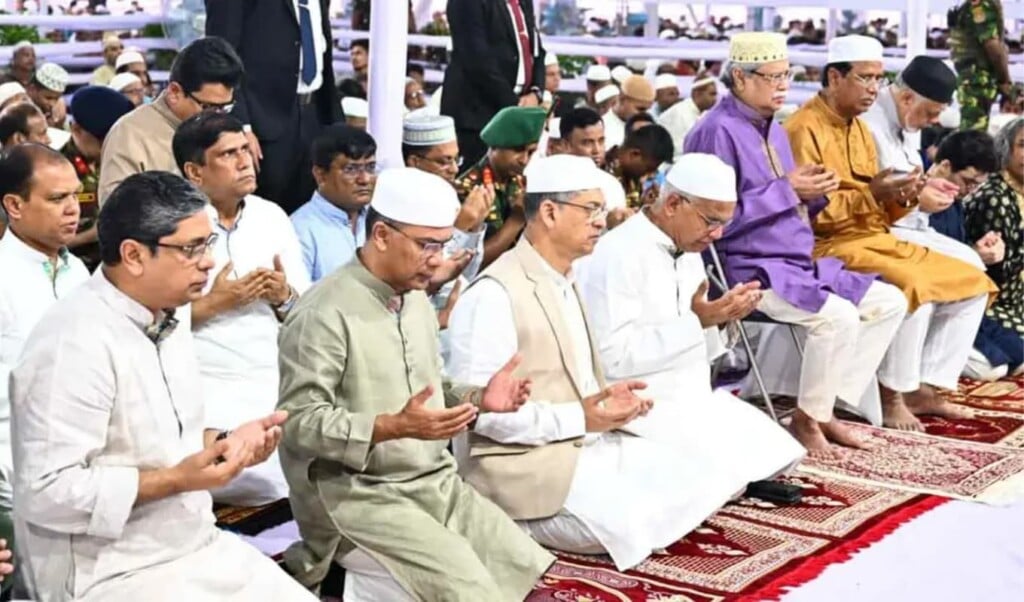
The principal congregation of Eid-ul-Adha was successfully observed at the National Eidgah in Dhaka at 07:30 BST on Thursday, 28 May 2026. The religious assembly brought together thousands of citizens alongside the country’s top state dignitaries, marking the national celebration with formal prayers and sermons.
President Mohammed Shahabuddin and Prime Minister Tarique Rahman attended the congregation, sitting alongside members of the newly formed cabinet. High-profile political leaders, state bureaucrats, foreign diplomats, and thousands of residents from diverse professional backgrounds joined the congregation, reflecting the national character of the annual event.
Key Civil and Administrative Roster
The religious services were formally administered by Mufti Maulana Mohammad Malek, the newly appointed Khatib of the Baitul Mukarram National Mosque. Following the conclusion of the two-unit Eid prayer, the Khatib delivered the traditional Eid sermon (Khutbah), which focused on the spiritual significance of sacrifice, personal discipline, and social responsibility.
The prominent political and administrative dignitaries who participated in the front-row congregation at the National Eidgah are structured in the table below:
| Public Official | Official Government Portfolio / Designation | Institutional Representation |
| Mohammed Shahabuddin | President of the People’s Republic of Bangladesh | Head of State |
| Tarique Rahman | Prime Minister of the People’s Republic of Bangladesh | Head of Government |
| Salahuddin Ahmed | Minister of Home Affairs | Ministry of Home Affairs |
| Mir Shah Alam | Minister of State for Local Government | Ministry of Local Government |
Prayers for National Welfare and Global Stability
Following the sermon, the congregation took part in a collective supplication (Munajat) that commenced at 07:51 BST. The prayer focused heavily on the economic prosperity, stability, and general welfare of Bangladesh and its citizens.
The Khatib also offered prayers for the protection, safety, and liberation of vulnerable Muslim communities facing oppression, conflict, and persecution globally. The supplication concluded with a collective call for citizens to implement the foundational lessons of Eid-ul-Adha—specifically its values of self-sacrifice, moderation, and humanitarian service—into their personal and public lives.
Operational Logistics and Security Management
The atmosphere surrounding the Supreme Court premises and the National Eidgah remained vibrant from the early hours of the morning, with families, friends, and colleagues arriving in large groups from across the capital.
To guarantee public safety, Dhaka Metropolitan Police (DMP) and associated security agencies enforced strict access-control protocols. All worshippers were required to clear designated security checkpoints and physical screenings before being permitted entry into the main prayer arena.
The operational layout of the venue handled large numbers efficiently. The main pavilion was engineered to safely host up to 35,000 worshippers at any given time. Organisers set up segregated entry gates and dedicated seating arrangements for state guests, general citizens, and female worshippers.
The Dhaka South City Corporation (DSCC) managed the venue infrastructure, providing clean ablution hubs, chilled drinking water stations, modern sanitation facilities, and emergency medical deployment tents staffed with mobile healthcare personnel. At the close of the service, President Shahabuddin and Prime Minister Rahman exchanged formal Eid greetings with individual citizens before departing under standard state security protocols.