A catastrophic explosion at a storage facility housing commercial mining explosives in north-eastern Myanmar has resulted in the deaths of more than 45 individuals, including several young children. The industrial accident, which transpired on Sunday afternoon in a territory directly bordering the People’s Republic of China, has concurrently left over 50 other people sustaining various degrees of physical injuries. The casualty figures and environmental impact details were compiled and corroborated by humanitarian rescue personnel and regional media networks, before being reported by the Associated Press (AP).
According to verified accounts detailing the incident, the powerful detonation occurred at approximately 12:00 pm local time in Kaungtup Village, situated within the administrative boundaries of the Namhkam Township. The affected rural settlement is positioned roughly three kilometres (two miles) due south of the international border line dividing Myanmar and China. The border enclave is currently managed under the direct administrative control of the Ta’ang National Liberation Army (TNLA), an ethnic armed organisation operating in active opposition to the ruling military junta state apparatus.
Emergency Rescue Operations and Diverse Casualty Estimates
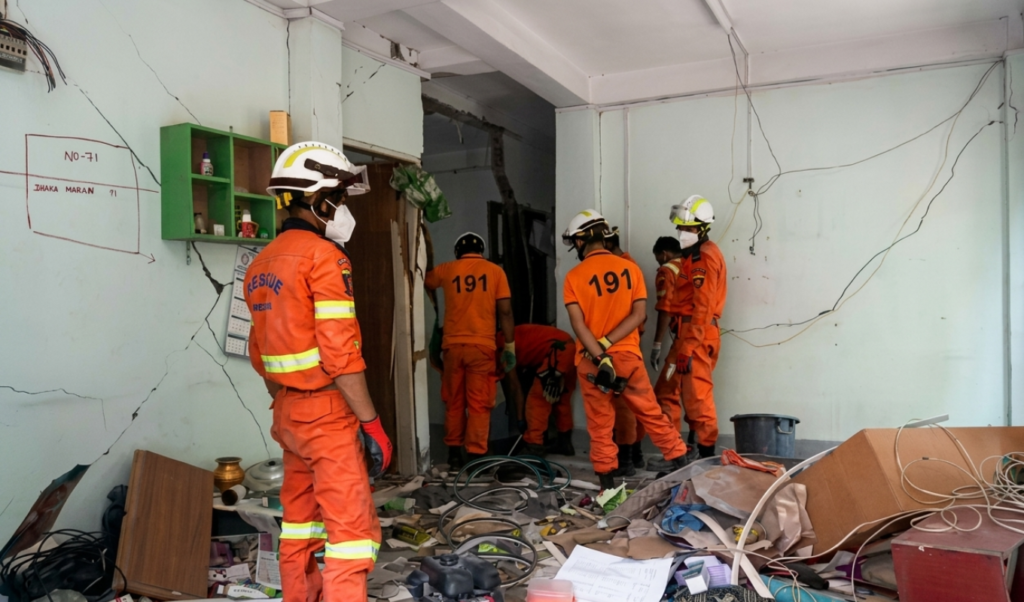
Following the midday blast, emergency response teams and civilian volunteer rescue units quickly deployed to the epicentre of the destruction to extract survivors from the debris. An active rescue worker, who participated in the initial body recovery operations and requested complete anonymity due to safety protocols, confirmed that 46 bodies had been extracted by Sunday evening. The recovery official explicitly stated that the dead included at least six young children, and that the remains had already been systematically transported to designated sites for traditional funeral rites.
The worker further disclosed that a minimum of 74 injured civilians had been prioritised and transferred to local medical centres and township clinics for emergency treatment. Despite the challenging structural conditions on the ground, search and recovery operations remained fluidly active well into the night.
Concurrently, a separate rescue operative based out of the primary Namhkam urban centre indicated that their baseline data pointed to approximately 40 confirmed fatalities. The second source emphasised that the immense shockwave generated by the blast had completely structurally compromised or destroyed over 100 residential homes located within the immediate vicinity.
In contrast to the initial humanitarian tallies, several indigenous news outlets operating within Shan State, including the prominent digital network Shwe Phee Myay, published higher estimations, claiming that the death toll had surged to between 50 and 55 individuals. Disseminated photographic and video evidence captured from the scene depicted dense plumes of dark smoke rising above the township alongside rows of completely flattened timber and concrete buildings.
Investigative Findings and Technical Analysis of Jellygnite
China’s state-controlled broadcaster, China Central Television (CCTV), reported that preliminary investigative frameworks established by border authorities indicated that the designated facility was being used to stockpile massive quantities of high-density commercial explosives intended strictly for regional mining initiatives. The concentrated storage of these materials within a populated village zone effectively magnified the blast radius. Regional administrative blocks are presently working to provide emergency relief goods, immediate medical triage, and temporary housing assistance to the displaced families.
In the wake of the domestic disaster, the Ta’ang National Liberation Army released an official statement via its authenticated Telegram communication channel to acknowledge the scale of the accident. The armed group clarified that the specific chemical agent stored within the depository was ‘jellygnite’—an explosive material explicitly designated for regional mining and stone quarrying activities. The TNLA command structure announced that a specialised technical committee has been formally instituted to investigate the precise mechanical or chemical failure that triggered the detonation.
Chemical Stability Notice: Industrial safety experts and chemical engineers note that jellygnite, which is widely utilised globally for rock blasting and mining due to its high velocity, poses extreme risks if managed incorrectly. If the substance is exposed to prolonged atmospheric moisture, inadequate ventilation, or fluctuating thermal conditions over an extended period, it can systematically decompose. This chemical degradation results in the leakage of highly sensitive nitroglycerin components, rendering the compound volatile and prone to spontaneous detonation from minimal friction or temperature variations.
Geopolitical Context of the Border Region
The geopolitical backdrop of Namhkam Township explains the complex governance structure currently managing the crisis. The TNLA is highly recognised as a core member of the ‘Three Brotherhood Alliance’, an influential coalition of ethnic minority armies that launched a synchronised, large-scale military offensive against the central military junta in late 2023.
During these coordinated operations across northern Shan State, TNLA combatants successfully seized full administrative and military control of the Namhkam zone from state forces. Consequently, the rebel governance structure is now solely responsible for regulating industrial safety standards, maintaining border security alongside Chinese counter-agents, and executing emergency rehabilitation protocols for the affected civilian populations.