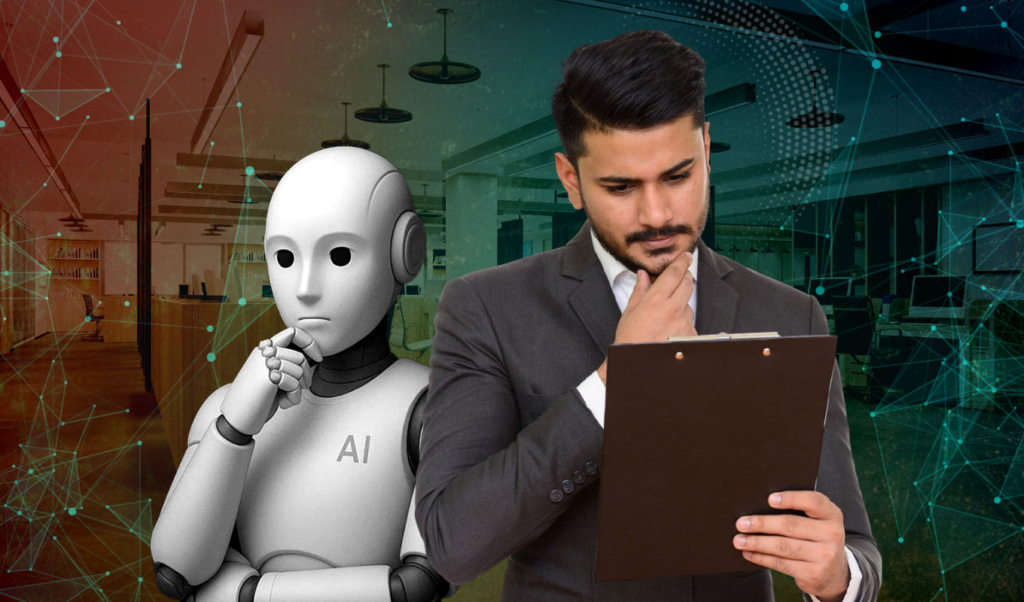
Over the preceding twenty-four months, the primary discourse surrounding the rapid proliferation of artificial intelligence (AI) has focused on a singular, existential question: will this technology completely eradicate human employment? However, alongside this ongoing debate, a distinct and equally troubling concern is emerging among industry analysts. Experts now suggest that while AI may not entirely replace human workers in the immediate future, it is increasingly being deployed to monitor, direct, and evaluate personnel in ways that threaten to make corporate environments significantly more stressful.
The Rise of the Algorithmic Supervisor
The Chief Executive Officer of Nvidia, Jensen Huang, recently issued a stark warning regarding this shifting dynamic. Speaking during a panel discussion at the Stanford Graduate School of Business, Huang cautioned that corporate professionals may soon find themselves operating under the constant oversight of automated systems.
Although delivered with a degree of levity, his commentary highlighted a genuine apprehension within the technology sector regarding the future of workforce management. Huang remarked that autonomous AI agents would persistently prompt and micromanage personnel, leading to an environment where human employees find themselves considerably more occupied than in previous operational eras.
“Your AI agents will be constantly nudging you, micromanaging you, and you will become busier than you ever were before,” noted Nvidia Chief Executive Jensen Huang during a recent academic summit.
This projection aligns with observations from other technology architects who fear the psychological toll of relentless digital oversight. Sagar Bishnoi, the co-founder of Future Shift Labs, has identified a phenomenon known as “alert fatigue,” which is directly triggered by an excessive influx of automated notifications, recommendations, and directives.
According to Bishnoi, while automated systems possess the capability to enhance raw productivity metrics, an over-reliance on continuous digital guidance can inadvertently transform helpful assistants into intrusive digital micromanagers. He argues that if every professional task becomes inextricably linked to an automated suggestion or a performance alert, human workers run the risk of losing their operational autonomy, which subsequently degrades overall job satisfaction.
From Software Assistant to Tireless Monitor
In the current corporate landscape, AI utilities are routinely utilized to execute structured administrative tasks. These functions include writing software code, synthesizing meeting minutes, managing complex schedules, drafting correspondence, and conducting large-scale data analysis.
However, enterprises are progressively expanding the scope of these tools. Rather than treating artificial intelligence merely as a passive operational assistant, firms are embedding it into corporate infrastructure to actively monitor human activity and run real-time productivity diagnostics.
Comparison of Human Managers and Automated Monitoring Systems
| Operational Attribute | Traditional Human Management | Artificial Intelligence Systems |
| Fatigue Levels | Subject to physical and mental exhaustion; requires rest cycles. | Operates continuously without experiencing cognitive decline. |
| Data Processing | Evaluates performance periodically via retrospective reviews. | Executes real-time, continuous analytical tracking of output. |
| Feedback Mechanism | Delivers periodic, structured assessments and guidance. | Issues instantaneous, automated prompts and micro-directives. |
| Short-term Impact | Standardised productivity gains bounded by administrative hours. | Rapid escalation of short-term efficiency and task throughput. |
| Long-term Impact | Fosters interpersonal relationships and sustained morale. | Risk of systemic alert fatigue and diminished worker autonomy. |
Paramdeep Singh, the co-founder of Shorthills AI, points out that whilst many corporate professionals currently welcome the integration of basic AI “co-pilots,” the deeper integration of these platforms could soon generate unprecedented workplace pressure. Singh emphasizes a fundamental difference between biological and digital oversight: a human manager inevitably tires by the conclusion of the working day, deferring further scrutiny until the following morning. Conversely, an automated agent experiences no such physical limitations.
As these systems become more deeply entrenched within enterprise software, corporate workforces will face uninterrupted real-time tracking, continuous performance appraisals, and granular behavioral analytics. While this shift is designed to maximise operational efficiency, Singh warns it will simultaneously elevate psychological stress. Consequently, he suggests that international labor frameworks may soon need to legally codify the “right to disconnect,” ensuring employees can fully disengage from digital communication channels outside of official working hours.
Strategic Variations in Corporate Implementation
The long-term consequence of this technological shift will ultimately depend on how individual corporate boards choose to deploy these advanced tracking tools. Rahul Attri, a partner at the executive recruitment firm Pro-Edge Services, suggests that while automated surveillance may yield brief, short-term spikes in productivity, it risks severely damaging employee morale over an extended duration.
Attri observes that corporate approaches to AI integration generally fall into two distinct philosophical categories:
-
The Efficiency Model: Favouring organizations that utilize the technology strictly as a mechanism to accelerate task completion and downsize human personnel. In these environments, automated micromanagement is expected to become dominant.
-
The Decision-Enhancement Model: Favouring enterprises that leverage computational analytics to improve the quality of executive decision-making. These firms are expected to maintain a more balanced, legally compliant approach to human-machine collaboration.
This distinction is echoed by Dr Srinivas Padmanabhuni, an prominent AI specialist, who asserts that the most sustainable and beneficial corporate environment is one where technology acts strictly as a supportive “co-pilot” rather than an overbearing “backseat driver” that dictates every individual movement of the employee.
Financial Realities and the Future Employment Debate
Despite the growing anxiety surrounding workplace surveillance, executive leaders like Jensen Huang maintain a highly optimistic view regarding total employment volumes. Huang has dismissed the notion that artificial intelligence will trigger widespread, permanent unemployment as entirely baseless. In his view, the compounding productivity gains generated by automation will ultimately allow corporations to expand their financial operations, thereby prompting them to recruit a larger number of specialized engineers and skilled professionals.
Similarly, OpenAI Chief Executive Sam Altman and Anthropic Chief Executive Dario Amodei have both adopted increasingly sanguine positions in recent public briefings. Although both executives previously signed public declarations warning of catastrophic, large-scale job displacement, their current rhetoric emphasizes that the expansion of the digital economy will inevitably stimulate the creation of entirely new, unforeseen sectors of employment.
However, current macroeconomic data from the global technology market presents a more complicated reality, as corporate restructuring efforts continue to result in substantial workforce reductions. Major multinational technology conglomerates, including Meta, Amazon, and LinkedIn, have systematically terminated thousands of positions as part of explicit internal reorganisations designed to transition towards AI-centric operational models.
Furthermore, the popular software development repository platform GitLab recently confirmed a major restructuring plan that includes the immediate redundancy of approximately 14 per cent of its global workforce.
Reflecting on these conflicting indicators, Paramdeep Singh suggests that both sides of the contemporary employment debate may eventually be validated in part. In the short term, automation will undoubtedly cannibalise routine administrative roles, leading to localized economic disruption and job losses. Over a longer temporal horizon, entirely new vocational categories will emerge, though this transition will legally require human workers to aggressively upskill and achieve absolute literacy in automated systems.
Ultimately, the defining challenge of the future workplace may not revolve entirely around whether human positions exist, but rather the precise environmental conditions under which humans must perform. Operating under the unceasing gaze of a digital supervisor that measures every keystroke, pause, and operational decision represents a profound shift in industrial relations, making the preservation of workplace autonomy a critical priority for the next generation of labor advocates.