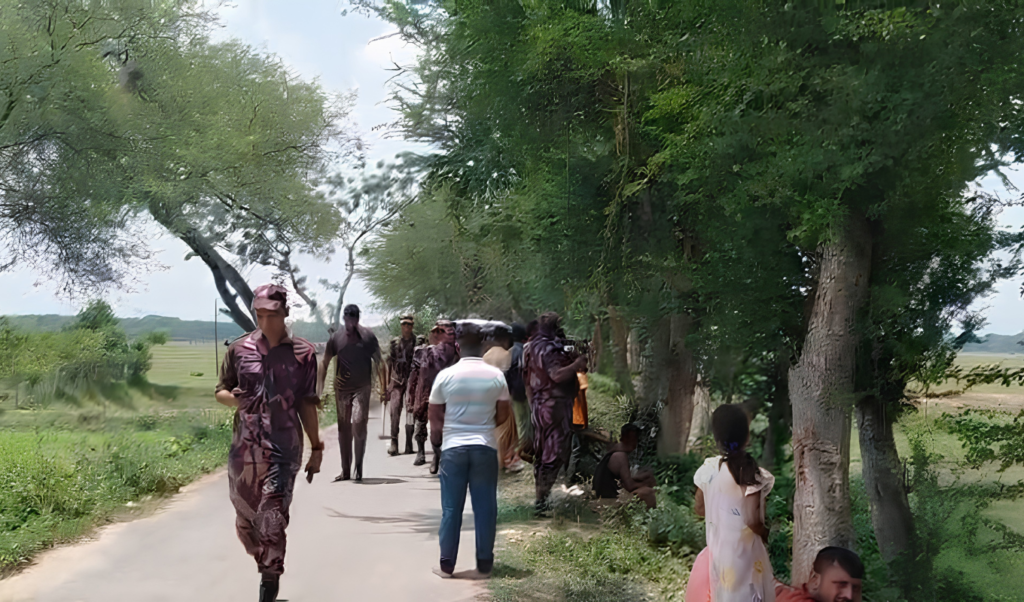
Border guard deployments have been significantly strengthened along the Benapole border under Sharsha Upazila in Jessore. Although the immediate threat of forced repatriation attempts—locally termed “push-ins”—by the Indian Border Security Force (BSF) has subsided, a state of alert, anxiety, and underlying tension persists across the frontier region.
Increased Surveillance and Troop Reinforcements
While no fresh attempts at forced entry have occurred in recent days, intelligence reports indicate that a substantial number of individuals remain gathered across the border on the Indian side. In response, Border Guard Bangladesh (BGB) has augmented security measures, virtually doubling its troop presence at the Benapole border to counter potential incursions or unexpected contingencies. Surveillance, patrols, and intelligence-gathering operations have been expanded, particularly across vulnerable sections of the frontier.
On the morning of Tuesday, 9 June, round-the-clock monitoring was visible across several frontier settlements, including Sadipur, Daulatpur, Putkhali, Kagazpukur, and Ghiba. BGB personnel have increased nocturnal patrols alongside the deployment of additional forces at strategic border points. Local residents in these border villages remain highly vigilant, with many voluntarily providing information to assist the border guards.
Strategic Timeline of Border Events
The escalation followed an incident on the night of 31 May, when BSF personnel reportedly attempted to push several individuals, including women and children, into Bangladeshi territory through the Sadipur border. Prior to the attempt, the BGB received intelligence indicating that approximately 100 to 120 individuals had been assembled on the opposite side of the frontier. Acting on this verification, BGB troops took up positions along the border line, successfully preventing the crossing and forcing the group to remain at the zero line.
According to local accounts, the displaced group endured deteriorating humanitarian conditions at the zero line for nearly two days, facing extreme heat, shortages of clean drinking water, and a lack of food. Women and children experienced the most severe distress. Local residents noted that the BSF eventually withdrew the group from the zero line late on the night of 2 June.
The table below outlines the chronological sequence of events and tactical actions observed at the Benapole border:
| Date (2026) | Historical and Tactical Event Description | Current Security Status |
| 31 May | BSF attempts to push 100–120 individuals across the Sadipur border under cover of darkness; BGB repels the attempt. | Initial confrontation and alert. |
| 1–2 June | Displaced individuals remain stranded at the zero line under severe weather conditions. Local residents join BGB in night watches. | Elevated border tension; community mobilisation. |
| 2 June (Night) | BSF withdraws the stranded group from the zero line back into Indian territory. | Immediate border pressure temporarily eases. |
| 3 June | National Citizen Party (NCP) Chief Coordinator Naseeruddin Patwari visits the frontier to assess security. | Political review and civic consultation. |
| 9 June | Subedar Mizan Hossain and Lt. Col. Mohammad Saiful Islam confirm double BGB deployment based on intelligence. | Maximum vigilance; situational control maintained. |
Public and Institutional Responses
The border standoff triggered widespread concern among local communities, prompting residents to volunteer alongside border security forces. Villagers organized night watches and reported suspicious activities directly to the authorities. Sagar Hossain, a resident of Sadipur, noted that community members actively joined BGB personnel on night patrols once the initial push-in attempt was thwarted on 1 June. Another resident, Jasim Uddin, emphasized that border protection is a collective civic responsibility, pledging continued local cooperation.
From a commercial perspective, Palashi Ahmed, a trader at Benapole Bazaar, stated that while the initial reports caused public anxiety regarding potential instability, prompt action by the BGB effectively managed the situation. Shariful Islam, an import-export businessman, noted that unilateral border transfers violate international norms and diplomatic protocols, adding that maintaining border stability remains crucial for regional trade.
Military Commands and Legal Standing
Subedar Mizan Hossain, the Benapole Checkpost ICP Camp Commander, verified that verifiable intelligence confirms a large number of individuals are being held at various BSF holding centres across the border. He noted that under direct instructions from BGB headquarters, troop numbers have been doubled, and operational readiness remains at its peak to block any unauthorized entry.
Lieutenant Colonel Mohammad Saiful Islam, Commanding Officer of the Jessore-49 BGB Battalion, confirmed that the situation at the Benapole border is fully under control, with regular patrols continuing systematically. He stated that there is currently no evidence to verify whether the individuals involved in the transfer attempt possess Bangladeshi citizenship. He emphasized that if any individuals are legally proven to be Bangladeshi nationals, their repatriation must follow established international law, bilateral diplomatic dialogue, and formal legal channels, noting that unilateral, nighttime operations lack legal validity.