The phenomenon of biological brothers representing different national teams on the global stage has evolved from a rare curiosity into a recognised reality of modern international football. Driven by global migration, multicultural identities, and dual nationality, the geopolitical landscape of the sport is undergoing a notable shift. The FIFA World Cup highlights this evolving social trend, featuring four distinct pairs of brothers who are registered to play for different national teams.
The Doué and Williams Siblings
Among the most prominent examples are the France-born brothers, Désiré Doué and Guéla Doué. The younger sibling, Désiré, represents the French national team and plays domestically for the European club Paris Saint-Germain. Conversely, his older brother, Guéla, opted to represent Côte d’Ivoire, the nation of their ancestral roots. This sporting divergence was highlighted during a recent friendly match; Désiré witnessed from the stands as Guéla scored a decisive goal to secure a victory for Côte d’Ivoire against France.
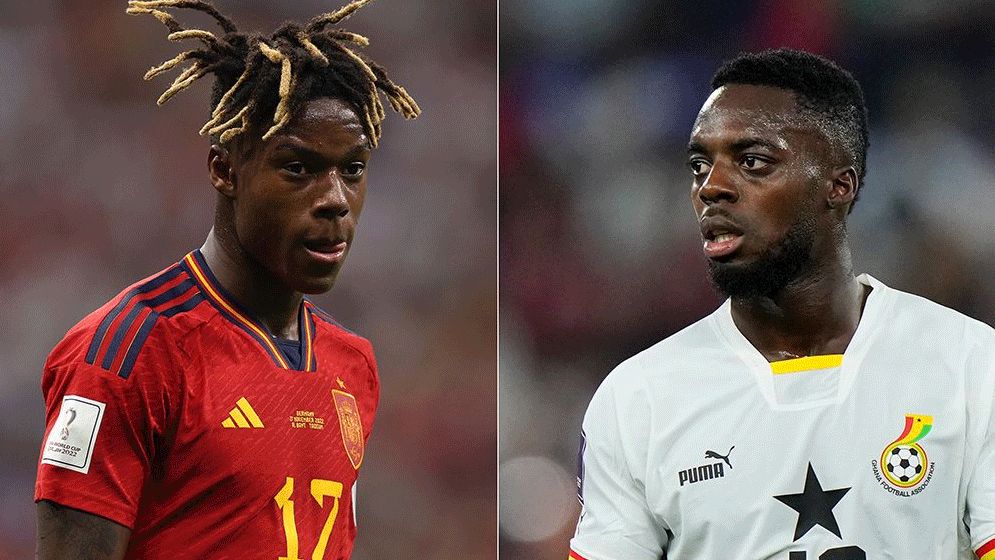
A similar trajectory is observed in Spain with the Williams brothers. Born in the Basque region, the younger brother, Nico Williams, has established himself as a core member of the Spanish national team, earning widespread acclaim for his contributions to their recent European Championship victory. His older brother, Inaki Williams, initially represented Spain but subsequently chose to pledge his international allegiance to Ghana, honouring his family heritage. He has since become a reliable fixture in the Ghanaian attacking line-up.
Continental Divergences: Luckassen, Brobbey, and the Souttars
The Ghanaian squad features another intricate family connection involving Derrick Luckassen. The Netherlands-born defender secured a place in the Ghana national squad, whilst his half-brother, Brian Brobbey, represents the Netherlands. Sharing the same maternal lineage, the two brothers operate on completely different international paths, with Luckassen reinforcing the Ghanaian defence and Brobbey serving as a crucial component of the Dutch attacking vanguard.
Beyond the Euro-African axis, this trend extends to the geopolitical relationship between Scotland and Australia. Born in Aberdeen, Scotland, the brothers John Souttar and Harry Souttar pursued entirely different international paths. Owing to family ties to Australia, the younger brother, Harry, committed to the Australian national team, anchoring their defensive line for a significant period. Meanwhile, his older brother, John, continues to represent Scotland on the international stage.
Migration Trends and Historical Precedents
The historical precedent for siblings facing each other in separate national shirts was famously set by Jérôme Boateng and Kevin-Prince Boateng, who represented Germany and Ghana respectively during the 2010 and 2014 World Cups.
However, the current tournament marks a statistical milestone with four pairs of brothers simultaneously participating under different flags. Decades of migration within Europe have allowed athletes to select national teams based on their place of birth, parental heritage, or personal alignment. This has led to a significant influx of European-born or European-raised players opting to play for African nations, a trend clearly visible in the contemporary squads of Algeria, Morocco, Senegal, and Tunisia.
Sibling Representation across Different National Teams
The table below outlines the four pairs of biological brothers competing for different countries, including their birthplaces and respective national allegiances.
| Sibling Pair | Player | National Team | Place of Birth | Ancestral / Family Connection |
| Pair 1 |
Guéla Doué Désiré Doué |
Côte d’Ivoire France |
France France |
Côte d’Ivoire France |
| Pair 2 |
Inaki Williams Nico Williams |
Ghana Spain |
Spain Spain |
Ghana Spain |
| Pair 3 |
Derrick Luckassen Brian Brobbey |
Ghana Netherlands |
Netherlands Netherlands |
Ghana (Maternal connection) Netherlands |
| Pair 4 |
Harry Souttar John Souttar |
Australia Scotland |
Scotland Scotland |
Australia Scotland |