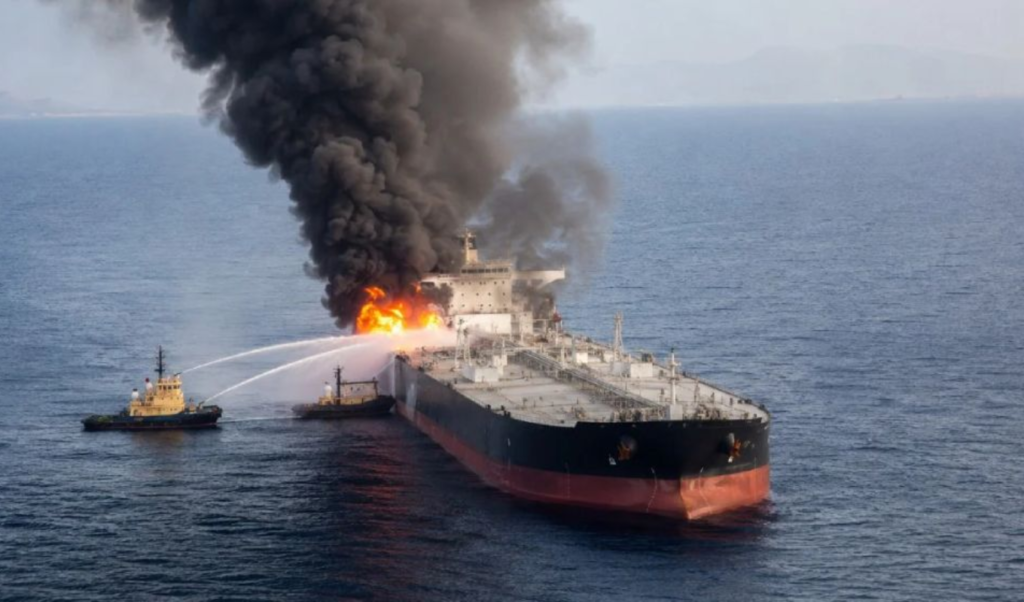
The United Kingdom Maritime Trade Operations (UKMTO), a maritime security agency based in the United Kingdom, has reported a new security incident involving a tanker vessel off the coast of Oman, near the strategically critical Strait of Hormuz. According to an official assessment released by the agency on Saturday, 13 June 2026, the commercial tanker was struck by an unidentified airborne or floating object on Friday, 12 June 2026.
The UKMTO confirmed that the maritime attack transpired at a geographical position located precisely six nautical miles east of the Omani coastline. Despite the physical impact on the vessel’s structure, the security agency affirmed that all crew members aboard the tanker survived the encounter without sustaining physical injuries. Furthermore, official assessments indicated that the strike did not cause any structural breaches that could lead to environmental degradation or hazardous oil spills in the surrounding marine habitat. Following the containment of the immediate incident, the tanker resumed its passage toward its designated port of destination.
Escalating Geopolitical Tensions Following Fatal Missile Strikes
This fresh maritime assault closely follows a highly volatile military intervention executed by the United States armed forces in the waters off the coast of Oman during the preceding week. In that earlier operation, United States military units launched targeted missile strikes against two maritime vessels traversing the region, resulting in the verified deaths of three Indian seafarers who were working aboard. The occurrence of this subsequent tanker attack has significantly exacerbated pre-existing security concerns across the global shipping lanes that intersect near the Arabian Peninsula.
The Government of India has registered a severe diplomatic protest in response to the operational fatalities of its three citizens. In a swift manifestation of bilateral friction, the Indian Ministry of External Affairs took the rare step of summoning the United States Ambassador to New Delhi on two consecutive occasions to formally demand accountability for the military actions. The casualties have triggered a tense diplomatic stand-off between the two traditional strategic partners, drawing widespread analytical scrutiny from international maritime safety observers and foreign policy experts.
Unyielding Enforcement of the US Maritime Blockade
Amidst the growing diplomatic friction, the United States Secretary of State, Marco Rubio, conducted a high-level telephonic communication with the Indian Minister of External Affairs, Dr Subrahmanyam Jaishankar. During this official discussion, Secretary Rubio explicitly reinforced the geopolitical position of the American administration, asserting that the comprehensive naval and commercial blockade imposed by the United States on Iranian ports within the Strait of Hormuz must be strictly observed by all international sovereign entities and commercial shipping lines.
Secretary Rubio extended a formal directive to Minister Jaishankar, demanding that all commercial vessels operating inside the logistical boundaries of the Strait of Hormuz comply fully with the maritime instructions issued by the United States government. The American Secretary of State made it explicitly clear that any operational activity deemed a violation of the active American blockade would not be tolerated under any circumstances. In his communication, Rubio stated that the circumvention of the United States blockade in the Strait of Hormuz, alongside any unauthorized or illegal transportation of Iranian petroleum products, would face absolute resistance and strict enforcement measures.
Ministerial Protests Amid Transatlantic Diplomatic Missions
Minister Jaishankar, who is currently undertaking an official diplomatic tour across several European nations, utilized the telephonic consultation with Secretary Rubio to firmly articulate India’s security and humanitarian grievances. The Indian External Affairs Minister formally raised the critical matter of the three deceased Indian sailors, noting that their lives were lost as a direct consequence of a targeted United States military strike executed against a commercial merchant ship within the Gulf of Oman.
The kinetic military operations carried out by United States forces near Oman occurred during a week characterized by severe escalation over the control of this vital global oil transport corridor. The Strait of Hormuz functions as a primary chokepoint through which a significant percentage of the world’s daily petroleum supply passes, making its operational stability crucial to international energy market security. According to global news agency Reuters, the combination of consecutive naval strikes, civilian casualties, and rigid enforcement mandates has pushed regional tensions to an unprecedented peak, threatening the continuity of commercial navigation across the Middle Eastern maritime trade routes.