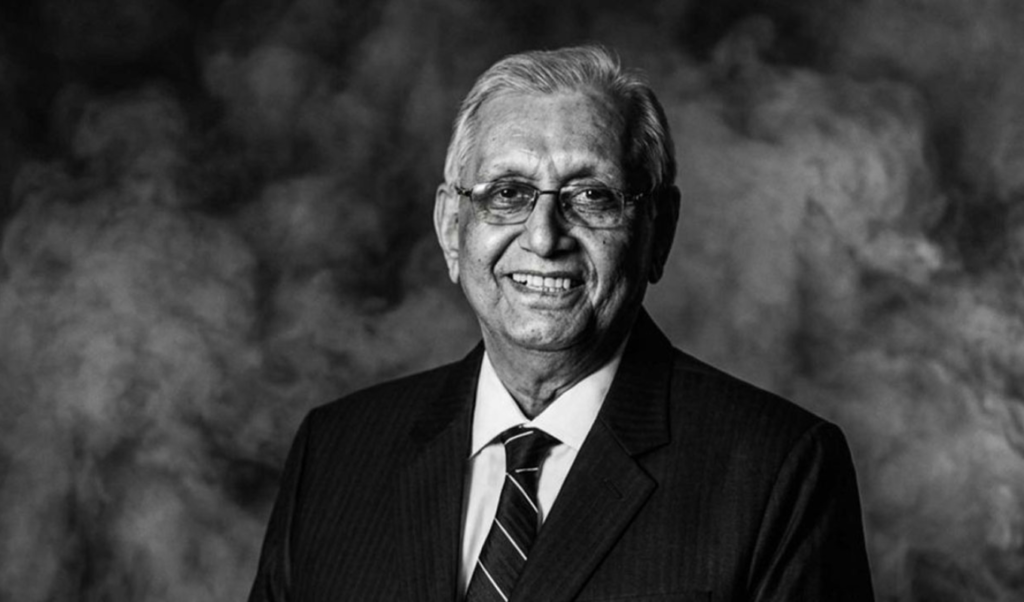
Abdus Sadeq, a legendary figure in Bangladeshi sports as both an elite athlete and a prominent administrator, has passed away at the age of 80. He died at 8:00 am on Saturday at the Continental Hospital in Dhaka after a 1.5-year battle with cancer. He is survived by his wife, two sons, a daughter, and a large circle of admirers.
The first funeral prayer (Janaza) is scheduled to be held after the Asr prayer at the Baitus Sobhan Jame Mosque in the I-Block of Bashundhara Residential Area. The second Janaza will take place the following Sunday at 10:30 am at the Old DOHS ground in Banani, Dhaka. Notably, his younger brother, Ahmed Akbar Sobhan, is the Chairman of the Bashundhara Group, whilst his eldest son, Ishtiaque Sadeq, is a prominent sports personality serving as the Chief Executive Officer (CEO) of T Sports.
Born on 17 September 1946 into an affluent sporting family, Abdus Sadeq inherited a rich athletic legacy. His father, Advocate Abdus Sobhan, was a renowned swimmer during the British era. Sadeq excelled across multiple sports, demonstrating high proficiency in hockey, football, and cricket.
International and National Career Milestones
During the pre-independence era, despite a restrictive political environment, Sadeq earned selection to the undivided Pakistan National Hockey Team. He was named in the 1968 Olympic squad but was unable to participate due to an injury. In 1969, he joined the national team for a 1.5-month tour of Europe, competing in West Germany, Italy, Spain, France, Belgium, the Netherlands, and England, followed by a match against Egypt. Sadeq gained widespread recognition during this tour and developed a close rapport with the team’s star player, Rashid Junior. His fluency in English further distinguished him within a squad where many top players struggled with the language.
Following the independence of Bangladesh, Sadeq continued his career domestically. In the 1973 National Hockey Championship, he captained the Comilla district team. Comilla secured the championship title in the final match through a decisive, solitary goal scored by his younger brother, Ahmed Akbar Sobhan, who played as a right-half and had previously played alongside him in the East Pakistan youth team.
| Year / Period | Role / Team | Key Achievement / Event |
| 1968 | Player, Pakistan Olympic Squad | Selected for the Olympics (missed due to injury) |
| 1969 | Player, Pakistan National Hockey Team | Completed a multi-nation European tour |
| 1972 | Captain, Abahani Krira Chakra | First football and hockey captain of the club |
| 1973 | Captain, Comilla District Hockey Team | Won the National Hockey Championship |
| 1977 | Coach, Abahani Football Team | Achieved an unbeaten domestic league championship |
| 1977–1978 | Captain, Bangladesh National Hockey Team | Led the team against Sri Lanka and at the 1978 Asian Games |
| 1983–1985 | General Secretary, Bangladesh Hockey Federation | Secured and hosted the 1985 Asia Cup in Dhaka |
| 1996 | Recipient, National Sports Award | Honoured by the state for outstanding contributions |
Leadership at Abahani and National Team
In 1972, following the liberation of Bangladesh, the newly founded Abahani Krira Chakra sought an experienced leader to guide its squads. The club’s founder, Sheikh Kamal, appointed Abdus Sadeq—who had previously played for prominent clubs like Victoria and Dilkusha—as the first captain of both the football and hockey teams. Sadeq justified this appointment by leading the hockey team to three consecutive championship titles.
In 1977, he transitioned to management, taking charge of the Abahani football team. Under his tutelage, Abahani made history by remaining completely undefeated throughout the league season, registering emphatic victories alongside only three draws, thereby becoming the first club in independent Bangladesh to achieve an undefeated championship.
Following the assassination of Sheikh Mujibur Rahman and his family in August 1975, Abahani faced severe institutional uncertainty. Amidst an atmosphere of fear where many organizers fled or went abroad, Sadeq assumed the responsibility of preserving the club. He convened meetings at his personal residence in Dhanmondi to restructure the organization and bring the teams back to the competitive field. In recognition of this critical intervention, Abahani Limited later accorded him a lifetime membership.
Sadeq also assumed pivotal roles for the inaugural Bangladesh National Hockey Team. During the 1977–78 season, he captained Bangladesh in its first international fixture—a three-match test series against Sri Lanka, which yielded one victory, one draw, and one defeat. In 1978, he captained the national contingent during its maiden appearance at the Asian Games.
Sports Administration and Legacy
Transitioning into sports governance, Sadeq served as the General Secretary of the Bangladesh Hockey Federation from 1983 to 1985. Through his diplomatic efforts at the Asian Hockey Federation meeting, he successfully secured the hosting rights for the 1985 Asia Cup for Dhaka, despite Japan being the initial choice. His proposal won critical backing from Pakistan, Malaysia, South Korea, and Iran.
Sadeq was also instrumental in bringing the Asia Cup back to Dhaka in 2017 and spearheaded modernization efforts, including the installation of floodlights and electronic scoreboards. His administrative capabilities earned praise from international figures, including the former International Hockey Federation (FIH) President, Leandro Negre, who publicly lauded Sadeq’s vision for the sport. For his extensive contributions to the nation’s sporting landscape, Abdus Sadeq was bestowed with the prestigious National Sports Award in 1996.