On Monday, India released dramatic footage revealing significant damage to multiple Pakistani military airbases, inflicted during the recently concluded Operation Sindoor. The operation, launched on 7th May, was a decisive response to the deadly terror attack in Pahalgam, Jammu and Kashmir, last month.
Key Developments in Operation Sindoor
| Location | Details of Damage | Significance |
|---|---|---|
| Nur Khan Airbase, Rawalpindi | Massive explosion, extensive fire | Critical military hub near Islamabad |
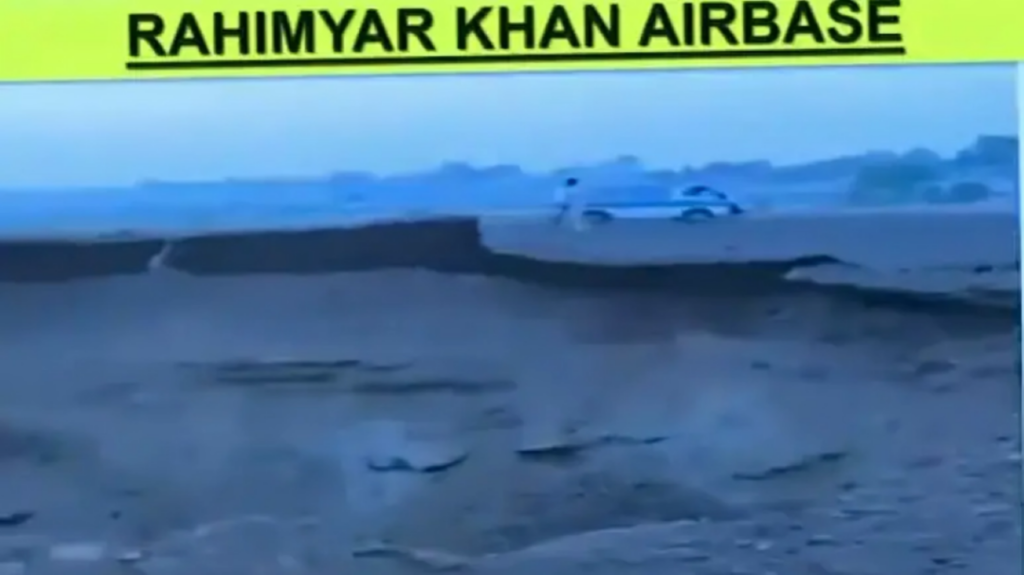
| Rahim Yar Khan Airbase, Punjab | Runway severely damaged | Key tactical airbase in southern Punjab |
| Malir Cantonment, Karachi | Surface-to-air missile site destroyed | Vital air defence installation |
| Rafiqui, Chaklala, Sukkur, Sialkot | Radar sites, command centres, ammunition depots hit | Key infrastructure for military coordination |
Targeted Airstrikes and Ground Operations
During a press conference, Air Marshal AK Bharti, the Director General of Air Operations, presented the first video of the Nur Khan airbase in Rawalpindi, a critical military facility less than 10 kilometres from Islamabad, engulfed in flames after a massive blast. The airbase, positioned close to Pakistan’s military headquarters, plays a strategic role in the country’s aerial defence.
The second video revealed severe damage to the runway at the Rahim Yar Khan airbase in Pakistan’s Punjab province, effectively crippling one of the primary air logistics routes in the region.
In addition to these high-profile strikes, Indian forces targeted a surface-to-air missile installation at Malir Cantonment in Karachi, a critical component of Pakistan’s air defence network.
Operation Overview
Operation Sindoor was a meticulously planned and executed campaign, targeting nine terror hubs within Pakistan and Pakistan-occupied Kashmir (PoK). The strikes primarily aimed at dismantling the operational bases of notorious terror outfits such as Lashkar-e-Taiba (LeT), Jaish-e-Mohammad (JeM), and Hizbul Mujahideen. According to official sources, over 100 terrorists were eliminated in these precision strikes.
Air Marshal Bharti noted that the Indian armed forces’ objective remained solely the elimination of terrorist infrastructure. However, Pakistan’s direct military support to these groups compelled India to expand the scope of its operations, leading to a broader confrontation.
Pakistan’s Retaliation and Ceasefire
In the aftermath of the Indian airstrikes, the Pakistani Army launched a series of drone and missile attacks targeting the western regions of India. These attempts were successfully intercepted by India’s advanced air defence systems, preventing any significant damage.
Following four days of intense aerial and artillery exchanges, both nations agreed to a ceasefire on Saturday, bringing an immediate halt to hostilities.