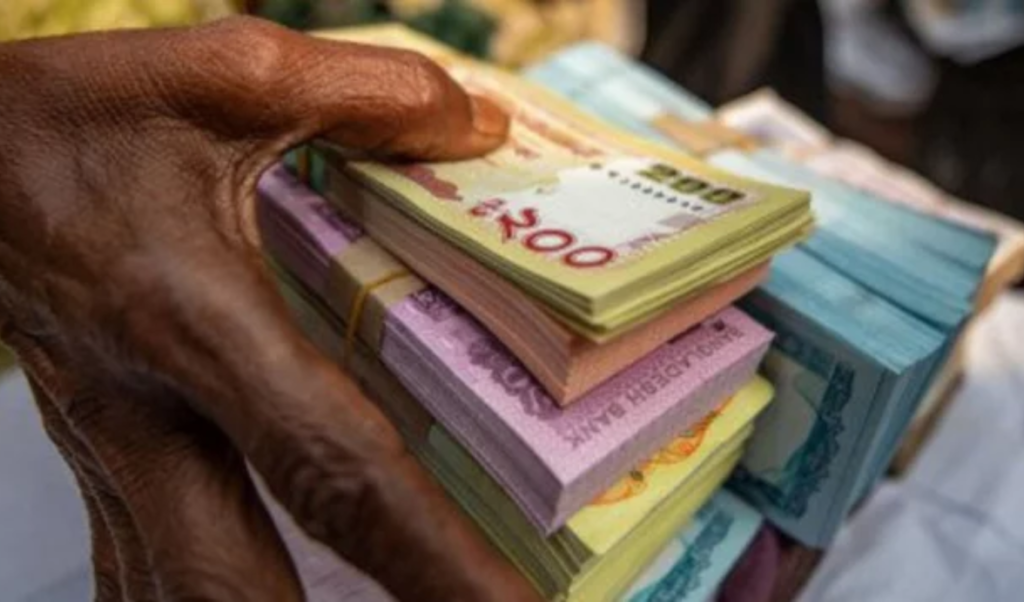
The volume of cash currency held by the public outside the formal banking network in Bangladesh has registered a fresh increase, raising operational concerns within the financial sector. Financial analysts and policymakers view this ongoing development as a problematic signal for the broader macroeconomic framework. According to sector evaluations, the primary driver behind this accelerating currency drain is an emerging crisis of consumer confidence regarding the structural stability of specific banking institutions. Financial authorities have warned that if this pattern of continuous fund withdrawals persists without an equivalent volume of deposits returning to the system, the banking sector faces an elevated risk of encountering a severe liquidity shortage.
Detailed Statistical Breakdown of Liquid Currency
An objective analysis of the official statistical data released by the central bank, Bangladesh Bank, illustrates the scale of the shifting currency distribution. By the conclusion of March in the current fiscal timeline, the total volume of banknotes and coin currency remaining outside the banking vaults climbed to 303,018 crore taka. When contrasted with the figures from four months prior in December, when the volume stood at 275,343 crore taka, the total capital circulating independently of the banking infrastructure expanded by approximately 27,675 crore taka in a brief four-month window. This demonstrates a steady progression from November, when the total external currency was recorded at 269,018 crore taka.
The multi-month accumulation indicates that while the growth across the December-to-March period reached 27,675 crore taka, the net expansion strictly within the first three months of the calendar year (January to March) accounted for approximately 20,392 crore taka. The velocity of this movement was most pronounced between February and March, during which a single-month surge of 16,614 crore taka was documented.
The official chronological trajectory maintained in the central bank’s latest statistical ledger details the steady rise over the preceding months:
-
December: 275,343 crore taka
-
January: 282,626 crore taka
-
February: 286,404 crore taka
-
March: 303,018 crore taka
Commercial bankers and macroeconomists state that widespread economic uncertainty, elevated domestic inflation, and specific structural anxieties affecting certain banks have collectively driven the population to prioritize physical cash preservation. Experts caution that the protracted duration of this public hoarding habit threatens to disrupt liquidity management operations across commercial banks and severely complicate the execution of monetary policy by the central bank. The operational term “currency outside banks” specifically denotes issued cash that, following its withdrawal by account holders, fails to return to the formal banking grid. Although this capital continues to facilitate everyday informal consumer transactions within the wider economy, its complete detachment effectively isolates it from the credit creation and deposit mobilization capabilities of commercial banks.
Inflation Dynamics and Expert Economic Commentary
When assessed through the perspective of institutional research, the specific socio-economic motivators behind this monetary behaviour become clear. M Helal Ahmed Jony, an economist and Research Fellow at Change Initiative, clarified the underlying institutional dynamics governing these consumer actions. He noted that the public typically expands its cash holdings due to two distinct economic catalysts. Firstly, persistent high inflation forces citizens to maintain larger volumes of physical cash simply to handle escalated daily living costs and household expenditures. Secondly, an institutional confidence deficit within specific credit institutions prompts depositors to systematically liquidate their accounts to safeguard their capital.
The researcher observed that a major segment of the population is currently retaining physical currency precisely due to diminished organizational trust in particular banking firms. He added that once macroeconomic conditions stabilize, depositors are highly likely to either redistribute their accumulated capital into healthier banking institutions or return the funds to their original accounts.
Simultaneous Expansion of the Reserve Money Base
In tandem with the upward movement of cash outside formal repositories, the total volume of high-powered money generated directly by the central bank—formally classified as reserve money—has also expanded. Bangladesh Bank’s data indicates that the reserve money base stood at 424,618 crore taka in February. By the end of March, this fundamental monetary metric rose to 443,269 crore taka, marking a sharp single-month expansion of 18,650 crore taka.
Economists warn that when the baseline supply of high-powered reserve money and the physical cash retained by consumers rise in unison, the dual expansion risks applying severe inflationary pressure on consumer goods and services.
Contextual Trajectory of Financial System Confidence
The central bank’s historical tracking logs reveal that the volume of cash held outside banks had been on a steady upward trajectory until August 2024. During that period, widespread reporting on institutional irregularities, corruption scandals, and visible liquidity shortages within the banking industry caused consumers to withdraw funds for home storage.
Following the political transition on 5 August 2024, public trust in the financial architecture experienced a temporary recovery. Consequently, from September 2024 through to February 2025, the volume of external currency showed a consistent month-on-month decline as capital flowed back into institutional vaults.
However, this recovery trend reversed at the start of March, marked by a sharp rise in capital liquidations. Analysts view this sudden shift as a renewed sign of consumer anxiety within the financial sector. Warning against the long-term impacts of this trend, M Helal Ahmed Jony emphasized that a continuous, unmitigated drain of deposits that remains isolated from the banking system represents a major structural challenge. He concluded that relevant financial regulatory authorities must maintain strict oversight over the shifting currency metrics to prevent systemic disruptions.